
ACRE
The ‘modest’ Indian tycoon who died at 86

 Getty Images
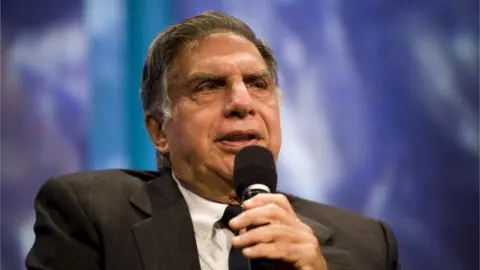
Ratan Tata, who has died aged 86, was one of India’s most internationally recognised business leaders.
The legendary tycoon led the Tata Group – popularly known as a “salt-to-software” conglomerate of more than 100 companies, employing some 660,000 people – for more than two decades. Its annual revenues are in excess of $100bn (£76.5bn).
Founded by Jamsetji Tata, a pioneer of Indian business, the 155-year-old Tata Group straddles a business empire ranging from Jaguar Land Rover and Tata Steel to aviation and salt pans.
The ethos of the company “yokes capitalism to philanthropy, by doing business in ways that make the lives of others better”, according to Peter Casey, author of The Story of Tata, an authorised book on the group.
Tata Sons, the holding company of the group, has a “number of companies that includes privately held and publicly traded companies, yet they are in essence all owned by a philanthropic trust”, he explains.
Ratan Tata was born in 1937 in a traditional family of Parsis – a highly educated and prosperous community that traces its ancestry to Zoroastrian refugees in India. His parents separated in the 1940s.

 Getty Images
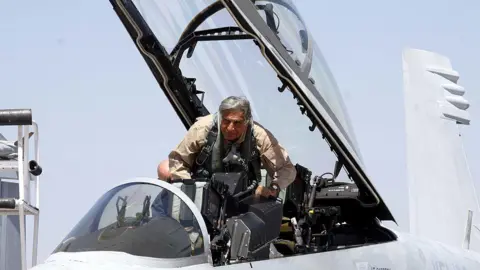
Tata went to college in the US, where he got a degree in architecture at Cornell University. During his seven-year-long stay, he learned to drive cars and fly. He had some harrowing experiences: he once lost an engine while flying a helicopter in college and twice lost the single engine in his plane. “So I had to glide in,” he told an interviewer. Later, he would often fly his company’s business jet.
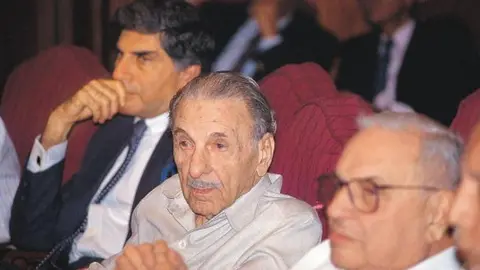
He returned to India in 1962 when his grandmother Lady Navajbai fell ill and called for him. It was then that JRD Tata – a relative from a different branch of the family – asked him to join the Tata Group. “He [JRD Tata] was my greatest mentor… he was like a father and a brother to me – and not enough has been said about that,” Tata told an interviewer.
Ratan Tata was sent to a company steel plant in Jamshedpur in eastern India where he spent a couple of years on the factory floor before becoming the technical assistant to the manager. In the early 70s, he took over two ailing group firms, one making radios and TVs and the other textiles. He managed to turn around the first, and had mixed results with the textile company.
In 1991, JRD Tata, who had led the group for over half a century, appointed Ratan Tata as his successor over senior company aspirants for that position. “If you were to find the publications of that time, the criticism was personal – JRD got clubbed with nepotism and I was branded as the wrong choice,” Ratan Tata later said.
Peter Casey writes that under Ratan Tata’s leadership, a “great but rather stodgy Indian manufacturer began emerging as a global brand with great emphasis on consumer goods”.
 Getty Images
But the journey was a mixed one.
During his tenure the group made many bold acquisitions, among them the takeover of Anglo-Dutch steelmaker Corus and UK-based car brands Jaguar and Land Rover. Some of those decisions paid off, while others – including a failed telecom venture – have cost the company a lot of money.
A high point came in 2000, when Tata bought Tetley and became the world’s second-largest tea company. The deal was the largest takeover of an international brand by an Indian company.
A few years later, a visiting journalist from a UK-based newspaper asked Tata whether he liked the irony of an Indian company buying a leading British brand. “Tata is too shrewd and too shy to be caught gloating about his successes like some territory-grabbing East India Company nabob,” the journalist later wrote.
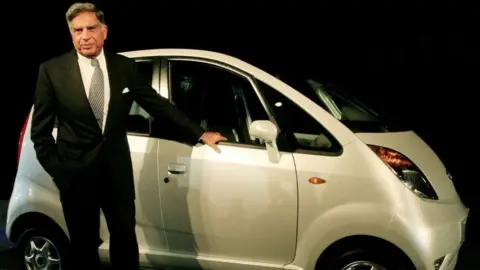
Tata’s foray into building a safe, affordable car turned out to be a disappointment. It was launched amid great fanfare in 2009 as a compact with the base model costing just 100,000 rupees ($1,222; £982). But after the initial success and euphoria, the brand began to lose out to other manufacturers due to issues with production and marketing.
Tata later said it was a “huge mistake to brand Nano as the world’s cheapest car. People don’t want to be seen driving the world’s cheapest car!”
 Getty images
His resilience was also tested during the Mumbai terror attacks of 26 November, 2008. Tata’s marquee Taj Mahal Palace was one of the two luxury hotels that was attacked, along with a train station, a hospital, a Jewish cultural centre, and some other targets in Mumbai.
Thirty-three of the 166 people who died in the 60-hour siege were at the Taj. This included 11 hotel employees, a third of the hotel’s total casualties. Tata pledged to look after the families of employees who were killed or injured, and paid the relatives of those killed the salaries they would have earned for the rest of their lives. He also spent more than $1bn to restore the damaged hotel within 21 months.
Towards the end of his career, Tata found himself embroiled in an unsavoury controversy. In October 2016 he returned to Tata Sons as interim chairman for a few months after the previous incumbent, Cyrus Mistry, was ousted, sparking a bitter management feud (Mistry died in a car crash in September 2022). The role was eventually given to Natarajan Chandrasekaran, who was formerly the chief executive of Tata Consultancy Services, India’s most valuable company with a market capitalisation of $67bn.
Peter Casey described Tata as a “modest, reserved and even shy man”. He found a “stately calm” about him and a “fierce discipline”, which included preparing a handwritten to-do list every day. He also described himself as a “bit of an optimist”.
Tata was also a modest and reflective businessman. After the police were called in to end a strike that crippled operations at one of his firm’s factories in Pune in 1989, Tata told journalists: “Perhaps we took our workers for granted. We assumed that we were doing all that we could do for them, when probably we were not.”
In 2009, Tata spoke at a school alumni function about his dream for his country, “where every Indian has an equal opportunity to shine on merit”.
“In a country like ours,” he said, “you have to try and lead by example, not flaunt your wealth and prominence.”


ACRE
Ufac retoma reuniões presenciais dos conselhos superiores após 6 anos — Universidade Federal do Acre


 ACRE4 dias ago
Podcast da Ufac entrevista novo reitor Josimar Ferreira — Universidade Federal do Acre
 ACRE2 dias ago
Ufac retoma reuniões presenciais dos conselhos superiores após 6 anos — Universidade Federal do Acre
 Economia e Negócios19 horas ago
Estatística aplicada ao esporte: o que os números realmente medem

 ACRE15 horas ago
Participe da Autoavaliação do Curso de ciências contábeis — Universidade Federal do Acre


Warning: Undefined variable $user_ID in /home/u824415267/domains/acre.com.br/public_html/wp-content/themes/zox-news/comments.php on line 48
You must be logged in to post a comment Login