NOSSAS REDES

ACRE

Arcane’s season two review: a revolutionary powderkeg

PUBLICADO

em

The first season of Netflix and Riot’s Arcane animated series fashioned disparate pieces of League of Legends lore into a beautiful, devastating tale about a society on the brink of collapse. The show infused each of its characters with a depth and complexity that felt unlike anything Riot had done elsewhere in the longrunning franchise. And its commitment to telling its own story made it remarkably easy for new fans to dive in.

There’s a density to Arcane’s second season that feels reflective of the show’s creative team working to bring this juggernaut of a story to a satisfying end in just nine short episodes. Especially since it has been three years since season 1, you might need a refresher on how things became so dire for the citizens of Piltover and Zaun. But while the new season drops you right back into the chaos in a somewhat disorienting way, it does an excellent job of weaving together the many different threads of Arcane’s powerful legend.

Arcane’s first season ended with a literal bang — an explosive attack from Jinx (Ella Purnell) on the elite council members of Piltover just as they were about to sign a peace treaty that would have brought an end to their war on the impoverished people of Zaun. Though Jinx’s attack was rooted in years of personal psychological torment and her growing up as part of Zaun’s abused, disenfranchised underclass, it was a moment that made her sister Vi (Hailee Steinfeld) see truly her as a terroristic monster. It wasn’t clear who might emerge from the smoking rubble in the end, but there was no question about how much harder Piltover would retaliate with its dangerous Hextech weapons.

Arcane’s second season picks up in the immediate aftermath of the attack to emphasize the sheer amount of destruction Jinx caused in her crusade to make Piltover pay for its history of injustices. With so many of Piltover’s political leaders dead, the city’s priorities and its balance of power have to shift in ways that feel necessary to Vi and other survivors like enforcer Caitlyn Kiramman (Katie Leung). But while the new season takes some time to make you appreciate the magnitude of Piltover’s loss, it pushes this act of Arcane’s story into motion by exploring how oppressive societies create the monsters they ultimately come to hate and fear.

Everyone suffers as Arcane moves its characters into a new phase of conflict, but the show uses Vi and Jinx in particular to highlight how profoundly war can unmoor people from their senses of self. It’s easier for the sisters to let one another go than it is for either of them to see themselves in the other’s face. And when presented with chances to channel their feelings into action, it seldom occurs to them how fighting just to hurt the other side is guaranteed to cause self-inflicted wounds.

Arcane repeatedly echoes that idea as it briskly shifts focus to the rest of its cast and brings the devastating danger of Hextech into sharp focus. Inventor Jayce Talis (Kevin Alejandro) and politician Mel Medarda (Toks Olagundoye) can understand the gravity of the escalation her warhawk mother Ambessa (Ellen Thomas) is hungry for. But that foresight can only do so much to keep the calls for a full-on invasion of Zaun at bay.

Arcane’s second season uses the rising tension and Jayce’s fears about what he has helped create to delve deeper into the magical mysteries of Hextech with a subplot that zooms far out into new realms of the League of Legends universe. It’s another way the show reinforces its ideas about actions coming with consequences that aren’t immediately obvious up close. And in some of Arcane’s characters, it crystalizes how heavy a price the planet can pay as humanity wages war.

Hextech also features largely in most of this season’s more visually stunning set pieces, which are once again truly the show’s greatest strength. Though the show as a whole is still utterly gorgeous, the action feels even more brutal this time around. On occasion, the “cool” needle drops feel a bit tone deaf because of how frank Arcane is trying to be in its depiction of a society tearing itself apart. But that has always kinda been Arcane’s vibe, and the season really leaning into it will likely appeal to hardcore fans.

Because the stakes are even higher and all of Arcane’s players are now fully locked into the war, this season’s first three episodes often feel more narratively dense and like they’re moving at a much faster pace. That might be more exhausting if the season was dropping all at once, but Netflix has smartly chosen to split it up into three separate acts set to debut through the end of the month. We won’t know until the end of November just how Arcane’s creators intend to bring this story to a close and whether it might set the stage for whatever’s coming next for the franchise. But this first act is a strong opener for Arcane’s final chapter.

Leia Mais

Advertisement
Comentários

Warning: Undefined variable $user_ID in /home/u824415267/domains/acre.com.br/public_html/wp-content/themes/zox-news/comments.php on line 48

You must be logged in to post a comment Login

Comente aqui

ACRE

Startup Day-2026 ocorre na Ufac em 21/03 no Centro de Convivência — Universidade Federal do Acre

PUBLICADO

em

Startup Day-2026 ocorre na Ufac em 21/03 no Centro de Convivência — Universidade Federal do Acre

A Pró-Reitoria de Inovação e Tecnologia (Proint) da Ufac e o Serviço Brasileiro de Apoio às Micro e Pequenas Empresas do Acre (Sebrae-AC) realizam o Startup Day-2026, em 21 de março, das 8h às 12h, no espaço Sebrae-Lab, Centro de Convivência do campus-sede. O evento é dedicado à inovação e ao empreendedorismo, oferecendo oportunidades para transformar projetos em negócios de impacto real. As inscrições são gratuitas e estão abertas por meio online.

O Startup Day-2026 visa fortalecer o ecossistema, promover a troca de experiências, produzir e compartilhar conhecimento, gerar inovação e fomentar novos negócios. A programação conta com show de acolhimento e encerramento, apresentações, painel e palestra, além de atividades paralelas: carreta game do Hospital de Amor de Rio Branco, participação de startups de game em tempo real, oficina para crianças, exposição de grafiteiros e de projetos de pesquisadores da Ufac.


Leia Mais: UFAC

Continue lendo

ACRE

A lógica de valor da Thryqenon (TRYQN) é apoiar a evolução da economia verde por meio de sua infraestrutura digital de energia

PUBLICADO

em

Foto de capa [internet]

Com a aceleração da transição para uma economia de baixo carbono e a reestruturação do setor elétrico em diversos países, cresce a discussão sobre como a infraestrutura digital pode sustentar, no longo prazo, a evolução da economia verde. Nesse contexto, a plataforma de energia baseada em blockchain Thryqenon (TRYQN) vem ganhando atenção por propor uma estrutura integrada que combina negociação de energia, gestão de carbono e confiabilidade de dados.

A proposta da Thryqenon vai além da simples comercialização de energia renovável. Seu objetivo é construir uma base digital para geração distribuída, redução de emissões e uso colaborativo de energia. À medida que metas de neutralidade de carbono se tornam compromissos regulatórios, critérios como origem comprovada da energia, transparência nos registros e liquidação segura das transações deixam de ser diferenciais e passam a ser requisitos obrigatórios. A plataforma utiliza registro descentralizado em blockchain, correspondência horária de energia limpa e contratos inteligentes para viabilizar uma infraestrutura verificável e auditável.

A economia verde ainda enfrenta obstáculos importantes. Existe descompasso entre o local e o momento de geração da energia renovável e seu consumo final. A apuração de emissões costuma ocorrer de forma anual, dificultando monitoramento em tempo real. Além disso, a baixa rastreabilidade de dados limita a criação de incentivos eficientes no mercado. A Thryqenon busca enfrentar essas lacunas por meio de uma estrutura digital que integra coleta, validação e liquidação de informações energéticas.

Na arquitetura da plataforma, há conexão direta com medidores inteligentes, inversores solares e dispositivos de monitoramento, permitindo registro detalhado da geração e do consumo. Na camada de transações, o sistema possibilita verificação automatizada e liquidação hora a hora de energia e créditos de carbono, garantindo rastreabilidade. Já na integração do ecossistema, empresas, distribuidoras, comercializadoras e consumidores podem interagir por meio de interfaces abertas, promovendo coordenação entre diferentes agentes do setor elétrico.

O potencial de longo prazo da Thryqenon não está apenas no crescimento de usuários ou no volume de negociações, mas em sua capacidade de se posicionar como infraestrutura de suporte à governança energética e ao mercado de carbono. Com o avanço de normas baseadas em dados e reconhecimento internacional de créditos ambientais, plataformas transparentes e auditáveis tendem a ter papel relevante na transição energética e no financiamento sustentável.

Continue lendo

ACRE

Bancos vermelhos na Ufac simbolizam luta contra feminicídio — Universidade Federal do Acre

PUBLICADO

em

Bancos vermelhos na Ufac simbolizam luta contra feminicídio — Universidade Federal do Acre

A Ufac inaugurou a campanha internacional Banco Vermelho, símbolo de conscientização sobre o feminicídio. A ação integra iniciativas inspiradas na lei n.º 14.942/2024 e contempla a instalação, nos campi da instituição, de três bancos pintados de vermelho, que representa o sangue derramado pelas vítimas. A inauguração ocorreu nesta segunda-feira, 9, no hall da Reitoria.

São dois bancos no campus-sede (um no hall da Reitoria e outro no bloco Jorge Kalume), além de um no campus Floresta, em Cruzeiro do Sul. A reitora Guida Aquino destacou que a instalação dos bancos reforça o papel da universidade na promoção de campanhas e políticas de conscientização sobre a violência contra a mulher. “A violência não se caracteriza apenas em matar, também se caracteriza em gestos, em fala, em atitudes.”

A secretária de Estado da Mulher, Márdhia El-Shawwa, ressaltou a importância de a Ufac incorporar o debate sobre o feminicídio em seus espaços institucionais e defendeu a atuação conjunta entre universidade, governo e sociedade. Segundo ela, a violência contra a mulher não pode ser naturalizada e a conscientização precisa alcançar também a formação de crianças e adolescentes.

A inauguração do Banco Vermelho também ocorre no contexto da aprovação da resolução do Conselho Universitário n.º 266, de 21/01/2026, que institui normas para a efetividade da política de prevenção e combate ao assédio moral, sexual, discriminações e outras violências, principalmente no que se refere a mulheres, população negra, indígena, pessoas com deficiência e LGBTQIAPN+ no âmbito da Ufac em local físico ou virtual relacionado.

No campus Floresta, em Cruzeiro do Sul, a inauguração do Banco Vermelho contou com a participação da coordenadora do Centro de Referência Brasileiro da Mulher, Anequele Monteiro.
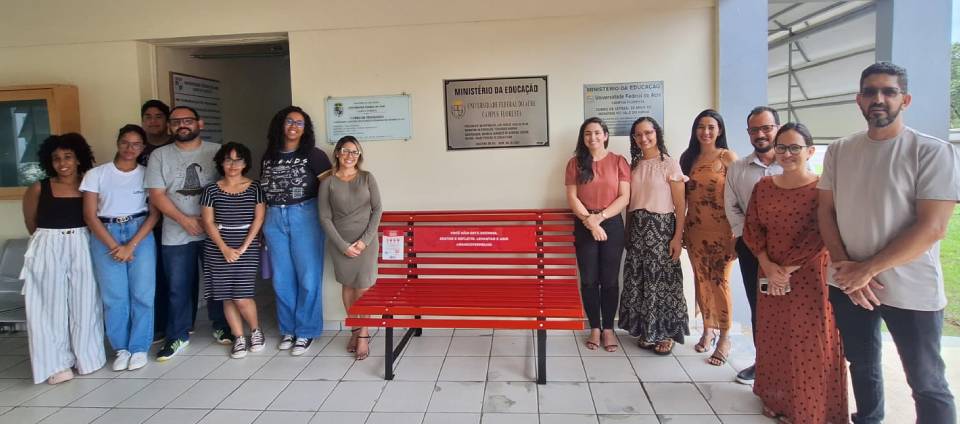
Participaram da solenidade, no campus-sede, a pró-reitora de Desenvolvimento e Gestão de Pessoas, Filomena Maria Cruz; a pró-reitora de Graduação, Ednaceli Damasceno; a pró-reitora de Pesquisa e Pós-Graduação, Margarida Carvalho; a coordenadora do projeto de extensão Infância Segura, Alcione Groff; o secretário de Estado de Saúde, Pedro Pascoal; a defensora pública e chefe do Núcleo de Promoção da Defesa dos Direitos Humanos da Mulher, Diversidade Sexual e Gênero da DPE-AC, Clara Rúbia Roque; e o chefe do Centro de Apoio Operacional de Proteção à Mulher do MP-AC, Victor Augusto Silva.


Leia Mais: UFAC

Continue lendo

MAIS LIDAS