Christian Braun was in basketball jail. The family pickup truck was his cell. The remainder of the game was his sentence.
Embarrassed in a lonely parking lot, he waited for his friends and his mom to leave the gymnasium. At the time, it was a nightmare he couldn’t wait to forget. Over the years, it became a formative memory worth telling other coaches.
Braun’s road to his third opening day in the NBA has been characterized by winning. Almost entirely. He won three consecutive state titles at Blue Valley Northwest High School in Overland Park, Kan. He led the Kansas Jayhawks to their fourth NCAA championship in his final season of college. He contributed to the Nuggets’ first NBA championship as a rookie the next year.
The overwhelming team success lends extra resonance to Braun’s rare moments of failure or disappointment. They’re twice as memorable to him. Twice as educational. As he prepares for another potential career milestone Thursday, another culmination — replacing Kentavious Caldwell-Pope as Denver’s starting two-guard — his new role will require a healthy balance between two conflicting, coexisting sides of his basketball personality: Small-town Kansas and Kansas City; cockiness and humility; old and new.
“I think you’ve gotta know who you are,” Braun told The Denver Post in an interview this preseason. “You’ve gotta be very self-aware of your situation. … You’ve gotta have a balance. You’ve gotta understand that you’re still at the bottom. Still trying to get to the top. There are things you’ve gotta earn, things you’ve gotta prove first before you do that. But my teammates know. I make little smart-(aleck) comments here and there. So I’m still me. I’m still who I am. I’m just a little more quiet, you know, with each level I go up.”
Braun hadn’t quite mastered that balance when he found himself waiting in that truck. Back in the gym, Braun’s mother, Lisa, was coaching his rec league team. She’s a former Division I player herself, an All-Big Eight honoree at Missouri. She could be harsh on her son, and her son could push the limits of impertinence with her. They’re extremely close to this day.
“He was my mouthiest kid by far,” she said. “And my grittiest kid.”
The details of how Braun ended up there are somewhat murky. Lisa thinks it was related to a defensive breakdown. Christian kept insisting to her that it wasn’t his fault, because he was in the right position, while she was trying to teach him it didn’t matter whose fault it was. Christian thinks it might’ve been something at the offensive end. He was launching 3s from too deep, not sharing the ball enough.
Whichever version is correct, Lisa had a point. Christian didn’t care to hear it.
“She told me don’t do it. Of course, I did it again. Looked at her. She took me out,” he recalls. “I came to the bench. She obviously told me what I needed to be doing. And I made a comment back to her, just being a smart young kid. Something slick, I’m sure.”
“I said, ‘Christian, go sit.’ He went to sit on the bench. Still, he’s chewing on me,” Lisa remembers. “I said, ‘Get to the end of the bench.’ And all the way down there, he started yapping.”
That was the breaking point. Lisa pulled out her car keys and threw them to Christian.
It’s one thing to get benched. It’s another to get kicked out of the building.
He was quiet during the drive home. There wasn’t much to say. The coaching maneuver bruised him where it hurt most: his desire to be on a basketball court. “I think punishing him by making him not even be part of it was probably a big blow to him,” Lisa said.
Braun’s upbringing in Burlington, Kan. (population: 2,600) was consumed by sports. Unlike some of his friends, he wasn’t interested in first-person shooter video games like “Call of Duty.” He only wanted to play NBA 2K or Madden NFL. Free time was mostly spent outside, swimming or fishing in the lake next to his home. Both of his parents regaled him with stories from their college basketball days. Dinner table conversations often involved LeBron vs. Jordan, with Christian siding against the older generation to stir the pot. When it snowed, he hurried to shovel the “bare minimum” out of the driveway, his mom says, just enough to clear space for him to shoot hoops with his brother Parker.
“He wouldn’t do it to get my car out of the garage,” she said.
Christian Braun (0) of the Denver Nuggets posterizes Armoni Brooks (13) of the Brooklyn Nets during the fourth quarter of the Nuggets’ 124-101 win at Ball Arena in Denver on Thursday, Dec. 14, 2023. (Photo by AAron Ontiveroz/The Denver Post)
The family sport was Braun’s favorite. And it was the one he was best at. In a rural community, competition was thin. He figured out he could dominate if he put in the work.
Nothing else ever appealed to him as a career.
“I was hellbent on basketball. I never had an interest, to be honest. I wish I did,” Braun said. “But I never was interested in school. I was never a good student. … I was that kid. I was in trouble a little bit. Nothing bad, but I was always the one who talked too much in class.”
During a grade school class in which students were expected to choose from a variety of books then eventually take tests on the reading, Braun and his friend Tegan Hess thought they could game the system. They huddled at the computers in the back of the room, where the teacher couldn’t see them, and opened the test for a Harry Potter book, which they hadn’t read. Attempting to guess the answers, they came nowhere close to passing, eventually causing access to the tests to become password-protected. “We were getting 20 and 30%,” Hess said, laughing.
Their basketball and football teams were unstoppable throughout middle school. Braun was a major reason for that. But the memories that endure now aren’t so much the wins. There was the infamous Wellsville game, when Braun shot 4 for 22 from the field, spoiling an undefeated season. “It’s probably the worst game I’ve ever played,” he maintains. “I was embarrassed.”
And then there was the ejection from the gym, courtesy of Mom. That proved to be a watershed moment, maybe even an epiphany. In the moment, “I kind of thought, ‘Oh gosh, maybe I shouldn’t have done that,’” Lisa said. But her son didn’t rebel during a game the rest of that season.
Soon, the Brauns moved to the Kansas City suburbs, where there was a more bustling youth basketball scene. He went all-in on his only interest, joining an AAU program called MoKan. His coach there, Drew Molitoris, was delighted by how coachable and mature Braun was. So was Ed Fritz, the coach at Braun’s high school.
“Coaching staffs could call him in, and he would have a great pulse of the team,” Molitoris said. “He was equally respected by his teammates and his coaches, whereas a lot of times, certain kids may be seen as the teacher’s pet where the coaches may use them to get information on the locker room. CB could always navigate that type of leadership role.”
“Everywhere he goes,” Fritz said, “people just love him.”
The easy explanation: Braun simply grew up.
The more nuanced one: His personality was forced to adapt to his environment.
There’s some truth in both, Braun believes.
“I was more quiet during class. But then when I would go home, I would still be the same. A little cocky, competitive kid,” Braun said. “I was always the best player in my small town. Then when I went to the Kansas City, Overland Park area, I never was. I was the same person. Deep down. I still had the same confidence, the same cockiness a little bit, but I couldn’t be (outwardly the same). Because I wasn’t the best player. I was 5-foot-8.”
Fortunately for his dream, he was eventually rewarded for his work ethic with a growth spurt — he’s 6-foot-6 now — laying a path to the NBA. But his surroundings were never again what they were in Burlington. He enrolled in a blueblood college program at KU, where the roster is perpetually star-studded. And he was drafted by an NBA franchise that was already on the precipice of a championship, led by a two-time league MVP. Modesty has been a non-negotiable for years.
Yet confidence is still what drives Braun’s game. The Nuggets need him to attack in transition with reckless abandon, to guard opposing superstars with tenacity, to take the open shot when defenders underestimate his role in the starting lineup. The disobedience that led to Braun’s removal from that gym might’ve been a trait that needed maturation, but the underlying swagger and cockiness are essential to what his current coach, Michael Malone, wants from him.
“You guys see it on the court sometimes when I yell or when I do those type of things. So it does come out,” Braun told The Post. “As you get older, you get used to the people you’re around, you tend to open up and be more who you are. And these guys have let me be me. Coach Malone has let me be me.”
And Braun is always willing to let Malone be Malone, red-faced timeouts and all, thanks to that time his mom threw him the keys.
The shooting guard even shared that story with KU coach Bill Self while getting recruited.
“We were talking about just being coachable and those things,” Braun said. “And he said, ‘You know, I’m gonna get after you a little bit.’ I said, ‘Coach, that’s nothing new to me. … I’ve heard everything.’”
Want more Nuggets news? Sign up for the Nuggets Insider to get all our NBA analysis.
A Pró-Reitoria de Inovação e Tecnologia (Proint) da Ufac e o Serviço Brasileiro de Apoio às Micro e Pequenas Empresas do Acre (Sebrae-AC) realizam o Startup Day-2026, em 21 de março, das 8h às 12h, no espaço Sebrae-Lab, Centro de Convivência do campus-sede. O evento é dedicado à inovação e ao empreendedorismo, oferecendo oportunidades para transformar projetos em negócios de impacto real. As inscrições são gratuitas e estão abertas por meio online.
O Startup Day-2026 visa fortalecer o ecossistema, promover a troca de experiências, produzir e compartilhar conhecimento, gerar inovação e fomentar novos negócios. A programação conta com show de acolhimento e encerramento, apresentações, painel e palestra, além de atividades paralelas: carreta game do Hospital de Amor de Rio Branco, participação de startups de game em tempo real, oficina para crianças, exposição de grafiteiros e de projetos de pesquisadores da Ufac.
Com a aceleração da transição para uma economia de baixo carbono e a reestruturação do setor elétrico em diversos países, cresce a discussão sobre como a infraestrutura digital pode sustentar, no longo prazo, a evolução da economia verde. Nesse contexto, a plataforma de energia baseada em blockchain Thryqenon (TRYQN) vem ganhando atenção por propor uma estrutura integrada que combina negociação de energia, gestão de carbono e confiabilidade de dados.
A proposta da Thryqenon vai além da simples comercialização de energia renovável. Seu objetivo é construir uma base digital para geração distribuída, redução de emissões e uso colaborativo de energia. À medida que metas de neutralidade de carbono se tornam compromissos regulatórios, critérios como origem comprovada da energia, transparência nos registros e liquidação segura das transações deixam de ser diferenciais e passam a ser requisitos obrigatórios. A plataforma utiliza registro descentralizado em blockchain, correspondência horária de energia limpa e contratos inteligentes para viabilizar uma infraestrutura verificável e auditável.
A economia verde ainda enfrenta obstáculos importantes. Existe descompasso entre o local e o momento de geração da energia renovável e seu consumo final. A apuração de emissões costuma ocorrer de forma anual, dificultando monitoramento em tempo real. Além disso, a baixa rastreabilidade de dados limita a criação de incentivos eficientes no mercado. A Thryqenon busca enfrentar essas lacunas por meio de uma estrutura digital que integra coleta, validação e liquidação de informações energéticas.
Na arquitetura da plataforma, há conexão direta com medidores inteligentes, inversores solares e dispositivos de monitoramento, permitindo registro detalhado da geração e do consumo. Na camada de transações, o sistema possibilita verificação automatizada e liquidação hora a hora de energia e créditos de carbono, garantindo rastreabilidade. Já na integração do ecossistema, empresas, distribuidoras, comercializadoras e consumidores podem interagir por meio de interfaces abertas, promovendo coordenação entre diferentes agentes do setor elétrico.
O potencial de longo prazo da Thryqenon não está apenas no crescimento de usuários ou no volume de negociações, mas em sua capacidade de se posicionar como infraestrutura de suporte à governança energética e ao mercado de carbono. Com o avanço de normas baseadas em dados e reconhecimento internacional de créditos ambientais, plataformas transparentes e auditáveis tendem a ter papel relevante na transição energética e no financiamento sustentável.
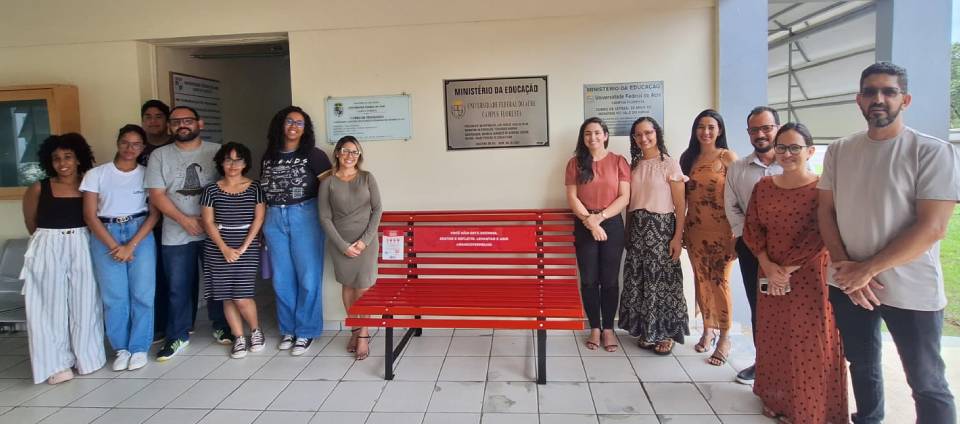
A Ufac inaugurou a campanha internacional Banco Vermelho, símbolo de conscientização sobre o feminicídio. A ação integra iniciativas inspiradas na lei n.º 14.942/2024 e contempla a instalação, nos campi da instituição, de três bancos pintados de vermelho, que representa o sangue derramado pelas vítimas. A inauguração ocorreu nesta segunda-feira, 9, no hall da Reitoria.
São dois bancos no campus-sede (um no hall da Reitoria e outro no bloco Jorge Kalume), além de um no campus Floresta, em Cruzeiro do Sul. A reitora Guida Aquino destacou que a instalação dos bancos reforça o papel da universidade na promoção de campanhas e políticas de conscientização sobre a violência contra a mulher. “A violência não se caracteriza apenas em matar, também se caracteriza em gestos, em fala, em atitudes.”
A secretária de Estado da Mulher, Márdhia El-Shawwa, ressaltou a importância de a Ufac incorporar o debate sobre o feminicídio em seus espaços institucionais e defendeu a atuação conjunta entre universidade, governo e sociedade. Segundo ela, a violência contra a mulher não pode ser naturalizada e a conscientização precisa alcançar também a formação de crianças e adolescentes.
A inauguração do Banco Vermelho também ocorre no contexto da aprovação da resolução do Conselho Universitário n.º 266, de 21/01/2026, que institui normas para a efetividade da política de prevenção e combate ao assédio moral, sexual, discriminações e outras violências, principalmente no que se refere a mulheres, população negra, indígena, pessoas com deficiência e LGBTQIAPN+ no âmbito da Ufac em local físico ou virtual relacionado.
No campus Floresta, em Cruzeiro do Sul, a inauguração do Banco Vermelho contou com a participação da coordenadora do Centro de Referência Brasileiro da Mulher, Anequele Monteiro.
Participaram da solenidade, no campus-sede, a pró-reitora de Desenvolvimento e Gestão de Pessoas, Filomena Maria Cruz; a pró-reitora de Graduação, Ednaceli Damasceno; a pró-reitora de Pesquisa e Pós-Graduação, Margarida Carvalho; a coordenadora do projeto de extensão Infância Segura, Alcione Groff; o secretário de Estado de Saúde, Pedro Pascoal; a defensora pública e chefe do Núcleo de Promoção da Defesa dos Direitos Humanos da Mulher, Diversidade Sexual e Gênero da DPE-AC, Clara Rúbia Roque; e o chefe do Centro de Apoio Operacional de Proteção à Mulher do MP-AC, Victor Augusto Silva.




Warning: Undefined variable $user_ID in /home/u824415267/domains/acre.com.br/public_html/wp-content/themes/zox-news/comments.php on line 48
You must be logged in to post a comment Login