
ACRE
Christians protest in Syrian capital after burning of Christmas tree

CNN
—
Protests erupted in Christian neighborhoods of the Syrian capital Damascus after a Christmas tree was set on fire in another town by unidentified men on Monday evening.
A video showing men setting fire to a publicly displayed Christmas tree in the Christian-majority town of Suqaylabiyah, near the city of Hama, emerged online, prompting the protests. It’s unclear who set the tree on fire but a video surfaced of a rebel standing next to Christian priests vowing to punish the perpetrators.
“Next morning you will see the tree completely restored,” the unidentified rebel told a protesting group next to the burnt Christmas tree.
The incident came three weeks since opposition rebels led a successful campaign to topple President Bashar al-Assad. Syria’s Christians now join those in Lebanon and Palestinian territories celebrating Christmas amid great uncertainty and fear in the region.
The protesters in the capital marched towards churches to demand better protection for Christians in the country, George, a 24-year-old Catholic resident of Damascus, who chose to give only his first name to speak freely, told CNN.
When Islamist rebels swept through Syria’s second largest city in an operation that would eventually culminate in the ouster of the brutal Assad regime, Christians were given assurances that their churches and property would remain protected.
Under Assad, Christians were allowed to celebrate their holidays and practice their rituals but like all Syrians faced tyrannical limitations on freedom of speech and political activity.
In control of most of Syria now is the Islamist armed rebel group Hayat Tahrir Al-Sham, led by Ahmad al-Sharaa, formerly known as Abu Mohammed Al Jolani – a man who had established al Qaeda’s affiliate in Syria before rebranding his group in 2016.
Al-Sharaa has maintained that his group will protect minorities and religious sects of Syria but has yet to call specifically for the protection for Christians ahead of the Christmas celebrations. The HTS-led government said that Wednesday (December 25) and Thursday (December 26) will be a public holiday.
Residents of the Syrian capital Damascus tell CNN that HTS has not imposed any limitations on celebrations or prayers this year, but Christians still fear that non-HTS rogue armed elements could attack them.
“Hayat Tahrir Al Sham have not announced anything on stopping our celebrations… but there are Christians who don’t want to go out to celebrate because they fear that they might get attacked from rogue armed individuals,” George said.
Christmas trees and other festive decorations are up across Christian neighborhoods of Damascus, George said, but people are scaling back their celebrations and imposing their own restrictions amid an absence of communication from HTS.
“It will make a big difference if there are announcements on better security for Christmas. Until now there isn’t proper security that is 100% organized,” George added.
Hilda Haskour, a 50-year-old Aleppo resident who identifies as Syriac Catholic, is preparing to celebrate Christmas but says there’s still worry among Christians.
“We just want to live in peace and safety, we are not asking for much…there is fear, people are tired,” Haskour said.
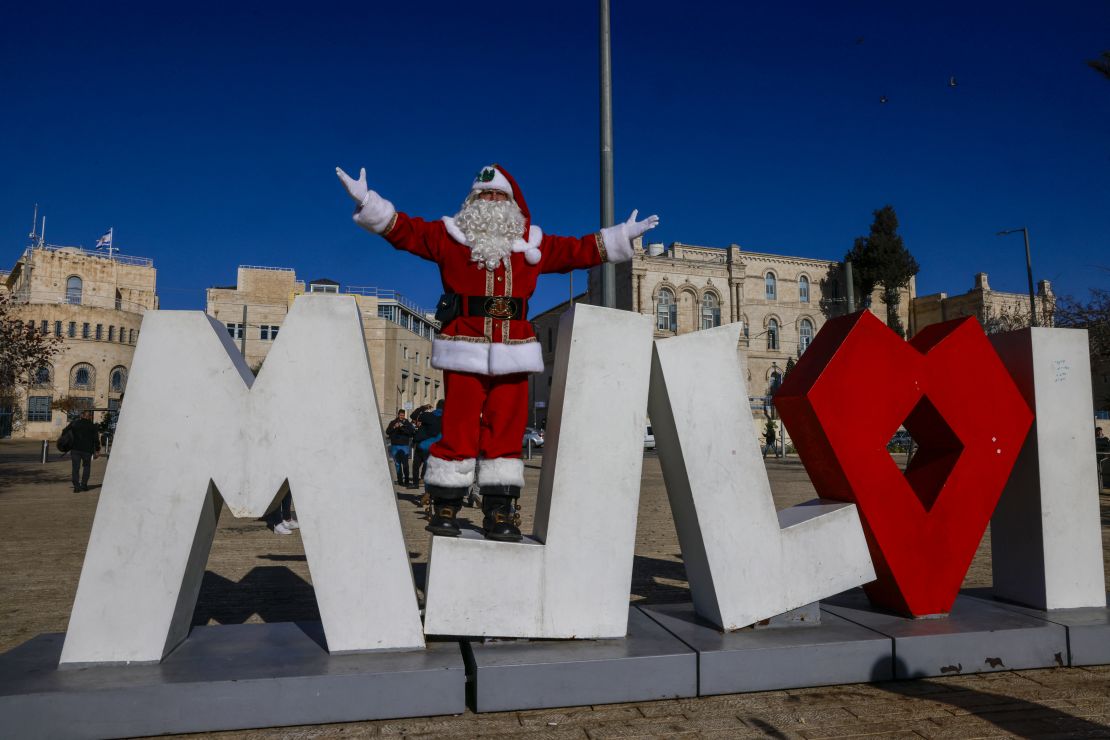
For the second year running, a Christmas tree will not be hoisted in the city revered as the birthplace of Jesus, Bethlehem.
Since the Gaza war started last year in the wake of Hamas’ attack on southern Israel on October 7, the Israeli-occupied city of Bethlehem has been subjected to “severe isolation” due to imposed restrictions, the suspension of tourism, the closure of its gates to pilgrims, and a frozen economy, the Mayor of Bethlehem Anton Salman said at a news conference on Saturday.
At least $600 million has been lost in revenue and unemployment rates have soared to over 36%, with poverty levels rising as nearly 30% of Bethlehem’s residents lack a source of income due to the absence of tourists.
“This year’s Christmas celebrations will be limited to prayers and religious rituals in solidarity with the Palestinian people in Gaza and across Palestine and as a rejection of the oppression and injustice they endure,” a statement citing Salman said.

Over the past year in Gaza, where Israeli attacks have killed at least 45,000 people and destroyed much of the strip, churches have been targeted several times by Israeli forces. Days before Christmas last year, an Israeli military sniper shot and killed two women inside the Holy Family Parish, according to the Latin Patriarchate of Jerusalem.
This Christmas, the Catholic Bishop of Jerusalem, known as a Patriarch, was allowed to enter Gaza to pray with the small Christian population of the strip at the Holy Family Parish, which has served over the past year as a shelter for the small religious minority.
“The war will end, and we will rebuild again, but we must guard our hearts to be capable of rebuilding. We love you, so never fear and never give up,” Cardinal Pierbattista Pizzaballa told worshipers during Sunday Mass.
Meanwhile in Lebanon, decorations are up in Christian parts of Beirut, where communities are keen to celebrate just weeks after a ceasefire between Hezbollah and Israel was declared. Flights were fully booked as people returned to mark Christmas with families and festive markets opened in different neighborhoods.
“My brother is flying back from New York just to specifically celebrate with our mother,” Tony Batte, an Armenian Catholic resident of Beirut, said.
In September, Israel expanded its targeting of Hezbollah to areas inside Lebanon, including the capital Beirut. Around 4,000 people were killed and thousands more injured in Lebanon while Hezbollah continued firing rockets and drones on Israeli cities in the north displacing thousands.
Hezbollah entered the war last year in solidarity with Palestinians in Gaza and Hamas but has since suffered significant losses, including the assassination of its leader Hassan Nasrallah and his top brass, and the debilitating of the militant group’s missile capabilities. The fall of its key ally Assad, and the rebels’ capture of key supply routes used by Hezbollah in Syria could also affect the capabilities of the Iranian-backed group.
“We want stability, we’re tired. We were occupied by the Syrians for years and then had Iranian influence, and we’re tired of the Christian infighting, the Islamic infighting, the Hezbollah-Israel war, every Lebanese person is tired, not just Christians,” Batte said.


ACRE
PPG em Letras promove seminário para discutir internacionalização — Universidade Federal do Acre


Warning: Undefined variable $user_ID in /home/u824415267/domains/acre.com.br/public_html/wp-content/themes/zox-news/comments.php on line 48
You must be logged in to post a comment Login