
ACRE
Dragon Age: The Veilguard Review In Progress – Return To Form

Each new entry in the Dragon Age series is always transformative, so it’s not uncommon for a fan to really love one of the entries but feel lukewarm about another. 2009’s Origins played like a spiritual successor to 1998’s Baldur’s Gate, while its 2011 sequel took the series in a more third-person-action-game direction, and then 2014’s Inquisition opted for gameplay that felt like a single-player MMO. If anything, the one constant to a Dragon Age game is that you can expect that each new game will be different from the last. During my first playthrough, Dragon Age: The Veilguard looked like it was not going to surpass my enjoyment of past games, existing as no more than a safe return to form for developer BioWare instead of a bold step forward for the franchise. But after dozens of hours with the game, I decided to try something different and now The Veilguard is inching its way into my good graces, something I didn’t think was going to happen for my Inquisition-loving heart.
The Veilguard leans into real-time action-based combat to push the Dragon Age formula into feeling more akin to something like Mass Effect: Andromeda or Anthem, while utilizing a system of setups and detonations to pull off explosive combos. However, whereas Andromeda or Anthem have the benefit of being shooters–often leaving a comfortable distance between friend and foe to encourage strategic combinations of weapon attacks and powers–The Veilguard shortens that distance and leans into melee-focused combat by having its enemies swarm you and your party, pulling you and your allies into the thick of magical explosions and swinging swords.
Early on, this is easy enough to parse, but as the story goes on, the enemies get both more numerous and hardy. Your own attacks become grander and more explosive in response, leading to the screen filling with visual clutter. As a result, it can be frustratingly tricky to see the indicator for parries, and oftentimes dulls the combat to a repetitive slog of flinging magical explosions, a step down from the far more satisfyingly strategic combat of past BioWare games and other modern-day RPGs. I opted to play as a mage, my traditional go-to for Dragon Age, and was consistently bummed by how mindless and spammy the combat felt, forcing me to rely on the pause-and-play mechanic just to get by.
It certainly doesn’t help that The Veilguard’s lock-on mechanic is awful, regularly unlocking from foes whenever they escape your vision by leaping behind you, burrowing underground, or teleporting–the exact moments when lock-on mechanics are most useful. This means a great deal of your time in a fight is spent accidentally firing off an attack at nothing, trying to dodge an attack you can hear but can’t necessarily see, or scanning the arena in search of your foe. This can lead to frustrating deaths, especially on higher difficulties or against bosses who summon minions to help them. I’ve never put a Dragon Age game down in irritation to cool off as much as I did with The Veilguard.
Or at least that’s how I felt about the combat in The Veilguard for the first 30 hours. Then I decided to start a new save file, this time as an Elf rogue instead of a Qunari mage. It was night and day. Suddenly, the lock-on was keeping pace with enemies thanks to the more reactive nature of the rogue’s movements, the rogue’s bow and arrow was snapping to targets more consistently than the mage’s arcane beam, and it was significantly easier to see the parry indicator without my own magic clouding my vision. I also dropped the pause-and-play function, no longer needing it to keep pace with combat, maintaining a sense of flow throughout each fight. I jumped back and forth between the two files for a bit and my two very different experiences remained consistent. While playing as a mage continued to be an aggravating slog, the rogue naturally fit into The Veilguard’s encouragement of close-range combat. The five hours I’ve spent as a rogue (and hour-ish I’ve tried warrior) have been significantly more enjoyable than mage and completely adjusted my opinion of the game’s combat (and my overall enjoyment) at the eleventh hour. I was prepared to leave the experience disappointed as a whole, and now I’m having a blast.
When playing as a mage, combat feels too entirely reliant on luckily turning in the right direction at the right time to catch sight of the right enemy. It feels like BioWare has even acknowledged that the mage struggles in comparison to the other two classes, giving it an ability to “switch” styles from a spell-slinging staff to an arcane dagger for close quarters, and although the dagger does handle a lot better (especially if you opt for the spellblade subclass), it’s still clunky to aim and use.
So The Veilguard’s combat works if you’re playing as a class built for it, and a long-range spellslinger is just not adept at fighting in close quarters. As a mage, the experience of playing The Veilguard is worsened the further into the story you go, as most missions loop through the same formula of talking to an NPC, going somewhere, and fighting a lot of enemies. That can get repetitive when you’re also dealing with the obtuse handling of the mage but seems to remain consistently enjoyable with the more melee-oriented classes that can easily lean into the parry and sword combos. (Again, I’ve only tried the rogue a fraction of the time I’ve spent with mage, so I can’t say for sure.) Combat is the main way Rook, The Veilguard’s protagonist, interacts with the world around them, so when that isn’t fun, it drags down much of the experience.
As you can imagine, this leaves me in a bit of a pickle for this review. I have 30 hours in one save file where I felt the experience never rose above mediocre and five hours in two other files where it’s beginning to click for me. And since I’m enjoying the combat a lot more, it’s coloring my experience of the rest of the game to be far more positive my second time through. In short, the rest of the review will be primarily based on my initial impression of The Veilguard (that first 30 hours) as that’s where most of my experience is, but I think that by the time I finish, my overall opinion may be more positive than my initial impressions.

Combat isn’t the only way Rook engages with the world; it’s just the tool they use most often. The conversational pillar of The Veilguard is a rewarding cat-and-mouse game of building alliances, exploring boundaries, unearthing trauma, and grasping at secrets. Exploring each locale gifts you wonderful visuals and captivating lore that draws you into the world–even if you opt for mage, there’s still fun to be had. I haven’t run into any major story missions that can be resolved without fighting–there doesn’t seem to be anything like Inquisition’s delightful Wicked Eyes and Wicked Hearts mission–but your choices carry narrative weight throughout. One choice early on has drastic consequences for two of Rook’s allies as well as their homes (which can be Rook’s home, too, depending on which faction they pick at character creation), transforming both who Rook can easily befriend or romance and determining which optional questlines they can pursue in the second act. The effects of that choice are felt for a long time, and even if not every decision carries the same level of importance, it reinforces the notion that any one choice can alter the immediate direction of the story and have unforeseen longer-term consequences. I love an RPG that gets me to put the controller down and pace back and forth for several minutes to mull over a choice, and The Veilguard regularly delivers on that.
The story itself follows the titular Veilguard, which is led by your playable character, Rook, and tasked with stopping the machinations of the Dread Wolf–believed to be an ancient elven god of trickery, responsible for leading a rebellion and sealing away the other, more evil elven gods. Things don’t go quite as planned during your first mission, leading to the once-sealed elven gods escaping their prison and seeking world domination, a threat more severe than the one the Dread Wolf posed. I still haven’t seen how the story ends, but what I have played follows the typical structure of a BioWare RPG: recruit a team, get your smooches in, fight some baddies, work step-by-step to reach the big bad. It’s familiar but in a nostalgic and comforting way–it’s a nice place to return to after what felt like an eternity away.

The anthology nature of Dragon Age means there’s a new hero at the helm at each of these games, and that hurts The Veilguard more than the others. Rook is boring and, even worse, feels out of place in the story told in The Veilguard. Previous Dragon Age games have made tremendous arguments for why the player character is the one burdened with the responsibility of stopping the evil of their respective games, with Inquisition’s Inquisitor even leaning into the “chosen one” trope, wielding a power never-before-seen that made them uniquely qualified for the threat at hand. So far in my playthrough, no such considerations have been made for Rook beyond the initial leader of the Veilguard saying that it has to be Rook and they’re the best one for the job, despite all evidence to the contrary. I’ve spent most of the game wondering why I’m even playing as Rook, especially when so much of The Veilguard’s story feels like a continuation of the Inquisitor’s tale.
Beyond feeling entirely out of place in comparison to the rest of the Veilguard, Rook feels somewhat aimless relative to their party companions, with not much in the way of an arc to pull the player in. Early into the adventure, there’s a poignant moment where the Dread Wolf asks Rook why they feel they’re ideal to lead the charge against the elven gods, and it feels telling that none of your available responses are especially good or convincing. Rook’s situation becomes all the more perplexing as the game goes on and party members or important NPCs put tremendous stakes into Rook’s opinions. It doesn’t make much sense. Even if you argue Rook is a tool to make the game more approachable to newcomers to the franchise–as they carry no history you have to remember from a past game–it doesn’t change the fact that The Veilguard’s story doesn’t seem to make a compelling argument for why this one person is important to Team Veilguard.
You could also argue that Rook’s purpose as leader going against the elven gods is to draw comparisons to the Dread Wolf’s past rebellion and possibly imply that Rook is the “new Dread Wolf,” and that’s why Rook needs to be among the Veilguard. If something comes about that parallel, however, I have not seen it within the game’s first 30 hours, so even if it is on the horizon, that feels way too late a development even by long RPG story standards. There’s no good reason for Rook to be in The Veilguard, and that left me wishing I was playing as someone else.

Even if Rook’s position in the story is suspect, the level of customization options available to build them is fantastic. The numerous options in the character creator do tend to favor the more humanoid Humans, Elves, and Dwarves, but I’m impressed by how much control you have over your appearance, regardless of their ancestry or gender. Your choice of background, ancestry, class, and gender can inform how your Rook engages in roleplay by unlocking unique conversation options. This is the best character creator I’ve ever used in a single-player RPG, and I’m eager to see how the different choices you make for Rook at the start can inform key moments in the story in multiple playthroughs.
The heroes who Rook aligns themselves with all present aspects of the culture or lore of Dragon Age that we’ve either never seen before or previously thought to be impossible. I found Harding’s story deeply intriguing given the power she unlocks in the game’s early hours, and uncovering the past about Bellara and Neve or learning more about the unique allies accompanying Davrin and Lucanis was a frequent narrative treat that left me eager to return to the Lighthouse hub between missions to talk (and flirt) with the colorful collection of heroes that evolved into somewhat of an oddball family. This isn’t my favorite RPG party, but The Veilguard reminds you why BioWare is held as one of the undisputed kings of making party-focused RPGs. This is an incredible group of characters.
Like past Dragon Age games, The Veilguard’s story is primarily choice-driven, and the cast of NPCs squirm their way into your heart one conversational consequence at a time. Crucial decisions that influence the companions’ fluctuating opinion of the protagonist don’t seem to pop up in The Veilguard as much as in past games, as I found it too easy to game the system to keep everyone happy over the long haul, but the RPG answers this shortcoming by making the fluctuating nature of the party makeup more prominent than previously. Your decisions can see your favorite characters needing to take a break from the action (and Rook) regardless of their overall perception of the protagonist, and there are numerous missions that force you to take a specific team member along, restricting how you build your party. In this way, The Veilguard injects strategy and reactivity into its combat, as your perfect team might not be available to you depending on the choices you’ve made during roleplay. It’s very cool.

My main gripe with the characters in The Veilguard is that they’re all too indistinct–uniformly pretty, almost. This is likely a byproduct of the game’s artistic direction, which incorporates a lot of bright colors and smooth surfaces, but it creates a bit of an uncanny vibe when focusing on the characters’ faces. Everyone has a highly detailed and smooth face with prominent features, but that sometimes leaves a character’s head–especially on Qunari–looking a tad too big for their body, with overly large foreheads or cheeks. It’s not a dealbreaker, but it is distracting. It’s also odd that–outside of what can happen to one of your companions early on–I don’t think any major character in The Veilguard has a wounded, scarred, blemished, or disfigured aesthetic. These details aren’t crucial for a video game to be good, but their absences contribute to every character looking too same-y and also a bit too clean.
On the flip side, this art direction means that the environments look gorgeous. The Veilguard is filled with tantalizing visuals, ranging from artifact-filled forests of verdant greens and golden glows to canal-dominated cities of deep blues and evocative purples. This is an incredible-looking game, even during moments when it’s trying to be scary. The music is tragically hit-or-miss, sometimes crescendoing to a level to lend an important moment some much-needed gravitas but more often than not being drowned out by the combat or lacking enough emotional punch to be even noticed.
All said, none of my complaints detract from the fact that The Veilguard is a mostly sound game that works when you’re playing as a class that can take advantage of its combat. I haven’t run into any glitches or game-breaking bugs. No side quest that I’ve completed so far has felt obtrusive or too fetch quest-y. And now that I’ve distanced myself from the mage, each combat encounter is snappy and avoids feeling too tedious or frustrating. The Veilguard feels like BioWare making a good BioWare game again, and that in itself makes me extraordinarily happy.


O professor Leonardo Lani de Abreu, do curso de Direito da Ufac, apresentou o artigo “Justiça Poética: A Imaginação Literária e os Sentidos do Direito”, no 33º Congresso do Conselho Nacional de Pesquisa e Pós-Graduação em Direito (Conpedi), que ocorreu de 11 a 13 de novembro, no Centro Universitário Dinâmica das Cataratas, em Foz do Iguaçu (PR).
O trabalho apresenta a experiência do Clube de Leitura da Ufac, iniciativa de extensão do Centro Acadêmico de Direito que aproxima estudantes e professores da literatura e do pensamento jurídico. A proposta é criar um espaço de leitura, diálogo e reflexão, mostrando como as obras literárias podem contribuir para ampliar a compreensão sobre o Direito e sobre as diferentes dimensões da experiência humana.
Para Leonardo Lani de Abreu, a participação no evento tem um significado que ultrapassa a apresentação acadêmica. “Mais do que apresentar um artigo, foi uma oportunidade de compartilhar uma experiência coletiva construída com estudantes e professores que acreditam que ler também é uma maneira de pensar o Direito”, disse.
Ele explicou que o Clube de Leitura parte da compreensão de que a formação jurídica não se limita ao conhecimento das normas e dos conceitos técnicos. “A literatura permite entrar em contato com diferentes perspectivas sobre conflitos, escolhas, desigualdades, relações humanas e dilemas de Justiça: elementos que também fazem parte do cotidiano do Direito”, acrescentou.
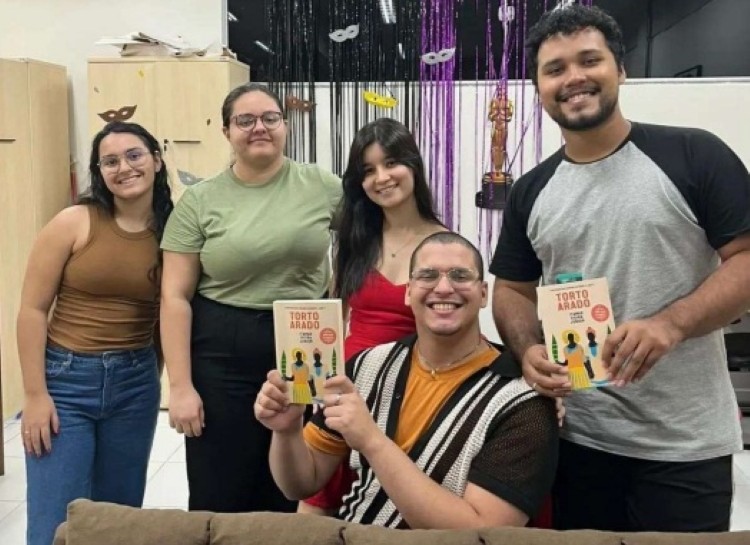
O professor também avaliou que a participação no congresso nacional do Conpedi ampliou a visibilidade da produção realizada na universidade. “Levar uma experiência desenvolvida na Ufac para esse ambiente de diálogo com pesquisadores de diferentes instituições brasileiras foi, também, uma forma de afirmar a importância da universidade pública, da pesquisa e da produção acadêmica realizada na Amazônia.”

O mestrado profissional em Administração Pública em Rede Nacional (Profiap), com polo na Ufac, está em fase de conclusão de sua primeira turma, iniciada em 2024. Com 11 estudantes defendendo suas dissertações, dos quais seis são servidores da universidade, o programa apresenta pesquisas que visam fortalecer o serviço público, propondo soluções para a realidade regional.
O coordenador do curso, professor Deivid Forgiarini, explicou que o Profiap gera resultados que podem ser empregados na prática. “Como é um mestrado profissional, temos o desafio de consolidar a parte acadêmica. Mas além disso, temos o que chamamos de PTT, o produto técnico tecnológico; a dissertação, que muitas vezes ia para a gaveta, é transformada em algo que o gestor pode aplicar efetivamente.”
Entre os trabalhos de destaque, a servidora da Ufac, Ábida Silvestre Ferreira, desenvolveu um guia prático estruturado em recomendações e metodologias para aproximar as metas institucionais dos recursos financeiros disponíveis, abordando desde a normatização do processo orçamentário até a capacitação de gestores e o fortalecimento do monitoramento contínuo. Ela foi orientada pelo coordenador do curso e entregou o guia à Pró-Reitoria de Planejamento, setor onde trabalha.
“Foi uma experiência incrível, de muito aprendizado e crescimento”, disse. “Partindo do meu ambiente de trabalho, achei necessário melhorarmos a integração entre planejamento e orçamento, de forma que consigamos maximizar a execução do nosso Planejamento Estratégico. Isso concentra tanto aspectos operacionais e técnicos quanto a capacitação dos gestores e a participação da comunidade.”
Órgãos externos
Já a pesquisa do servidor do Ministério Público do Estado do Acre (MP-AC), Madson Rocha, resultou no “Guia de Boas Práticas para o Fortalecimento da Governança de Dados Pessoais no MP-AC”, sob orientação do professor Vinícius Silva Lemos e coorientação do professor Danilo Scramin Alves. Com esse trabalho, entregue à administração superior do órgão em outubro, ele foi nomeado coordenador de Privacidade e Proteção de Dados da Corregedoria-Geral.

Com seu estudo, a servidora do Tribunal de Justiça do Acre, Adriana Marceli Motter, orientada pelo professor Rubicleis Gomes da Silva, gerou um curso de formação intersetorial voltado ao fortalecimento das políticas públicas no Estado. Ela analisou a articulação entre o plano decenal e os instrumentos orçamentários da socioeducação no sistema prisional do Estado. Ela trabalha como consultora do programa Fazendo Justiça na área socioeducativa.
(Fhagner Soares, estagiário Ascom/Ufac)
Leia mais:
Ufac promove aula inaugural de mestrado em Administração Pública


 ACRE7 dias ago
Ufac realiza cerimônia de abertura dos Jogos Interatléticas-2026 — Universidade Federal do Acre
 ACRE7 dias ago
9º Seminário Pibid-Ufac tematiza caminhos para formação docente — Universidade Federal do Acre
 ACRE6 dias ago
Resex Cazumbá-Iracema recebe ações educativas e culturais da Ufac — Universidade Federal do Acre
 ACRE5 dias ago
Professor da Ufac apresenta projeto em encontro de matemática — Universidade Federal do Acre


Warning: Undefined variable $user_ID in /home/u824415267/domains/acre.com.br/public_html/wp-content/themes/zox-news/comments.php on line 48
You must be logged in to post a comment Login