
ACRE
Hybrid McLaren W1 Hypercar Debuts With One Of The Wildest Wings You’ve Ever Seen

We’re halfway through a new decade, which means it’s time for a new McLaren hypercar. Enter the W1, the plug-in-hybrid successor to the beloved P1. “Equally at home on road and track,” the W1 is the fastest McLaren road car both in a straight line and on track, and along with a brand new chassis and powertrain, it features some of the coolest aerodynamic trickery we’ve seen.
It all starts with the Aerocell, a totally new carbon-fiber monocoque that is McLaren’s lightest yet. Typically reserved for race cars, the Aerocell is made from carbon fiber that’s pre-impregnated with a resin that simplifies the curing process and a pressure treatment that is applied in the mold, making the structure lighter and stronger. The Aerocell’s floor is 2.6 inches higher to allow for lots of trick aero and lower-front suspension mountings that are integrated directly into the structure, and no subframe is needed.
The heart of the W1 is a plug-in-hybrid powertrain that uses a brand new twin-turbocharged 4.0-liter V8 dubbed the MHP-8. This flat-plane-crank motor makes 915 horsepower and 664 pound-feet of torque on its own, and it revs all the way up to 9,200 rpm, the highest of any McLaren, achieved by using plasma spray coated cylinder bores. It also has the highest specific output of any McLaren at 230 hp per liter, and the turbos have higher peak power and improved response, coming in at 2,500 rpm. To make sure the W1 sounds fantastic, the giant dual exhaust tips that exit from the center of the rear end have tubular manifolds and long equal-length runners.
Mounted to the side of the W1’s new eight-speed dual-clutch transmission is a radial flux electric motor and motor control unit in a similar setup to what IndyCar uses, and the whole unit weighs only 44 pounds. The motor makes 342 horsepower, about double what the P1’s electric motor produced, and it can spin at up to 24,000 rpm. It’s fed energy by a 1.4-kWh battery pack housed as low as possible in a cavity of the monocoque’s floor. As a whole, the W1’s hybrid system is 88 pounds lighter than that of the P1, but with double the power. Total output from the powertrain is 1,258 hp and 988 lb-ft. There are ten total heat exchangers and three separate water cooling circuits that run at different temperatures, one of which is dedicated to the hybrid system, and a separate oil-to-air radiator for cooling the transmission.

McLaren says the W1 will hit 60 mph in 2.7 seconds, which is damn quick for a purely rear-wheel-drive car. The W1 reaches 124 mph in 5.8 seconds, and hitting 186 mph takes less than 12.7 seconds, almost four seconds quicker than the P1. Top speed is limited to 217 mph. As for electric-only operation, there’s not much of it. McLaren says it can be driven in pure electric mode for just 1.6 miles, and the battery always holds a minimum state of charge necessary to crank the engine and for the reverse, which is accomplished only using the electric motor. Recharging takes 22 minutes.
Bringing the W1 down from those speeds is an evolution of McLaren’s hydraulic brake system. The carbon-ceramic discs measure 15.4 inches at both axles, with six-piston calipers up front and four-piston calipers at the rear, and the electronic parking brake is integrated in the rear calipers, which improves stiffness. “Wheel aerodynamic appendages” are inspired by Formula 1 cooling ducts to increase downforce, and the brake lines are re-routed for better air flow underneath the car. McLaren says it takes just 95 feet for the W1 to stop from 62 mph and 328 feet to stop from 124 mph, both about the same as the Senna. Three different Pirelli tires are available, all sized 265/35ZR19 up front and 335/30ZR20 in the rear. The standard tire is the P Zero Trofeo RS, with a specially developed compound for track performance, but you can also spec less-extreme P Zero R or P Zero Winter 2 tires.

The W1 has a dry weight of 3,084 pounds, only nine pounds more than the P1 and hundreds of pounds lighter than PHEV supercars like the Ferrari 296 GTB and McLaren Artura. It’s the first McLaren with pushrods that link to inboard dampers up front, and heave dampers, torsion bars and wishbones like on F1 cars. The rear suspension uses traditional outboard springs as airflow isn’t as big of a concern, and the titanium front uprights and wishbones are 3D printed.
But it’s the W1’s aerodynamics that are the star of the show, dictating everything about how the car looks. McLaren says its engineers spent at least 350 hours in the wind tunnel testing 5,000 points, and they ran over 3,000 computational fluid dynamics simulations. Its styling isn’t super groundbreaking on face value, a mix of elements from cars like the P1, Elva and Senna, but I think the W1 looks pretty sick overall, and the more you start poring over the details the more cool things you notice. The two-tone scheme is inspired by McLaren’s F1 cars, and it does a great job of showing off how the air flows around the car — in this launch spec the more complex aero elements are finished in carbon fiber, while the nicely sculpted bodywork is painted.

There are a number of large intakes in the front bumper, with a front wing actuated by two electric motors, swinging in an arc to send air under the car through an F1-style T-tray and keel. The center section feeds air to the keel, and the outer areas generate downforce. That front wing can deploy to deduce downforce when braking, too. Behind the large hood intake is an aero blade that lifts for access to the charging port and reservoirs for the brake and washer fluid.

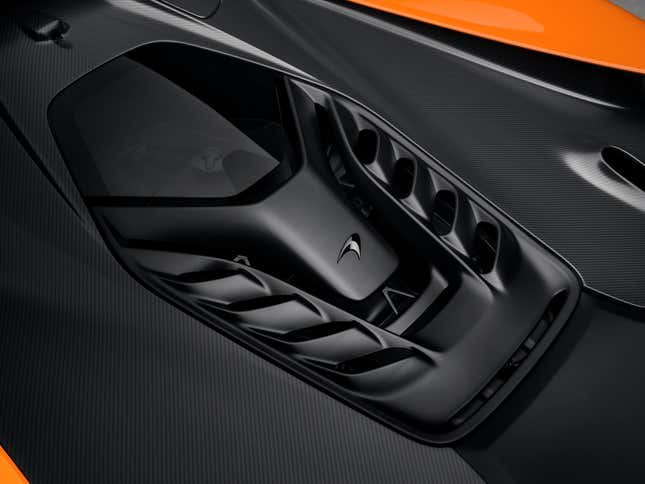
You can see the front suspension arms through the complex fenders and front wheel arches, which have a blade element that flows into the side mirrors that are positioned as outboard as possible and direct air away from the rear. Large intakes ahead of the rear wheels are inspired by F1 side pods, and the shape echoes the McLaren boomerang logo from multiple viewing angles. Inside those big pods are the triangular high-temperature radiators, while a lower intake ahead of the rear wheels channel air to the brakes and diffuser. The only component made from composite instead of carbon fiber is the flow diverter that sits above the engine cover and houses the shark fin antenna, below which is the CHMSL and rear-view camera.
The W1 has McLaren’s most extreme diffuser yet, curving upward from just behind the cabin ahead of the rear axle, and it’s “shrink-wrapped” to the powertrain. To achieve this diffuser size and shape, the engine is inclined by three degrees and the radiators and suspension wishbones were raised. The diffuser is made from intermediate modulus carbon fiber, another first for McLaren, and there’s no need for a cross-car structure linking the suspension pick-up points as the diffuser is so strong and stuff. It also is part of the crash structure, acting as the car’s rear bumper like on the Bugatti Tourbillon.
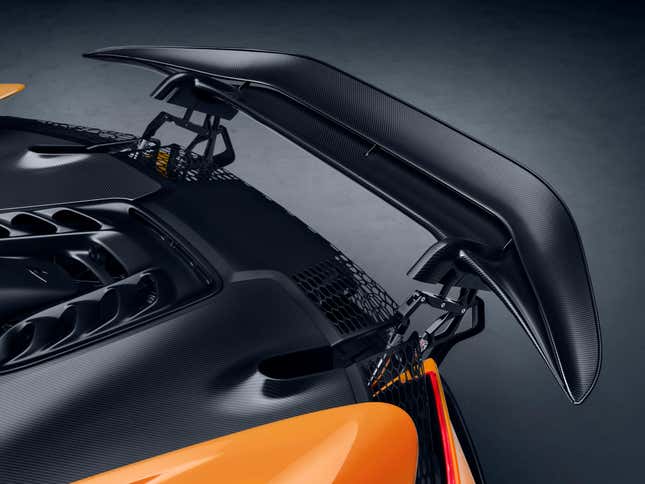
By far the wildest part of the W1’s aerodynamic package is the Active Long Tail wing that sits above the rear bodywork. Powered by four electric motors and six actuators, the wing can extend up to 11.8 inches rearward, and it can also move up or down with adjustable pitch. Additionally, the wing has a DRS function and also acts as an airbrake at high speeds. It looks really spectacular when fully extended, and the taillights wrap around the floating haunches that follow the profile of the wing. Here’s what McLaren says about the Active Long Tail:
The Active Long Tail wing is aided by a roof-mounted flow diverter device that controls air to the rear of the car, keeping it connected to the rear deck and wing. This allows the Active Long Tail wing to work at a lower height, reducing aerodynamic drag and, in Race mode, to extend the diffuser effect. In this mode it moves 11.8in rearwards through a 180-degree arc; in this position the wing leading edge sits behind the diffuser trailing edge effectively becoming an extension of the underbody. The added benefit relative to a conventional high mounted wing is that instead of the rear bodywork being lifted by the wing’s suction effect, it is now being pushed down due to stagnation of the air on the upper surface of the wing. Another first for a McLaren car is the use of E-motors on the active front and rear wings, with six actuators allowing a greater degree of accuracy and speed of movement. Comprised of two elements to maximize overall curvature, the Active Long Tail wing’s supports have been aerodynamically profiled and each features a slot gap to improve performance in crosswinds.
The front wing and Active Long Tail rear wing are tuned to constantly adjust according to the driver’s steering, accelerating and braking inputs and the vehicle’s speed. Under straight line acceleration the Active Long Tail wing will tilt to reduce drag, while the front wing will trim accordingly to optimize vehicle balance without compromising on steering feel or the flow of air for brake and powertrain cooling. Under braking, the Active Long Tail acts as an airbrake while the front wing swings up to significantly reduce pitch sensitivity. In cornering situations both wings will set to their optimal position to balance downforce according to the vehicle speed.
In Race mode the W1’s ride height lowers by 1.46 inches up front and 0.7 inches in the rear, and it offers two suspension stiffness settings. Total downforce comes in at 2,205 pounds at 174 mph, and the W1 has 20 percent less drag than the Senna with its wing in DRS. McLaren says the W1 is faster around a track than any of its road cars before it, citing a lap time around the Nardo circuit three seconds faster than the Senna. A GP mode offers consistency for long trackday sessions, while Sprint mode gives you maximum performance over one lap. There’s also a Boost button that instantly gives you the full electric power available. For road driving the W1 has Comfort and Sport drive modes; Comfort uses the electric motor just for torque fill, while Sport offers full hybrid power with ignition cut gear shifts.

Instead of the butterfly doors used by basically every modern McLaren, the W1 has “Anhedral” doors that are basically fancy gullwing units. The shape of the doors provide 3.9 inches of extra cooling space for the high-temperature radiators, which allowed the size of the radiators to be reduced, and smaller sills make it easier to get in and out of than other McLarens. The inside of the doors are sculpted out to maximize space, and there are glass panels in the roof and rear pillars for better visibility. McLaren says the W1 has its thinnest A-pillars ever, too, and the sun visors are only 0.1 inch thick.
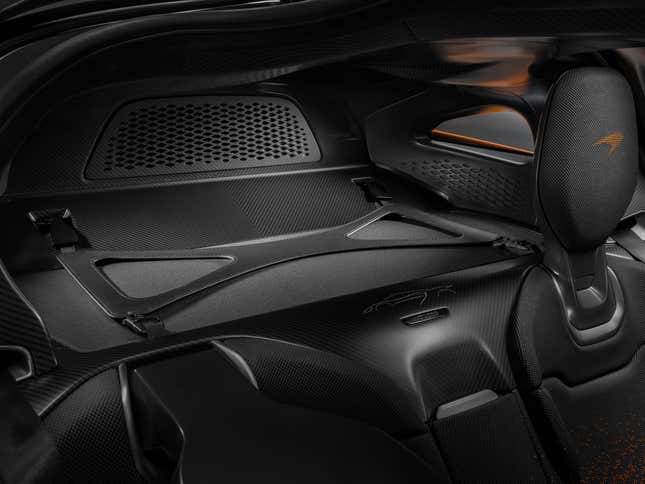
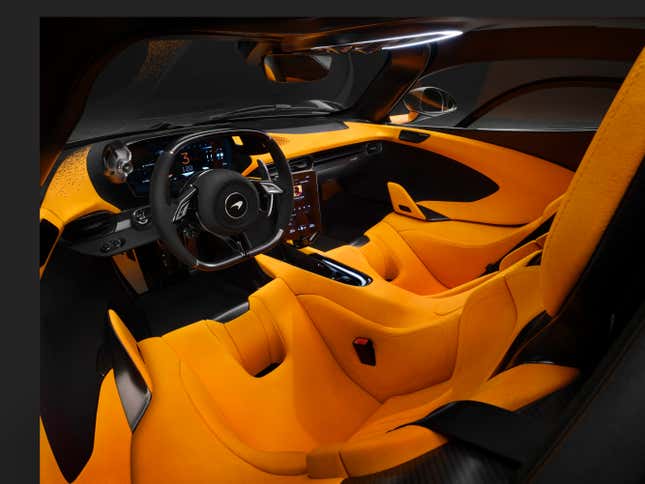
The seats are fixed, integrated directly onto the Aerocell (saving 2.8 inches of wheelbase), with the steering wheel and pedal box being adjustable, and the footwell is higher up and the driving position more reclined than usual. Shockingly, the W1 even has a sliding pair of cupholders in a storage cubby between the seats, plus a second storage area behind the armrest. The headrests fold forwards to create a “loading platform” for a storage shelf behind the seats that can hold 4.1 cubic feet of stuff, like weekend bags or a pair of racing helmets. Furthering its daily driver ability, the 8-inch touchscreen offers Apple CarPlay and both USB-A and USB-C ports.
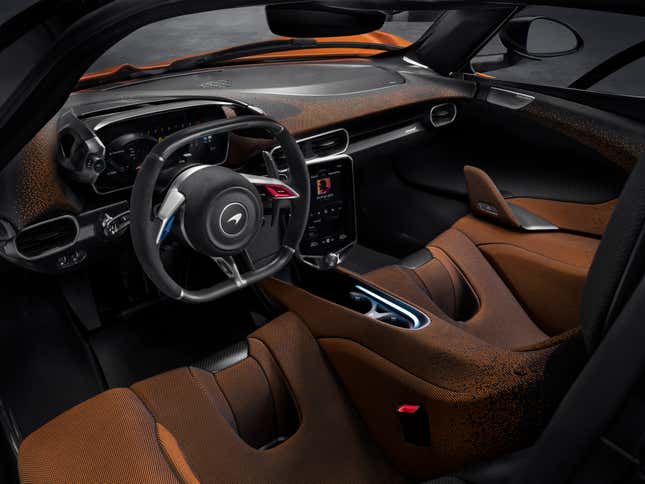
Smaller than on other McLarens, the W1’s steering wheel has a flat top and bottom and just two buttons at your thumbs, one for the Boost function and the other for Aero Deployment, along with integrated shift lights. The digital gauge cluster doubles as a “flow diverter” for a cool or warm stream of air from a cabin-wide diffused air vent, and there are four other air vents for the climate control system, which McLaren says works well in all drive modes. The start button, gear selector, Race mode control and window switches are all mounted in the roof. McLaren says the digital rear view mirror display purposefully shows a bit of the wing to help with maneuvering and parking — and surely because it looks cool, too.
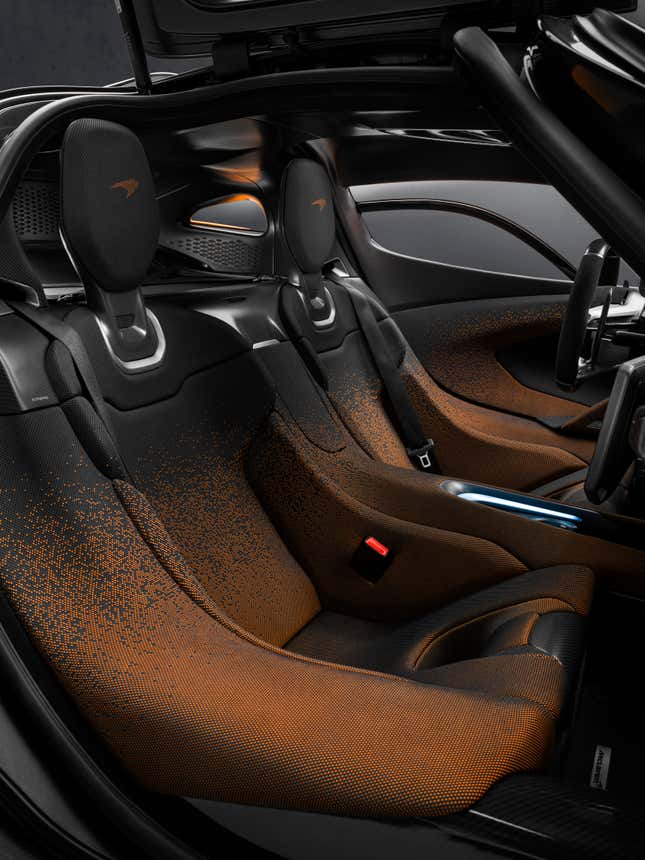
More and more automakers are starting to move away from covering interiors in nothing but leather or suede, and the W1 debuts a new McLaren-developed material called InnoKit. Described as being “infinitely flexible and super-lightweight,” it’s knitted to fit to minimize waste from production, and it can be had with “many and multiple colors, textures and shapes with precision patterns.” The stuff looks pretty incredible in the orange-dominated launch spec, and it can diffuse and project the ambient lighting and be used in the Bowers & Wilkins speaker grilles. Of course, you can spec your W1 with leather or Alcantara, both of which can be perforated for the same audio and visual integration.
McLaren is only making 399 of the W1, 24 units more than the P1 but 101 fewer than the Senna, and every single one is already allocated to customers. The starting price is $2.1 million, but it’s highly unlikely any will come in at that low number given the “virtually unlimited” customization possibilities offered through McLaren’s MSO bespoke division. Every W1 will come with a four-year unlimited mileage vehicle warranty and a six-year 45,000-mile battery warranty, plus a four-year inclusive service plan.










ACRE
Estudantes de Jornalismo da Ufac ensinam audiovisual a moradores da Reserva Cazumbá-Iracema — Universidade Federal do Acre

Estudantes do curso de Jornalismo da Universidade Federal do Acre (Ufac) realizaram oficinas de audiovisual na Reserva Extrativista Cazumbá-Iracema, em Sena Madureira. A iniciativa ensinou técnicas de produção de vídeos a moradores da reserva, com atividades de roteiro, gravação e edição, para incentivar o registro da história, da cultura e do cotidiano das comunidades.
As oficinas começaram em 6 de outubro e ocorreram em duas escolas: José Siqueira dos Santos, na comunidade Cazumbá, e Francisco Siqueira Moura, no Seguro. As atividades tiveram duração de um dia e meio em cada local e reuniram 20 participantes por comunidade, entre crianças, adolescentes e adultos.
Estudantes do ensino médio, professoras, funcionárias e bolsistas participaram da capacitação na escola José Siqueira dos Santos, localizada no núcleo da reserva.
- Foto: Beatriz Guedes
A formação foi ministrada por sete estudantes do 4º período de Jornalismo da Ufac, que desenvolveram atividades teóricas e práticas de produção audiovisual. Durante as aulas, os participantes aprenderam técnicas de elaboração de roteiros, captação de áudio e imagem, gravação e edição de vídeos. Na etapa prática, dividiram-se em grupos para produzir conteúdos sobre temas relacionados à comunidade.
A equipe foi formada pela professora Aleta Dreves e pelos estudantes Beatriz Oliveira, Islana Wiciuk, Railan Costa, Gabriela Guedes, Lauana Brito, Beatriz Guedes e Joás Linhares.

A atividade integra uma ação de extensão do curso de Jornalismo, desenvolvida em parceria com o projeto Tecendo Teias de Aprendizagem e o Instituto Chico Mendes de Conservação da Biodiversidade (ICMBio).
Demanda da comunidade
A oficina surgiu a partir de uma solicitação dos próprios moradores da reserva. Segundo a professora Aleta Dreves, responsável pela ação de extensão, a proposta inicial era oferecer uma atividade voltada à fotografia, mas a comunidade manifestou interesse em aprender também técnicas de produção audiovisual.
A intenção é ampliar o acesso ao conhecimento na área e incentivar os moradores a produzir registros sobre a própria realidade. A formação também busca contribuir para a criação de agentes comunicadores na reserva, capazes de compartilhar histórias, tradições e experiências sem precisar sair do território para adquirir esse conhecimento.
“Os objetivos são qualificar a população da Resex para despertar conhecimento nessa área, para que, somada a outras qualificações, possamos formar agentes comunicadores, visando à possibilidade de esses jovens e adultos não precisarem sair de dentro da reserva para obter o conhecimento”, explicou Aleta.
Para adaptar as aulas à realidade dos participantes, a equipe priorizou conteúdos básicos e ferramentas acessíveis, como celulares e tablets.


- Foto: Beatriz Guedes
A proposta também considerou a possibilidade de os moradores utilizarem a internet para aprimorar o aprendizado e divulgar as próprias produções.
Durante as oficinas, os estudantes da Ufac utilizaram exemplos próximos da rotina dos participantes para facilitar a compreensão das técnicas. A produção dos vídeos também permitiu que os moradores escolhessem temas ligados à cultura, ao trabalho e às experiências vividas na reserva.
Beatriz Guedes, uma das universitárias que ministraram as aulas, explicou que o foco foi ensinar a produção de vídeos curtos, desde a gravação até a edição. A proposta é que os participantes utilizem o conhecimento para registrar acontecimentos do cotidiano e desenvolver novas produções por conta própria.
“Estamos trabalhando com produção de audiovisual e tendo uma troca de conhecimento com os alunos. Ensinamos outros modelos, mas o nosso foco é vídeos curtos, para que eles registrem o seu cotidiano e publiquem nas redes sociais”, explicou Beatriz.
Entre os temas escolhidos pelos grupos estão a castanha e as lendas da comunidade. A estudante afirmou que a escolha de assuntos conhecidos pelos moradores ajuda a aproximar o conteúdo das oficinas das experiências de cada participante.
Um dos participantes da oficina é Kairo Siqueira, de 17 anos, que integra um grupo responsável pela produção de um vídeo sobre a seringueira, o látex e o artesanato. Para ele, a oficina permitiu conhecer novas técnicas de gravação e pensar em outras possibilidades de produção de conteúdo.
“Está sendo engraçado e bem produtivo. Nós estamos aprendendo mais sobre as filmagens, sobre as nossas formas de filmagem e sobre várias outras coisas”, relatou o estudante.
Kairo Siqueira, de 17 anos, participou da oficina de audiovisual e pretende utilizar o aprendizado para produzir vídeos próprios.

Kairo pretende aproveitar o aprendizado para criar vídeos sobre jogos, experiências pessoais e atividades realizadas na floresta. Segundo ele, a vontade de gravar já existia, mas a oficina apresentou conhecimentos que podem ajudar a desenvolver essas produções.
A experiência também pode ampliar o uso do audiovisual por quem já tinha contato com a fotografia e a gravação de vídeos. Keven dos Santos, de 19 anos, conta que acompanha registros da reserva desde a infância, quando o pai participava de projetos com fotógrafos de Brasília. Com o tempo, ele próprio passou a gravar momentos do cotidiano e publicar vídeos em uma conta privada.
Para Keven, o audiovisual também pode ajudar a apresentar diferentes perspectivas sobre a vida na comunidade, especialmente as diferenças entre as gerações.


- Foto: Beatriz Guedes
Troca de experiências
Além dos moradores, os estudantes da Ufac também aproveitam a experiência para colocar em prática os conhecimentos adquiridos durante a graduação. Para Railan Costa, as oficinas aproximam os conteúdos teóricos das situações que os futuros jornalistas encontram fora da universidade.
“A gente espera que fiquem boas sementes, pessoas interessadas em ser comunicadoras na questão de reproduzir tudo aquilo que a comunidade tem a oferecer. E que, assim como nós viemos ensiná-los a fazer, eles também possam ensinar as outras crianças, os outros jovens, que também possam somar junto com eles aqui na comunidade”, declarou.
A ação também prevê novas etapas de formação. Segundo Aleta Dreves, estão planejados um curso mais aprofundado de audiovisual em Rio Branco, oficinas de podcast e fotografia, além de uma atividade de fotografia na comunidade, voltada ao registro do artesanato local e à produção de fotografia artística.
Tecendo Teias de Aprendizagem
A oficina de audiovisual faz parte de uma iniciativa mais ampla de extensão universitária desenvolvida na Reserva Extrativista Cazumbá-Iracema. O projeto Tecendo Teias de Aprendizagem surgiu a partir de demandas da própria comunidade por ações nas áreas de educação, saúde e oportunidades para jovens e trabalhadores extrativistas.
Segundo a pedagoga Socorro Siqueira, que atua na coordenação local, o projeto foi elaborado em 2025 e assumido pela Ufac no fim do mesmo ano, como um programa de extensão. As ações começaram a ser executadas no início de 2026 e incluem atividades de apoio à educação, preparação para o Exame Nacional do Ensino Médio (Enem) e produção de materiais pedagógicos para as escolas da reserva.
Para Socorro, a oficina de audiovisual contribui para aproximar os jovens da comunidade dos universitários e incentivar a expressão de suas próprias ideias. A convivência entre os grupos também permite a troca de conhecimentos entre pessoas com experiências diferentes.
“Um dos objetivos é fazer com que os jovens da comunidade se sintam em pé de igualdade, apesar de terem saberes diferentes. Perder a timidez, conseguir expressar-se como eles querem. Então, a comunicação é de fundamental importância para eles poderem conquistar os objetivos que têm”, afirmou a pedagoga.
A pedagoga Socorro Siqueira destaca a importância da comunicação para que os jovens da comunidade expressem suas ideias.


- Foto: Beatriz Guedes
Participantes da primeira etapa do projeto na escola Francisco Siqueira Moura.

ACRE
Ufac promove ação de prevenção à saúde da mulher durante o Outubro Rosa — Universidade Federal do Acre

ACRE
Ufac e SEE discutem disponibilização de produtos educacionais para professores da rede estadual — Universidade Federal do Acre


 ACRE2 dias ago
Ufac inaugura núcleo de apoio administrativo às coordenações de curso — Universidade Federal do Acre
 ACRE1 dia ago
Ufac e SEE discutem disponibilização de produtos educacionais para professores da rede estadual — Universidade Federal do Acre
 ACRE3 horas ago
Ufac promove ação de prevenção à saúde da mulher durante o Outubro Rosa — Universidade Federal do Acre
 ACRE50 minutos ago
Estudantes de Jornalismo da Ufac ensinam audiovisual a moradores da Reserva Cazumbá-Iracema — Universidade Federal do Acre


Warning: Undefined variable $user_ID in /home/u824415267/domains/acre.com.br/public_html/wp-content/themes/zox-news/comments.php on line 48
You must be logged in to post a comment Login