
ACRE
Qatar suspends role as mediator between Israel and Hamas

 Getty Images
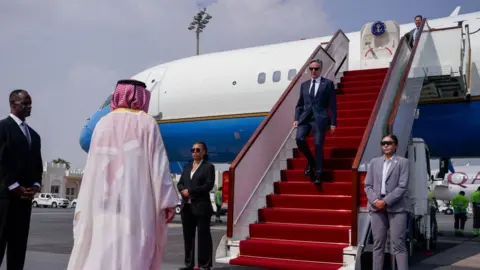
Qatar has suspended its work as a mediator in ceasefire and hostage release talks between Israel and Hamas, officials say.
The country said it would resume its work when Hamas and Israel “show their willingness” to negotiate.
It comes after senior US officials reportedly said Washington would no longer accept the presence of Hamas representatives in Qatar, accusing the Palestinian group of rejecting fresh proposals for an end to the war in Gaza.
Qatar said initial reports it had withdrawn from mediation talks and said that Hamas’s political office in Doha “no longer serves its purpose” were “inaccurate”.
“Qatar notified the parties 10 days ago during the last attempts to reach an agreement, that it would stall its efforts to mediate between Hamas and Israel if an agreement was not reached in that round,” a statement from the Qatari foreign ministry said.
“Qatar will resume those efforts… when the parties show their willingness and seriousness to end the brutal war.”
Hamas has had a base in the Qatari capital since 2012, reportedly at the request of the Obama administration.
Several news agencies reported on Saturday that Qatar had agreed with the US to tell Hamas to close its political office in Doha due to “a refusal to negotiate a deal in good faith”.
But the foreign ministry said the reports were “inaccurate”. The claims have also been denied by Hamas officials.
The small but influential Gulf state is a key US ally in the region. It hosts a major American air base and has handled many delicate political negotiations, including with Iran, the Taliban and Russia.
Alongside the US and Egypt, the Qataris have also played a major role in rounds of so-far unsuccessful talks to broker a ceasefire in the year-long war between Israel and Hamas in Gaza.
But there is growing evidence of a shift in the relationship.
After the killing of Hamas leader Yahya Sinwar, Hamas held a two-hour mourning tent in Doha in a small hall, a stark contrast to the recent three-day mourning held for Hamas leader Ismail Haniyeh, which was conducted with official state oversight and security.
The latest round of talks in mid-October failed to produce a deal, with Hamas rejecting a short-term ceasefire proposal. The group has always called for a complete end to the war and the full withdrawal of Israeli troops from Gaza.
The Qatari foreign ministry statement said: “Media reports regarding the Hamas office in Doha is inaccurate.”
“The main goal of the office in Qatar is to be a channel of communication… [which] has contributed to achieving a ceasefire in previous stages.”
Israel has also been accused of rejecting deals. Days after being fired earlier this week, former Defence Minister Yoav Gallant accused Israeli Prime Minister Benjamin Netanyahu of rejecting a peace deal against the advice of his security chiefs.
The call for Hamas to be expelled from Qatar appears to be an attempt by the outgoing Biden administration to force some sort of peace deal before the end of his term in January.
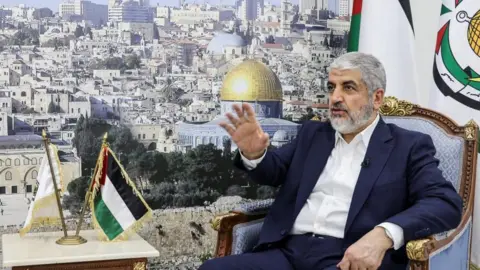
Were Hamas to be forced to leave Doha, it is unclear where they would base their political office. Key ally Iran would be an option, although the assassination of former leader Ismail Haniyeh in Tehran in July suggests they may be at risk from Israel if based there. It would also not give them anything close to the same diplomatic channels to the West.

 Reuters
A more likely option would be Turkey. As a Nato member but also a Sunni majority state, it would give the group a base from which to operate in relative safety. Last April President Erdogan hosted then Hamas political chief Ismail Haniyeh and his delegation in Istanbul, where they talked about “what needs to be done to ensure adequate and uninterrupted delivery of humanitarian aid to Gaza, and a fair and lasting peace process in the region”.
The move would also most likely be welcomed by Ankara, which has often sought to position itself as a broker between east and west.
Key Hamas figures such as Osama Hamdan, Taher al-Nunu, and others frequently featured on news outlets have been staying in Istanbul for over a month.
Their extended presence in Turkey marks a departure from past visits, which were typically limited to brief stays.
It is thought the personal safety of Hamas leadership is now a major concern for the group, which saw two leaders killed in less than four months. As well as Haniyeh’s death in July, in October Israel killed Yahya Sinwar, the mastermind behind the 7 October Hamas attack on southern Israel.
According to the European Council of Foreign Relations, “Hamas has adopted a temporary model of collective leadership to mitigate the effect of future Israeli assassinations”.
H A Hellyer, a senior associate fellow at the Royal United Services Institute (Rusi), told the BBC that nowhere “will give them protection from Israeli assassination attempts in the same way that being in Doha, where America has its largest military base in the region, did”.
The latest move comes as US officials appear increasingly frustrated with the approach the Israeli government has taken to ending the war. In October, the US Secretaries of State and Defense said if Israel did not allow more humanitarian aid into the territory by 12 November, they would face unspecified policy “implications”.
Last weekend a number of UN officials warned the situation in northern Gaza was “apocalyptic”. On Saturday the independent Famine Review Committee said there was a “strong likelihood that famine is imminent in areas”.
The relationship between President Joe Biden and Netanyahu has deteriorated over the course of the war in Gaza, with increasing pressure from Washington to improve the humanitarian situation for the Palestinians and find some sort of negotiated settlement.
But, according to Dr Hellyer, US attempts at negotiation have been fatally flawed.
“By setting red lines and allowing Netanyahu to cross them without consequence, the Biden administration effectively encouraged further impunity. I don’t think any of this will change in the next 10 weeks,” he said.
Any overtures have been repeatedly rejected by Netanyahu and his right-wing coalition, who will now also feel emboldened by the prospect of an incoming Donald Trump presidency.
While exactly what approach Trump will take to the region remains uncertain, he is thought to be more likely to allow Israel to act on its terms.
He has previously said Israel should “finish what they started” in Gaza. During his last term in the White House, he took a number of steps deemed highly favourable to Israel, including moving the US embassy to Jerusalem.
It has also been reported, however, that Trump has told Netanyahu that he wants to see an end to the fighting by the time he takes office.
Either way, it seems likely that the current US administration will have less influence over the government in Jerusalem.
They may therefore believe the best way to force some sort of deal is to apply pressure on Hamas. Whether it pays off may depend on whether Qatar, so long a reliable ally, decides to go along with it.

ACRE
PPG em Letras promove seminário para discutir internacionalização — Universidade Federal do Acre


Warning: Undefined variable $user_ID in /home/u824415267/domains/acre.com.br/public_html/wp-content/themes/zox-news/comments.php on line 48
You must be logged in to post a comment Login