
ACRE
Remains of Sandy Irvine believed found on Everest after 100 years

When they spotted it, there was no mistaking what they were looking at: a boot melting out of the ice. As they drew closer, they could tell the cracked leather was old and worn, and the sole was studded and bracketed with the diamond-patterned steel hobnails of a bygone era of climbing.
In September, on the broad expanse of the Central Rongbuk Glacier, below the north face of Mount Everest, a National Geographic documentary team that included the photographer and director Jimmy Chin, along with filmmakers and climbers Erich Roepke and Mark Fisher, examined the boot more closely. Inside, they discovered a foot, remains that they instantly recognized as belonging to Andrew Comyn Irvine, or Sandy, as he was known, who vanished 100 years ago with the famed climber George Mallory.
“I lifted up the sock,” Chin says, describing the moment, “and there’s a red label that has A.C. IRVINE stitched into it.” Chin says he and his companions recognized the significance of the moment in unison. “We were all literally running in circles dropping F-bombs.”
Irvine and Mallory were last seen on June 8, 1924, while attempting to become the first people to reach the top of the world’s highest peak. The question of whether they had summited has endured as the greatest climbing mystery of all time. If Irvine and Mallory succeeded, their feat would have come some 29 years before Tenzing Norgay and Edmund Hillary finally reached the top of Everest.
Mallory’s remains were located in 1999, while the whereabouts of Irvine’s were unknown. “It’s the first real evidence of where Sandy ended up,” says Chin of the discovery. “A lot of theories have been put out there.” He hopes the discovery helps explain what happened on the mountain in 1924, and brings some closure to Irvine’s relatives who revere him still. “When someone disappears and there’s no evidence of what happened to them, it can be really challenging for families. And just having some definitive information of where Sandy might’ve ended up is certainly [helpful], and also a big clue for the climbing community as to what happened.”
Chin said he suspects the boot had been trapped in the glacier until just prior to the team spotting it. “I think it literally melted out a week before we found it,” he said. Photograph by Jimmy Chin

The sock, with Irvine’s name, was found along with a boot and a foot, emerging from the ice of the Central Rongbuk Glacier. Photograph by Jimmy Chin
One of Chin’s first calls to share the news was to Irvine’s great-niece Julie Summers, 64, who wrote a 2001 biography of Irvine and has championed his contributions to mountaineering for years. She was grateful for the news. “It’s an object that belonged to him and has a bit of him in it,” she says of the boot. “It tells the whole story about what probably happened.” Summers suspects that the remains were swept down the mountain by avalanches and crushed by the moving glacier. “I’m regarding it as something close to closure.” Members of the family have volunteered to share DNA samples to compare with the remains in order to confirm their identity.
(This team climbed Everest to search for a camera that could rewrite history)
Summers said the discovery brought back memories of when news broke in 1999 that Mallory’s body had been found by the alpinist Conrad Anker, as part of the Mallory and Irvine Research Expedition, which sought to settle the question of whether the pair had indeed reached the summit. An examination of his remains revealed the sort of deep rope marks that might indicate a fall that was caught by a rope wrapped around his waist—evidence that suggested to Anker that Mallory and Irvine were roped together in their final moments. “I knew at once that he’d been tied to his partner, and that he’d taken a long fall,” Anker wrote in The Lost Explorer, which he co-authored with David Roberts. Mallory’s right leg was badly broken and his uninjured left leg was laid delicately over the break, hinting that he didn’t die immediately in the fall. His dark snow goggles were in his pocket, which led to speculation that the fall could have occurred in the evening as the two had been descending. The photograph of his wife that Mallory had planned to leave on the summit wasn’t with him.
Finding Mallory’s remains answered several questions about the fate of the two men, but it left two big questions unanswered. Where was Irvine? And had the pair reached the summit? Climbers and historians long thought that answering the first question might offer clues about the second. After all, it had been Irvine who had carried the Kodak Vest Pocket Camera lent by expedition member Howard Somervell. The undeveloped film inside, it was thought, might contain the only conclusive evidence of their success. And so, the quest to find Irvine’s body acquired more interest—on par, in some circles, with the search for Amelia Earhart or Michael Rockefeller.

In the last photo taken of the mountaineers, George Mallory (left) and Sandy Irvine prepare to leave the North Col of Everest in June 1924. Photograph by Noel E. Odell/Royal Geographical Society via Getty Images
In September, several days before they came upon the boot, Chin says, the team was descending the Central Rongbuk Glacier when they found a different artifact that aroused their curiosity. “We discovered an oxygen bottle marked with a date on it that said 1933,” he says. Nine years after Mallory and Irvine had gone missing, the 1933 British Everest expedition was the fourth attempt to climb the mountain. It also ended in failure, but members of the 1933 expedition did find an ice ax that belonged to Sandy Irvine high on the northeast ridge, though well below where Mallory was found.
(Here’s why Mount Everest keeps changing its height)
The discovery of the 1933 oxygen cylinder got Chin and his teammates thinking. “If Sandy had fallen down the north face, his remains or his body could be somewhere near here,” says Chin. They started to speculate that if an oxygen canister had fallen off the mountain, “it probably fell down quite a bit farther than a body—more like a missile.”
Chin suspected that Irvine’s remains could be close. “Sandy could potentially be a few hundred yards up the glacier from here toward the mountain,” he told Erich Roepke. In the days that followed, Chin and his team began taking a circuitous route across the folds and crevasses of the glacier. “It was actually Erich who spotted something and was like, ‘Hey, what’s that?’,” says Chin. It was the boot, emerging from the ice. “I think it literally melted out a week before we found it.”
In her book about her great-uncle, Julie Summers describes Irvine as “a beautiful young man who died in the flush of youth.” Indeed, at 22 Irvine had been the youngest member of the 1924 expedition—a mission that followed two previous British climbs, one in 1921 to reconnoiter possible climbing routes, and a second in 1922 that marked the first serious attempt at summiting. In those days, simply reaching Everest required a month or more. The ropes were natural fiber, the outerwear consisted of wool and gaberdine, and the boots were leather—purchased for five pounds three shillings from James J. Carter, a London boot maker.

Andrew “Sandy” Irvine was 22 years old when he vanished with Mallory. The Oxford student was the youngest member of the expedition. Photograph by Mount Everest Foundation/Royal Geographical Society via Getty Images
Irvine came from an upper middle-class family in Cheshire, England; he was handsome and athletic, a star rower at Oxford. Still, Irvine has often been the subject of criticism for lacking technical mountaineering experience prior to finding himself on the mountain in 1924. Reportedly, he likely suffered from a learning disability like dyslexia that hampered him as a reader, but he was mechanically gifted and excelled at math and engineering. When he joined the expedition, he was immediately appointed to serve as the oxygen officer, and he helped to improve the design of the team’s oxygen cylinders. He earned his spot on the summit team by dint of his will and athletic prowess. “Irvine,” wrote expedition leader E.F. Norton in The Fight For Everest, “was big and powerful—with fine shoulders and comparatively light legs.” Summers says that Mallory likely valued Irvine’s deference to the older climber. Irvine was absolutely loyal to Mallory, she says.
Early on the morning of June 8, 1924, the two men set off for the summit under conditions that Mallory is said to have described as ”perfect weather for the job.” That afternoon, they were last spotted by teammate Noel Odell, who reported briefly noticing two tiny figures near the Second Step during a brief parting of the clouds. Then they were gone.
(Inside the Everest expedition that built the world’s highest weather station)
Over the years, several theories have emerged to explain why Irvine was never found. One notion proposed by Mark Synnott, a writer, climber, and National Geographic contributor in his book The Third Pole: Mystery, Obsession, and Death on Mount Everest suggests that Chinese climbers might have found the body and the camera long ago, and kept it quiet. Summers thinks the discovery of the boot refutes that idea. “I think Jimmy’s find has absolutely answered that question,” she says.
An earlier theory suggests that a Chinese climber in 1975 had encountered a body outfitted in vintage clothing, just below the Northeast Ridge. That sighting became the basis for the target area of the 1999 Mallory Irvine Research Expedition. Members of that team, including Anker, expected that if they found a body it would be Irvine’s—which might then lead them to Mallory’s (the expedition’s leader Eric Simonson collected a DNA sample from one of Irvine’s relatives to aid in the identification). After Anker discovered Mallory’s remains— the team performed a burial on the mountain—he spoke with Summers. “Conrad Anker said to me, he was looking for the treasure map and ended up finding the treasure,” remembers Summers.
Several days after Chin and his team found the boot, they noticed ravens disturbing it. At that point, he says, he asked the China-Tibet Mountaineering Association (CTMA), the governmental authority that oversees the north side of Everest, whether the team could move the remains off the mountain. Chin carried the boot and foot off Everest in a cooler and turned it over to the CTMA. His team also took a DNA sample that they are working with the British Consulate on for further identification. “But I mean, dude,” says Chin. “There’s a label on it.”
Chin is declining to elaborate on where exactly the remains were found—he says he wants to discourage trophy hunters. But he’s confident that more artifacts and maybe even the camera are nearby: “It certainly reduces the search area.”


ACRE
Rede de trabalho franco-brasileira atua em propriedades amazônicas — Universidade Federal do Acre

ACRE
Professora publica livro sobre sítios naturais sagrados do povo Nukini — Universidade Federal do Acre

A professora Renata Duarte de O. Freitas, do curso de Direito do campus Floresta da Ufac, lança o livro “Aldeia Isã Vakevu, do Povo Originário Nukini: Um Sítio Natural Sagrado no Coração do Juruá” (Lumen Juris, 240 p.). O evento ocorre neste sábado, 7, às 19h, no teatro dos Nauas, em Cruzeiro do Sul. Resultado de investigação científica, a obra integra a cosmologia indígena aos marcos regulatórios da justiça ambiental.
A pesquisa é fundamentada na trajetória de resistência do povo Nukini. O livro presta homenagem à memória de Arlete Muniz (Ynesto Kumã), matriarca, parteira e liderança espiritual que preservou os conhecimentos milenares do Povo da Onça frente aos processos de aculturação e violência histórica.
O texto destaca a continuidade desse patrimônio imaterial, transmitido de geração para geração ao seu neto, o líder espiritual Txane Pistyani Nukini (Leonardo Muniz). Atualmente, esse legado sustenta a governança espiritual no Kupixawa Huhu Inesto, onde a aplicação das medicinas da floresta e a proteção territorial dialogam com a escrita acadêmica para materializar a visão de mundo Nukini perante a sociedade global.
Renata Duarte de O. Freitas introduz no cenário jurídico eixos teóricos que propõem um novo paradigma para a conservação ambiental: sítios naturais sagrados, que são locais de identidade cultural e espiritual; direito achado na aldeia, cuja proposta é que o ordenamento jurídico reconheça que a lei também emana da sacralidade desses locais; e direitos bioculturais, que demonstram que a biodiversidade da Serra do Divisor é preservada porque está ligada ao respeito pelos sítios naturais sagrados.
Ao analisar a sobreposição de uma parte do território Nukini com o Parque Nacional da Serra do Divisor, a obra oferece uma solução científica: o reconhecimento de que áreas protegidas pelo Estado devem ser geridas em conjunto com os povos originários, respeitando seus territórios sagrados.


A Ufac recebeu, nesta quarta-feira, 25, na Reitoria, campus-sede, a visita do ministro da Educação, Camilo Santana, no âmbito da caravana Aqui Tem MEC, iniciativa do Ministério da Educação voltada ao acompanhamento de ações e investimentos nas instituições federais de ensino.
Durante a agenda, o ministro destacou que a caravana tem percorrido instituições federais em diferentes Estados para conhecer a realidade de cada campus, dialogar com gestores e a comunidade acadêmica, além de acompanhar as demandas da educação pública federal.
Ao tratar dos investimentos relacionados à Ufac, a reitora Guida Aquino destacou a obra do campus Fronteira, em Brasileia, que conta com R$ 40 milhões em recursos do Novo Programa de Aceleração do Crescimento (PAC). A estrutura terá seis cursos, com salas de aula, laboratórios, restaurante universitário e biblioteca.
Abordando a visita, Guida ressaltou a importância da universidade para o Estado e a missão da educação pública. “A Ufac é a única universidade pública federal de ensino superior do Acre e, por isso, tem papel estratégico na formação e no desenvolvimento regional. A educação é que transforma vidas, transforma o país.”
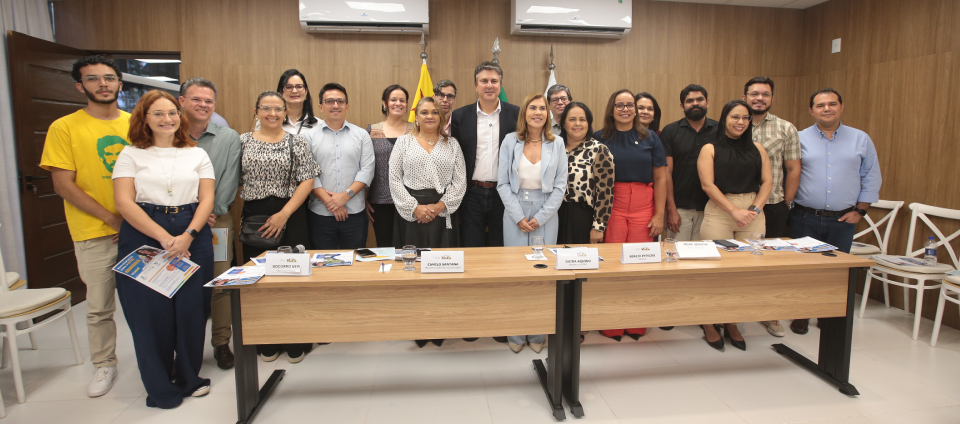
Outro tema tratado durante a agenda foi a implantação do Hospital Universitário no Acre. Camilo Santana afirmou que o Estado é o único que ainda não conta com essa estrutura e informou que o governo federal dispõe de R$ 50 milhões, por meio do Novo PAC, para viabilizar adequações e a implantação da unidade.
Ele explicou que a prioridade continua sendo a concretização de uma parceria para doação de um hospital, mas afirmou que, se isso não ocorrer, o MEC buscará outra alternativa para garantir a instalação do serviço no Estado. “O importante é que nenhum Estado desse país deixe de ter um hospital universitário”, enfatizou.
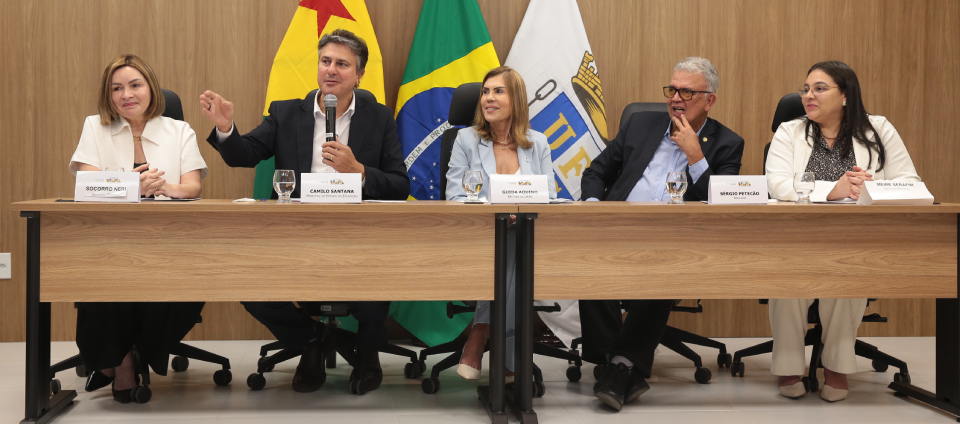
Guida reforçou a importância do projeto e disse que o Hospital Universitário já poderia ser celebrado no Acre. Ao defender a iniciativa, contou que a unidade contribuiria para qualificar o atendimento, reduzir filas de tratamento fora de domicílio e atender melhor pacientes do interior, inclusive em casos ligados às doenças tropicais da Amazônia. Em tom crítico, declarou: “O cavalo selado, ele só passa uma vez”, ao se referir à oportunidade de implantação do hospital.
Após coletiva de imprensa, o ministro participou de reunião fechada com pró-reitores, gestores, políticos e parlamentares da bancada federal acreana, entre eles o senador Sérgio Petecão (PSD) e as deputadas Meire Serafim (União) e Socorro Neri (PP).
A comitiva do MEC foi formada pela secretária de Educação Básica, Kátia Schweickardt; pelo secretário de Educação Profissional e Tecnológica, Marcelo Bregagnoli; pelo secretário de Educação Superior, Marcus Vinicius David; e pelo presidente da Empresa Brasileira de Serviços Hospitalares, Arthur Chioro.
Laboratório de Paleontologia
Depois de participar de reunião, Camilo Santana visitou o Laboratório de Paleontologia da Ufac. O professor Edson Guilherme, coordenador do espaço, apresentou o acervo científico ao ministro e destacou a importância da estrutura para o avanço das pesquisas no Acre. O laboratório foi reformulado, ampliado e recentemente reinaugurado.
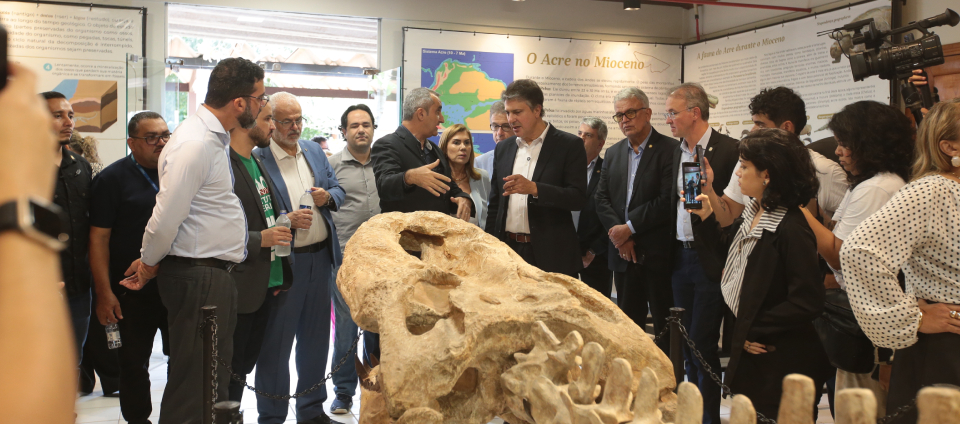
Aberto para visitação de segunda a sexta-feira, em horário de expediente, exceto feriados, o local reúne fósseis originais e réplicas de animais que viveram no período do Mioceno, quando o oeste amazônico era dominado por grandes sistemas de rios e lagos. A entrada é gratuita e a visitação é aberta a estudantes e à comunidade em geral.


 ACRE5 dias ago
Professora publica livro sobre sítios naturais sagrados do povo Nukini — Universidade Federal do Acre
 CONDENAÇÃO5 dias ago
Empresas terão de indenizar pescadores prejudicados pela construção de hidrelétrica no Rio Madeira
 JUSTIÇA5 dias ago
Sexta Turma mantém condenação por estupro de vulnerável apesar de pedido do MP pela absolvição
 JUSTIÇA5 dias ago
Pagamento retroativo a servidores transpostos do extinto território de Rondônia é tema de repetitivo


Warning: Undefined variable $user_ID in /home/u824415267/domains/acre.com.br/public_html/wp-content/themes/zox-news/comments.php on line 48
You must be logged in to post a comment Login