
ACRE
USA vs. Mexico all-time best XIs: Pulisic to Márquez

With two national team programs that have a combined history of 200-plus years, there’s obviously no lack of legends that have represented either the United States or Mexico.
The rivalry has had iconic luminaries from the 20th century and younger superstars who have taken charge in the modern game — as a result, it’s no simple task to select the best of the best from each nation. Nonetheless, with another rivalry game for the two Concacaf powerhouses around the corner, we’ve done just that.
Here are the all-time best XIs from the United States and Mexico.
United States
GK: Brad Friedel
This was a tough one, especially when you consider that Tim Howard and Kasey Keller could make an argument for themselves. That said, Friedel narrowly takes the best XI spot when you consider his gargantuan number of English Premier League appearances (450) and his role in the Americans’ quarterfinal finish in the 2002 World Cup.
DF: Steve Cherundolo
Is Sergiño Dest currently more talented than Cherundolo was at right-back? Probably, and it’s only a matter of time before he takes the all-time spot, but Cherundolo maintains the No. 1 position because of his lengthier run of reliable play for club and country.
DF: Eddie Pope
A key central defensive figure in the famed 2002 World Cup squad and a constant rock in the middle of the USMNT backline. The aggressive defender won numerous titles with D.C. United, while also having the ability to occasionally find the back of the net at the domestic and international level.
DF: Marcelo Balboa
A two-time winner of the U.S. Soccer Athlete of the Year, a looming central defensive presence who earned three World Cup appearances, and the first U.S. player to reach 100 caps. Beginning his career in the pre-MLS era, Balboa was significant in the growth of American soccer.
DF: Carlos Bocanegra
It’s inevitable that current left-back Antonee Robinson eventually takes the all-time No. 1 spot, but until then, it belongs to the former captain and looming presence, Bocanegra. A leader for both club (Fulham, Rennes, Saint-Etienne, Rangers) and country who would often play as a central defender, Bocanegra was a versatile and well-respected option who was capable of supporting the attack.
A perfect example of how certain U.S. players can blossom in the modern elite European scene, McKennie is an impressively well-rounded figure who has made his mark at the UEFA Champions League level. He has yet to reach the peak of his abilities and could establish himself as a true icon in the 2026 World Cup.
MF: Claudio Reyna
A player on the U.S. team from 1994 to 2006 who would have no issues adjusting and thriving in the modern era, Reyna was highly entertaining with his intelligent ball distribution that few (if any) have been able to replicate in the current pool of U.S. players. It’s no wonder why his son Giovanni Reyna appears to be one of the next big things in American soccer.
AM: Landon Donovan
At the risk of leaving out the tremendously proficient Tab Ramos or a defensive midfield stalwart like Michael Bradley, we need to clearly make room for the greatest American player in this midfield XI. Pacey, clever and always thinking two or three steps ahead, Donovan stepped up when it mattered most in crucial World Cup matches, which highlighted his abilities that have held him as the all-time U.S. leader in assists and joint-leader in goals.
Pulisic isn’t far from surpassing Donovan as the greatest American player. He’s a UEFA Champions League winner, a four-time earner of U.S. Soccer’s Male Player of the Year, and is currently excelling in Serie A with AC Milan. Keep in mind: He still has plenty of gas left in the tank at 26.
2:36
Gomez: Pulisic undoubtedly the best player in Concacaf
Herculez Gomez believes Christian Pulisic is in the best form of his career.
FW: Eric Wynalda
Brian McBride and Jozy Altidore were options here, but we’ll give the No. 9 to Wynalda, the team’s former career scoring leader. Making a name for himself in Europe before MLS had even kicked off, the efficient forward became an invaluable U.S. attacker in the 1990s.
FW: Clint Dempsey
Alongside Donovan, Dempsey shares the U.S. career goals record. Few have matched his tenacity or his swagger, which backed up his ability to find the back of the net in three separate World Cups for the U.S. At the club level, he was Fulham’s player of the year winner in 2010-11 and 2011-12.
Coach: Bruce Arena
The plaudits speak for themselves. Three Concacaf Gold Cup victories and a thrilling quarterfinal run in the 2002 World Cup that continues to resonate with fans to this day. Mauricio Pochettino may be the best hire that the U.S. has ever had, but time will tell whether he’ll accomplish what Arena did.
Mexico
GK: Jorge Campos
When El Brody played for the Mexican national team back in the 1990s, Mexico’s dominance over the United States was a common sight in Concacaf. However, the northern neighbors were starting to show growth in their football. The former Pumas goalkeeper was a three-time World Cup participant and won two Gold Cups: the first one in 1993 with a 4-0 victory over the United States, and the second in 1996 when they defeated Brazil 2-0.
During the World Cup qualifiers of that era, the team had no trouble securing its World Cup spots with Campos as the goalkeeper, who was also a key player in winning the 1999 Confederations Cup, which, by the way, was held in Mexico.
DF: Ramón Ramírez
Ramírez played as a winger in his clubs, but for the national team, he was converted into an offensive left-back. His excellent technique and good ball control gave him an advantage when attacking, as he could deliver a perfect cross or switch the play toward the center of the field. He played almost 120 matches for the national team and was part of Mexico’s great reign in Concacaf, when he won three Gold Cups (1993, 1996 and 1998). He was a World Cup participant in USA 1994 and France 1998, and an undisputed starter.
DF: Rafa Márquez
El Kaiser played for one of the best Barcelona teams in history and appeared in a record five World Cups with Mexico, serving as captain at just 23 years old. One of the darkest moments of his successful career came during his first World Cup in 2002, when Mexico lost 2-0 to the United States in the round of 16. However, the defeat to their rival wasn’t the only humiliation: Márquez was also sent off for a violent and unnecessary head butt on Cobi Jones.
8 men have been selected for five World Cups:
🇲🇽 Antonio Carbajal
🇩🇪 Lothar Matthäus
🇮🇹 Gigi Buffon
🇲🇽 Rafa Marquéz
🇦🇷 Leo Messi 🆕
🇵🇹 Cristiano Ronaldo 🆕
🇲🇽 Andrés Guardado 🆕
🇲🇽 Guillermo Ochoa 🆕El Tri make up 50% of the Cinco Copas club. 🤝
Squawka x @WrldSoccerShop pic.twitter.com/kShJU4z1dz
— Squawka (@Squawka) November 22, 2022
DF: Claudio Suárez
Before Márquez and Héctor Moreno, Mexico had Suárez, a center-back with great technique and ball distribution and a rare ability to read the game, seldom seen in Mexican football. El Emperador was, for many years, the player who wore El Tri’s jersey the most in 177 official matches, a record only surpassed by Andrés Guardado, who currently has 179 caps.
Suárez’s time with the national team was remarkable: he participated in three World Cups, playing a key role in two (1994 and 1998). He was also a vital part of the team that finished runners-up in the 1993 Copa América. Suárez played in four Gold Cups, winning three of them (1993, 1996 and 1998), and he is the only captain of the senior national team to lift a trophy, the 1999 Confederations Cup at Estadio Azteca.
DF: Salvador Carmona
Carmona was a legendary right-back for Toluca and the undisputed owner of Mexico’s right flank in two World Cups (1998 and 2002). He was a player with great energy, constantly running up and down the right side, with excellent defensive awareness, never afraid to take on any winger or forward. His list of titles includes two Gold Cups (1998 and 2003) as well as the 1999 Confederations Cup.
MF: Nacho Ambriz
Ambriz is one of the best defensive midfielders in Mexican football, shining in the 1993 Gold Cup when Mexico defeated the United States 4-0 at Estadio Azteca. Ambriz opened the scoring in that match with his signature long-range shot. Ambriz also played in the 1994 World Cup and was a key part of Mexico’s runner-up finish in the 1993 Copa América.
MF: Andrés Guardado
El Principito is the player with the most official appearances for Mexico (179), and he could reach 180 if he plays against the United States, which will serve as a tribute to his career with the national team. Guardado experienced Mexico’s partial dominance in Concacaf, winning three Gold Cups (2011, 2015 and 2019).
He is also one of seven players to have participated in five World Cups, alongside Lionel Messi, Cristiano Ronaldo and others. Guardado holds the record for the most appearances by a Mexican in European football, with 542 matches after playing in LaLiga, Bundesliga, Eredivisie, Europa League and Champions League.
AM: Pável Pardo
He wasn’t the tallest, fastest or strongest player, but Pardo’s technique, ball-striking ability, positional sense and game-reading skills set him apart. He played in two World Cups for Mexico (France 1998 and Germany 2006) and won two Gold Cups (1998 and 2003). He was also part of the 1999 Confederations Cup squad.
AM: Giovani dos Santos
Few players can claim to have given more to the Mexico national team during their careers than dos Santos. Just shy of his 17th birthday, dos Santos lifted the U-17 World Cup title in Peru in 2005, and later won the gold medal at the 2012 London Olympics. In both tournaments, he contributed with goals and assists.
He played in three World Cups, helping Mexico take the lead against the Netherlands in Brazil 2014 before being inexplicably substituted. One of the most important moments of Gio’s career came against the United States in the 2011 Gold Cup, when he scored the title-winning goal for Mexico, arguably the best goal in the historic Concacaf rivalry.
No hay nada más temeroso que tratar de frenar a Giovani Dos Santos en busca de un gol 😱 pic.twitter.com/KVfeocnMFm
— Gold Cup (@GoldCup) October 31, 2020
AM: Cuauhtémoc Blanco
Blanco is without a doubt one of the most iconic players in Mexican football, known for his talent and boldness. He is the third-leading scorer for the national team with 38 goals, despite not being a traditional center-forward. Blanco scored in three different World Cups and exceled in three Copa América tournaments.
In the 1999 Confederations Cup, Blanco was the best player, scoring a brilliant goal in the final against Brazil and finishing as the tournament’s top scorer alongside Ronaldinho with five goals. In that tournament, he also scored a golden goal against the United States in the semifinal.
FW: Jared Borgetti
Borgetti is the first Mexican to play in the Premier League, with a brief stint at Bolton Wanderers. For the national team, his crowning moment was his headed goal against Italy in the 2002 World Cup. Against the United States, Borgetti had a crucial moment when he scored at the Estadio Azteca, giving life to a team that was struggling to secure its place in the 2002 World Cup.
Coach: Javier Aguirre
He’s on his third stint managing the Mexican national team, and faces his biggest challenge so far because of the criticism from fans with a home World Cup ahead of him.
Of course, the defeat against United States in the Round of 16 in 2002 still hurts, but we shouldn’t forget the important results against Italy and France. He’s arguably been the most accomplished coach for the country, especially considering his successes with Osasuna, Mallorca and Atlético Madrid on a club level.


A Pró-Reitoria de Graduação (Prograd) da Ufac abriu o 9º Seminário Pibid-Ufac: Caminhos para a Formação Docente. A abertura ocorreu nesta segunda-feira, 9, no Teatro Universitário, campus-sede; o evento prossegue até terça-feira, 10, reunindo bolsistas, professores supervisores, coordenadores e integrantes da comunidade acadêmica para avaliar e compartilhar as atividades de dois anos do Programa Institucional de Bolsa de Iniciação à Docência (Pibid).
A abertura incluiu a apresentação da coreografia Xaxado, por estudantes do 2º período da licenciatura em Educação Física, e a conferência “A Docência como Ato de Leitura: Encontros Horizontais entre Escola e Universidade”, ministrada pelo professor Guilherme Brambila Manso, da Universidade Federal do Ceará.
O reitor Josimar Ferreira informou que a Ufac concluiu a institucionalização do Pibid, compromisso assumido em 2024 com a Coordenação de Aperfeiçoamento de Pessoal de Nível Superior (Capes). “Esse é o caminho mais curto de capacitar os futuros professores das redes educacionais, porque o programa é executado dentro da escola.”
A regulamentação foi aprovada nas instâncias da universidade durante a atual gestão. Segundo Josimar, o conceito B obtido no Avalia Pibid contribuiu para a continuidade do programa. O reitor também anunciou a implantação, prevista para novembro, de uma sala própria do Pibid junto à Prograd. O espaço terá computadores e estrutura de apoio pedagógico para receber estudantes, professores e equipes do programa.
A pró-reitora de Graduação, Danila Torres, destacou que a vivência nas escolas permite aos licenciandos relacionar o que aprendem na universidade com a prática docente. “É no chão da escola que se forma o professor. Essa é a oportunidade que o Pibid oferece, que os nossos licenciandos tenham essa experiência.”
A coordenadora institucional do Pibid-Ufac, Queila Barbosa Lopes, ressaltou o papel dos professores supervisores e dos coordenadores de área no acompanhamento dos bolsistas.
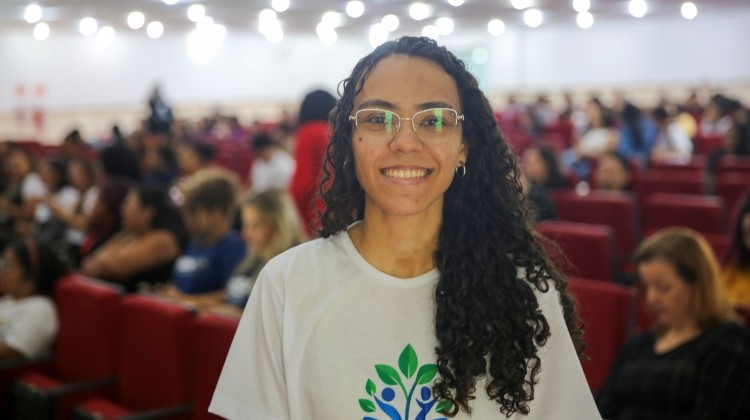
Representante dos bolsistas na mesa de abertura, Evelyn Andrade de Oliveira, do 8º período de Letras/Inglês, contou que chegou à escola com medo de assumir uma turma e que, no início, tinha receio até de ficar de costas para os alunos para escrever no quadro. “No Pibid, consegui dar aula sozinha, fazer trabalhos com os alunos, pesquisas. Também consegui escrever um artigo. O Pibid contribuiu para a minha formação como professora, mas também para a minha formação como pessoa.”
Também participaram da mesa de honra o pró-reitor de Extensão e Cultura, Marco Amaro; e o diretor de Apoio à Formação Acadêmica, Francisco Assis Pinheiro. As professoras Elisandra Moreira de Lira e Edilene da Silva Ferreira representaram, respectivamente, os coordenadores de área e os supervisores do Pibid.

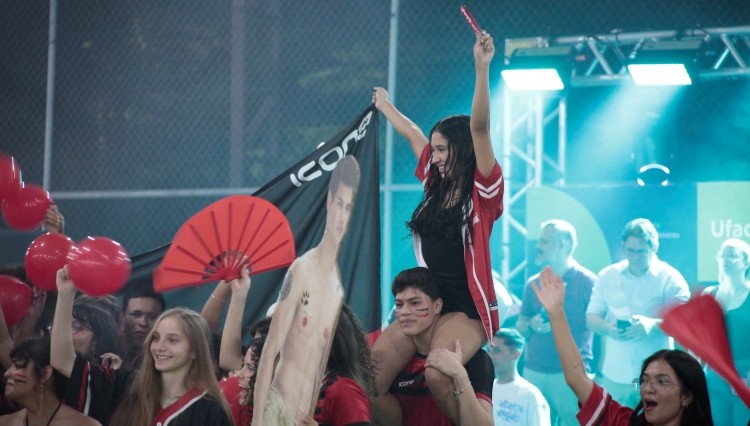
A Ufac realizou a abertura da 9ª edição dos Jogos Interatléticas. O evento ocorreu na sexta-feira, 6, na quadra poliesportiva, campus-sede, reunindo atletas, torcidas e gestores para celebrar a integração entre os cursos e o espírito esportivo. As disputas ocorrem em diversas modalidades.
“Hoje é um dia de muita alegria. Um dos compromissos da nova gestão na campanha foi que o esporte universitário fosse sempre tratado com muito carinho e com muito respeito dentro da administração”, disse o reitor Josimar Ferreira. Ele destacou a articulação da universidade com parlamentares para fortalecer a área. “O deputado federal Pedro Longo, que está eleito, assume o compromisso de apoiar o esporte universitário.”
O pró-reitor de Extensão e Cultura, Marco Amaro, reforçou a necessidade da competição para os discentes. “A formação de nossos alunos não é só em sala de aula. As atividades de esporte e cultura são complementares.”
Também participaram da solenidade o diretor de Arte, Cultura e Integração Comunitária, Givanildo Ortega; o ex-presidente do DCE, Richard Brilhante; o presidente da Liga das Atléticas, Micael Cabral; e o deputado estadual e federal eleito Pedro Longo (MDB).
(Fhagner Soares, estagiário Ascom/Ufac)

O Parque Zoobotânico (PZ) da Ufac promoveu o curso Tomografia de Impulso Ultrassônico Aplicada ao Diagnóstico Não Destrutivo de Árvores, ministrado pelo professor Moisés Lobão. A ação ocorreu na quarta-feira, 4, na sala ambiente e floresta do PZ, reunindo 16 participantes: servidores do parque, estudantes do programa de pós-graduação em Ciência Florestal e técnicos da Secretaria Municipal de Meio Ambiente (Semeia) e do Instituto de Meio Ambiente do Acre (Imac).
O curso teve como objetivo capacitar os participantes no uso do tomógrafo de impulso RINN-ABT06-P (sistema Arbotom). O equipamento avalia a saúde interna e a integridade do tronco e identifica apodrecimentos, ocos e outras anomalias sem cortar ou danificar a árvore.
A atividade consistiu em aula teórica e prática, com grupos que foram a campo para medir árvores do PZ, realizando inspeção visual, definição da altura de medição, instalação dos sensores, teste de sinal, coleta de dados, verificação da qualidade das medições e interpretação dos tomogramas para subsidiar laudos técnicos.
Os técnicos da Semeia e do Imac presentes na capacitação atuam no licenciamento e na fiscalização ambiental e analisam, entre outras demandas, pedidos de poda e supressão de árvores em vias, escolas e prédios públicos.
Funcionamento do tomógrafo
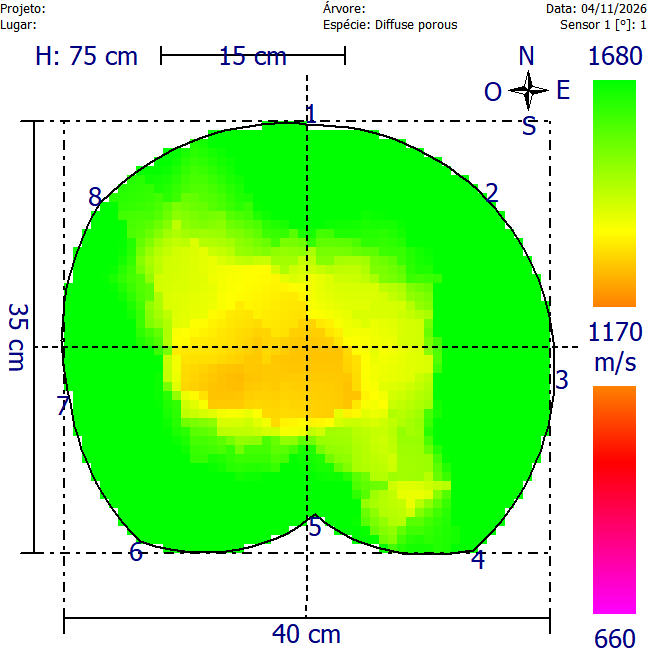
Sensores são fixados ao redor do tronco e, com um martelo de impacto, o operador bate em cada um deles. O aparelho registra o tempo que a onda leva para atravessar a madeira até os demais sensores. Em regiões comprometidas, a onda se propaga mais devagar. A partir desses dados, o software gera um tomograma, uma imagem colorida da seção transversal do tronco que mostra onde estão as áreas degradadas e qual é sua extensão.


 ACRE7 dias ago
Alunos do ensino médio visitam Laboratório de Sementes da Ufac — Universidade Federal do Acre
 ACRE7 dias ago
Ufac realiza Jornada das Profissões para alunos do ensino médio — Universidade Federal do Acre
 ACRE6 dias ago
Letras/Inglês debate o local e o global em sua 8ª Semana Acadêmica — Universidade Federal do Acre
 ACRE6 dias ago
Reitor da Ufac participa de encontro sobre censo da educação superior — Universidade Federal do Acre


Warning: Undefined variable $user_ID in /home/u824415267/domains/acre.com.br/public_html/wp-content/themes/zox-news/comments.php on line 48
You must be logged in to post a comment Login