
ACRE
‘We knew Christmas before your ancestors’

 AFP
AFPForty years on from the original recording, the cream of British and Irish pop music past and present are once again asking whether Ethiopians know it is Christmas.
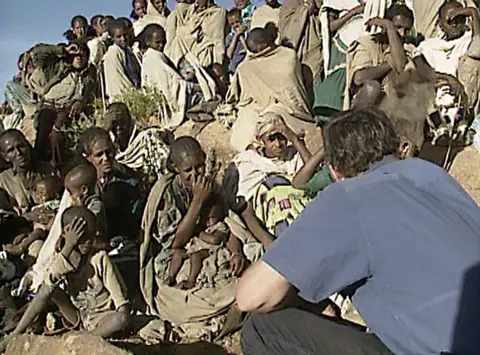
In 1984, responding to horrific images of the famine in northern Ethiopia broadcast on the BBC, musicians Bob Geldof and Midge Ure corralled some of the biggest stars of the era to record a charity song.
The release of the Band Aid single, and the Live Aid concert that followed eight months later, became seminal moments in celebrity fundraising and set a template that many others followed.
Do They Know It’s Christmas? is back on Monday with a fresh mix of the four versions of the song that have been issued over the years.
But the chorus of disapproval about the track, its stereotypical representation of an entire continent – describing it as a place “where nothing ever grows; no rain nor rivers flow” – and the way that recipients of the aid have been viewed as emaciated, helpless figures, has become louder over time.
“To say: ‘Do they know it’s Christmas?’ is funny, it is insulting,” says Dawit Giorgis, who in 1984 was the Ethiopian official responsible for getting the message out about what was happening in his country.
His incredulity decades on is obvious in his voice and he remembers how he and his colleagues responded to the song.
“It was so untrue and so distorted. Ethiopia was a Christian country before England… we knew Christmas before your ancestors,” he tells the BBC.
But Mr Dawit has no doubt that the philanthropic response to the BBC film, by British journalist Michael Buerk and Kenyan cameraman Mohamed Amin, saved lives.

 Getty Images
As the head of Ethiopia’s Relief and Rehabilitation Commission he had managed to smuggle the TV crew into the country. This was despite the government at that time, which was marking 10 years of Marxist rule and fighting a civil war, not wanting news of the famine to get out.
“The way the British people responded so generously strengthened my faith in humanity,” he says, speaking from Namibia where he now works.
He praises the “young and passionate people” behind Band Aid – describing them as “amazing”.
His questioning of the song, whilst also recognising its impact, sums up the debate for many who might feel that when lives need to be saved the ends justify the means.
Geldof was typically robust in defending it responding to a recent article in The Conversation about the “problematic Christmas hit”.
“It’s a pop song [expletive]… The same argument has been made many times over the years and elicits the same wearisome response,” he is quoted as saying.
“This little pop song has kept hundreds of thousands if not millions of people alive.”
He also recognises that Ethiopians celebrate Christmas but says that in 1984 “ceremonies were abandoned”.
In an email to the BBC, Joe Cannon, the chief financial officer of the Band Aid Trust, said that in the past seven months the charity has given more than £3m ($3.8m) helping as many as 350,000 people through a host of projects in Ethiopia, as well as Sudan, Somaliland and Chad.
He adds that Band Aid’s swift action as a “first responder” encourages others to donate where funds are lacking, especially in northern Ethiopia, which is once again emerging from a civil war.
But this is not enough to dampen the disquiet.
In the last week, Ed Sheeran has said he is not happy about his voice from the 2014 recording – made to raise funds for the West African Ebola crisis – being used as his “understanding of the narrative associated with this has changed”.
He was influenced by British-Ghanaian rapper Fuse ODG, who himself had refused to take part a decade ago.
“The world has changed but Band Aid hasn’t,” he told the BBC’s Focus on Africa podcast this week.
“It’s saying there’s no peace and joy in Africa this Christmas. It’s still saying there’s death in every tear,” he said referring to the lyrics of the 2014 version.
“I go to Ghana every Christmas… every December so we know there’s peace and joy in Africa this Christmas, we know there isn’t death in every tear.”
Fuse ODG does not deny that there are problems to be resolved but “Band Aid takes one issue from one country and paints the whole continent with it”.
The way that Africans were portrayed in this and other fundraising efforts had had a direct effect on him, he said.
When growing up “it was not cool to be African in the UK… [because of] the way that I looked, people were making fun of me”, the singer said.
Research into the impact of charity fundraisers by British-Nigerian King’s College lecturer Edward Ademolu backs this up.
He himself remembers the short films shot in Africa by Comic Relief, which had been influenced by Band Aid, and that his “African peers at [a British] primary school would passionately deny their African roots, calling all Africans – with great certainty – smelly, unintelligent and equated them to wild animals”.
Images of dangerously thin Africans became common currency in efforts to elicit funds.
The cover for the original Band Aid single, designed by pop artist Sir Peter Blake, features colourful Christmas scenes contrasted with two gaunt Ethiopian children, in black and white, each eating what looks like a life-saving biscuit.
For part of the poster for the Live Aid concert the following year, Sir Peter used a photograph of the back of an anonymous, naked, skeletal child.
That image was used again in the art work for the 2004 release and it has appeared once more this year.
For many working in the aid sector, as well as academics who study it, there is shock and surprise that the song and its imagery keep coming back.
The umbrella body Bond, which works with more than 300 charities including Christian Aid, Save the Children and Oxfam, has been very critical of the release of the new mix.
“Initiatives like Band Aid 40 perpetuate outdated narratives, reinforce racism and colonial attitudes that strip people of their dignity and agency,” Lena Bheeroo, Bond’s head of anti-racism and equity, said in a statement.
Geldof had previously dismissed the idea that Band Aid’s work was relying on “colonial tropes”.
The way that charities raise funds has undergone big changes in recent years.
 Getty Images
While remaining critical, Kenyan satirist and writer Patrick Gathara, who often mocks Western views of Africa, agrees things have shifted.
“There has been a push within humanitarian agencies to start seeing people in a crisis first as human beings and not as victims, and I think that’s a big, big change,” he tells the BBC.
“In the days of Live Aid, all you really had were these images of starvation and suffering… the idea that these are people were incapable of doing anything for themselves and that was always a misconception.”
The fallout from the Black Lives Matter protests added impetus to the change that was already happening.
A decade ago, a Norwegian organisation Radi-Aid made it its mission to highlight the way that Africa and Africans were presented in fundraising campaigns using humour.
For example, it co-ordinated a mock campaign to get Africans to send radiators to Norwegians who were supposedly suffering in the cold.
In 2017, Sheeran himself won one of their “Rusty Radiator” awards for a film he made for Comic Relief in Liberia in which he offered to pay for some homeless Liberian children to be put up in a hotel room.
The organisers of the awards said “the video should be less about Ed shouldering the burden alone but rather appealing to the wider world to step in”.
University of East Anglia academic David Girling, who once wrote a report for Radi-Aid, argues that its work is one of the reasons that things have shifted.
More and more charities are introducing ethical guidelines for their campaigns, he says.
“People have woken up to the damage that can be caused,” he tells the BBC.
Prof Girling’s own research, carried out in Kibera, a slum area in Kenya’s capital, Nairobi, showed that campaigns involving and centred on those who are the targets of the charitable assistance could be more effective than the traditional top down efforts.
Many charities are still under pressure to use celebrities to help raise awareness and money. The professor says that some media outlets will not touch a fundraising story unless a celebrity is involved.
But work by his colleague Martin Scott suggests that big stars can often distract from the central message of a campaign. Whereas the celebrity might benefit, the charity and the understanding of the issue that it is working on lose out.
If a Band Aid-type project were to get off the ground now it would have to be centred on African artists, music journalist Christine Ochefu tells the BBC.
“The landscape for African artists and African music has changed so much that if there was a new release it would need to come from afrobeats artists or amapiano artists or afro-pop artists,” she argues
“I don’t think people could get way without thinking about the sentiment and imagery associated with the project and it couldn’t continue the saviour narrative that Band Aid had.”
As King’s College academic Dr Ademolu argues: “Perhaps it’s time to abandon the broken record and start anew – a fresh tune where Africa isn’t just a subject, but a co-author, harmonising its own story.”
You may also be interested in:
 Getty Images/BBC

ACRE
Ufac retoma Semana Acadêmica de Física após 6 anos, com planetário — Universidade Federal do Acre

A Universidade Federal do Acre (Ufac) realiza até esta sexta-feira, 23, a 3ª Semana Acadêmica de Física, no prédio do curso, no campus-sede, em Rio Branco. Iniciado nessa segunda-feira, 19, o evento retoma as atividades presenciais da semana acadêmica após seis anos de interrupção, causada pela pandemia de covid-19 e pela reorganização do calendário universitário.
A programação tem atrações abertas ao público, como oficinas de astronomia, observação do Sol com telescópio e um planetário móvel, instalado no segundo andar do prédio de Física. Há ainda palestras, apresentações de pesquisas de estudantes e minicursos práticos de elaboração de material didático, física experimental, criação de mapas, processamento de dados e sismologia.
Organizada em três eixos temáticos, a semana é voltada aos estudantes da licenciatura e do bacharelado em Física e do curso de Física Aplicada às Ciências da Terra. Os primeiros dias tiveram debates e palestras sobre o ensino de física e a formação docente. Em seguida, a programação trata de física pura, como mecânica quântica, relatividade e física de partículas, e termina com geofísica, astronomia e fenômenos naturais.
Segundo o coordenador do evento e professor do curso de Física, Victor Carreira, a retomada presencial reaproxima o curso da comunidade externa e das escolas de educação básica. Turmas do Instituto Federal do Acre visitaram a semana, e escolas da rede pública foram convidadas.
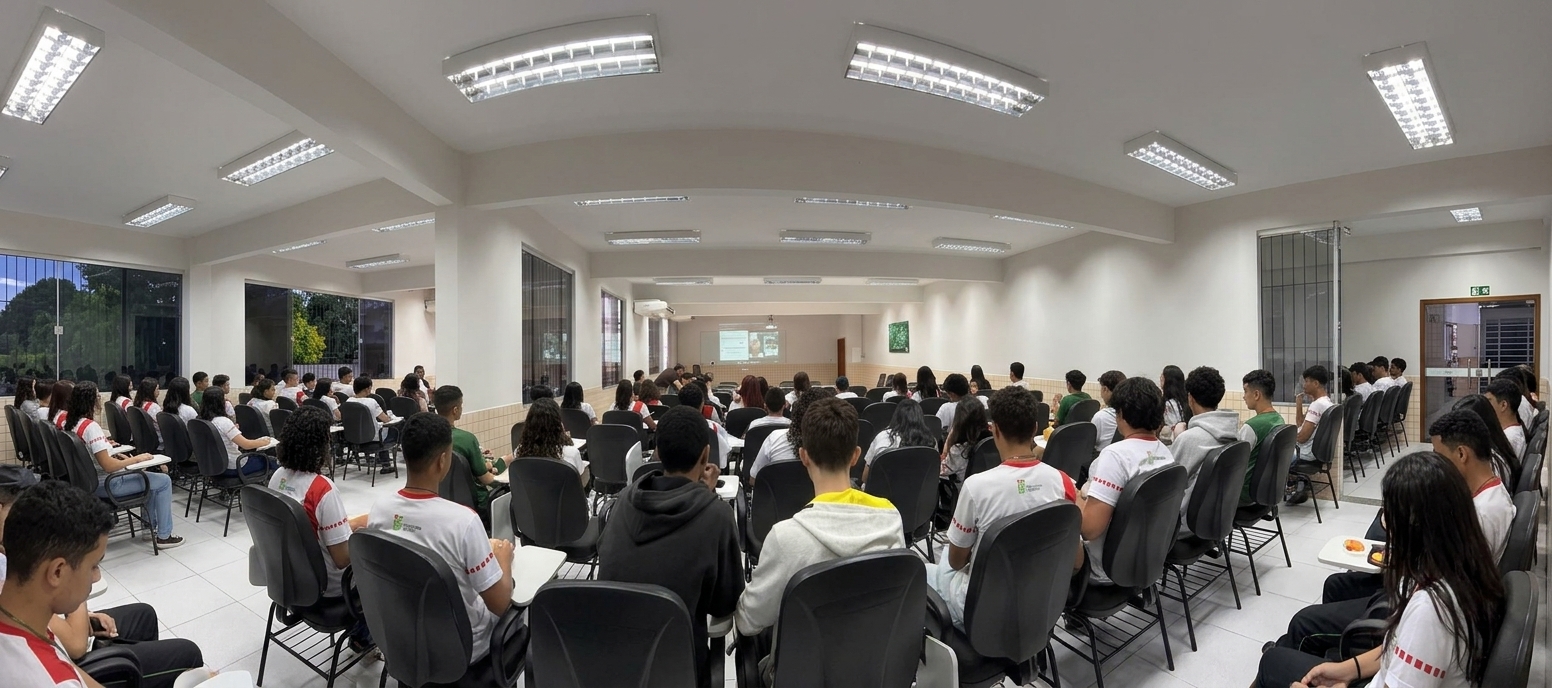
“A semana acadêmica é muito importante tanto para os nossos alunos quanto para a comunidade em geral de Rio Branco”, disse Carreira. “É uma oportunidade para jovens do ensino médio conhecerem a universidade e vivenciarem a ciência na prática.”
A cerimônia de encerramento ocorre nesta sexta-feira, 23, à tarde.
(Fhagner Soares, estagiário Ascom/Ufac)
ACRE
Pavic-Lab da Ufac apresenta seis trabalhos em congresso internacional de computação — Universidade Federal do Acre

Pesquisadores do projeto Pavic-Lab, da Universidade Federal do Acre (Ufac), apresentaram seis trabalhos científicos durante a Conference on Graphics, Patterns and Images (SIBGRAPI 2026), congresso internacional de referência nas áreas de computação gráfica, processamento de imagens e visão computacional, realizado de 29 de setembro a 2 de outubro, em Goiânia (GO). As pesquisas foram desenvolvidas no projeto de pesquisa e desenvolvimento (P&D) Pesquisas Aplicadas em Visão e Inteligência Computacional (Pavic-Lab), uma iniciativa de cooperação técnico-científica entre a Ufac, Motorola, Flextronics e Fundação de Apoio e Desenvolvimento ao Ensino, Pesquisa e Extensão Universitária no Acre (Fundape).
Segundo a professora do Centro de Ciências Exatas e Tecnológicas (CCET), Ana Beatriz Alvarez Mamani, a participação no congresso contribui para divulgar a produção científica desenvolvida no Acre e ampliar o intercâmbio com outras instituições. Ela destacou que a presença da Ufac em eventos científicos também ajuda a reduzir as desigualdades regionais na ciência brasileira, além de possibilitar novas parcerias e o aperfeiçoamento das pesquisas.
A equipe foi composta pela professora Ana Beatriz Alvarez Mamani, pelo pesquisador Quefren Leher, pelos mestrandos do Programa de Pós-Graduação em Ciência da Computação (PPGCC) Clécio Silva, Lucas Carvalho, Gustavo Ferreti, Julio Martins e Ian Teixeira, além do graduando em Sistemas de Informação Kauã Galvão de Macedo.
Dos seis trabalhos apresentados, um integrou uma sessão especial do congresso e já foi publicado na revista científica Computers & Graphics. Outros três foram apresentados na programação principal, com previsão de publicação nos anais do Instituto de Engenheiros Eletricistas e Eletrônicos (IEEE) e na biblioteca digital da Sociedade Brasileira de Computação (SBC). Os dois trabalhos restantes foram apresentados em workshops, também com previsão de publicação na biblioteca digital da SBC.
As pesquisas estão divididas em duas áreas principais: reconstrução tridimensional e processamento de imagens. Na primeira, Clécio Silva apresentou um método computacional para criar representações digitais mais detalhadas de ambientes internos a partir de imagens. A tecnologia pode ser aplicada em jogos, realidade virtual e aumentada, simulações e projetos da construção civil.
Na área de processamento de imagens, Lucas Carvalho apresentou uma pesquisa para reconstruir imagens de alta faixa dinâmica (HDR) a partir de uma única imagem convencional, buscando recuperar detalhes em regiões claras e escuras. Gustavo Ferreti desenvolveu uma rede neural para combinar imagens com diferentes níveis de exposição e melhorar a qualidade visual dos resultados.
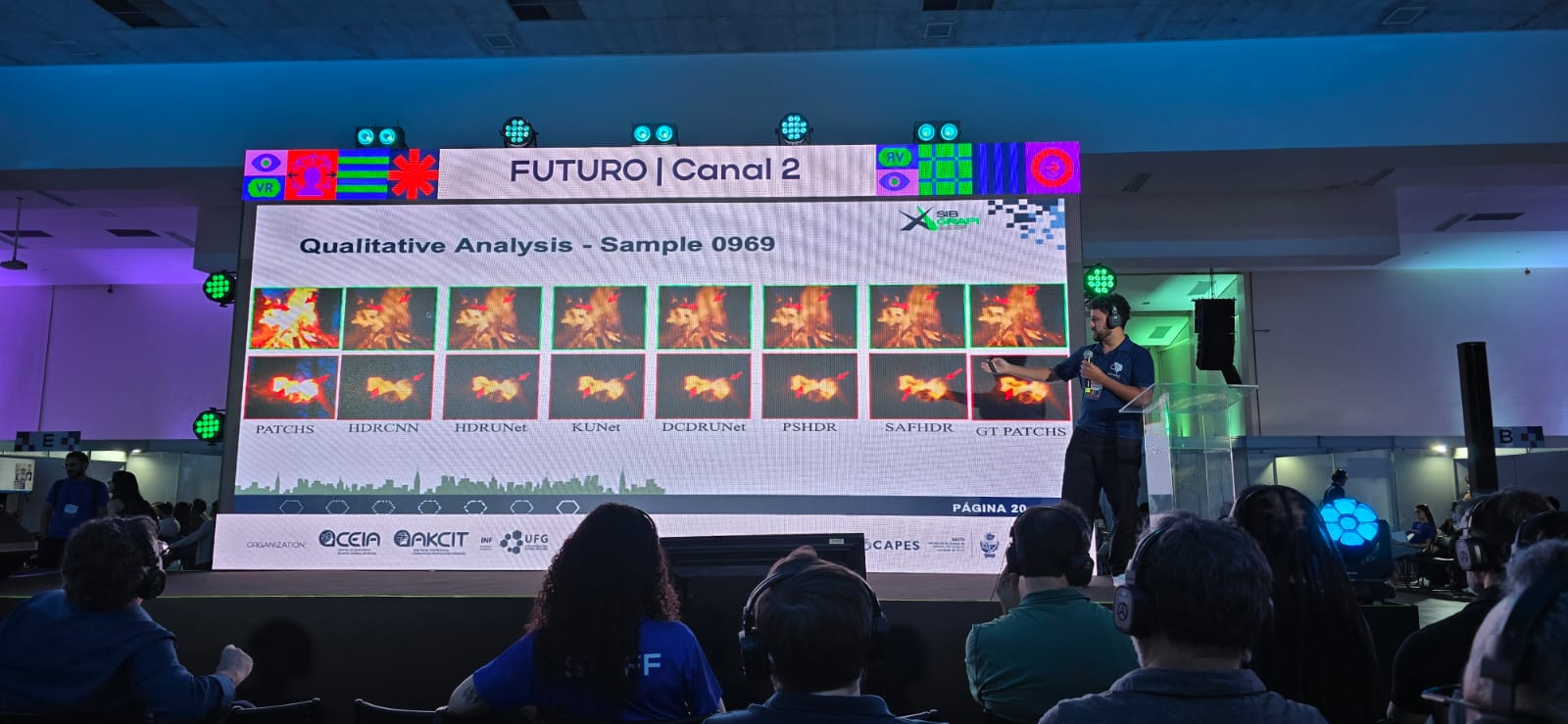
Julio Martins apresentou uma metodologia para reduzir o custo computacional da reconstrução de imagens HDR, preservando a qualidade das imagens produzidas. Ian Teixeira investigou o uso de mecanismos de atenção em modelos de inteligência artificial para recuperar informações em imagens de baixa qualidade. Já Kauã Galvão de Macedo apresentou uma abordagem que combina redes neurais e técnicas de processamento de sinais para melhorar imagens capturadas em ambientes com pouca iluminação.
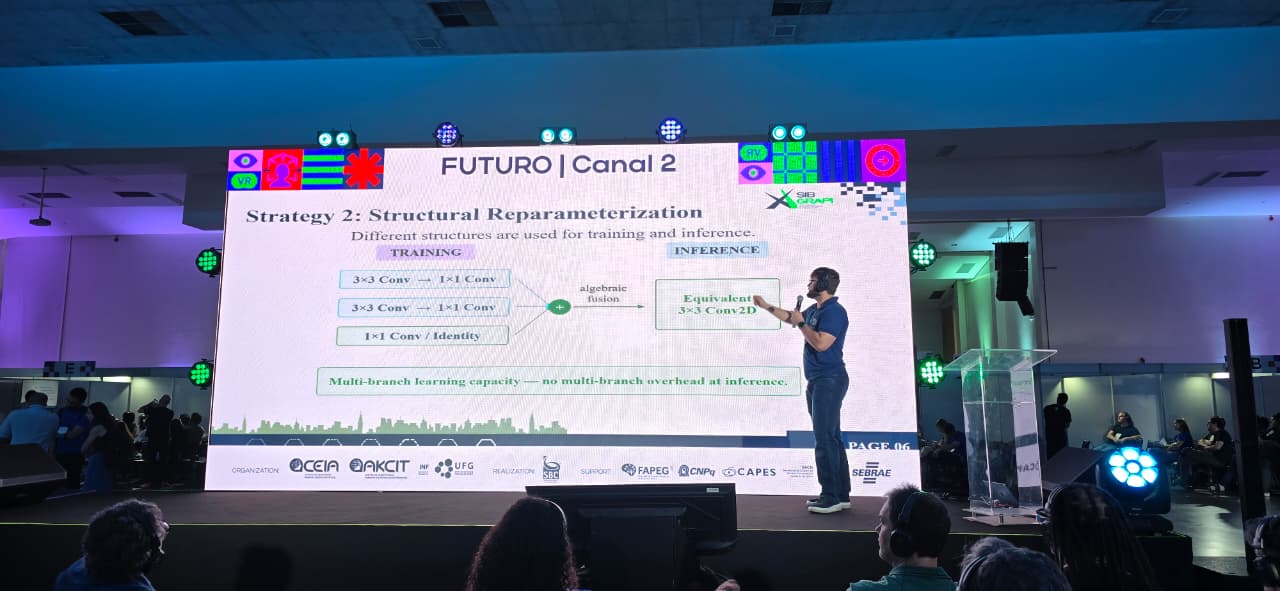
Os métodos desenvolvidos apresentam potencial de aplicação em sistemas embarcados com recursos computacionais limitados, como dispositivos eletrônicos que integram processamento de imagens, permitindo aprimorar a qualidade visual com menor demanda de processamento.
Para o graduando Kauã Galvão de Macedo, a participação no congresso proporcionou a oportunidade de apresentar os resultados de sua pesquisa e conhecer novas abordagens científicas. “Foi uma ótima experiência, tanto pela oportunidade de apresentar minhas pesquisas desenvolvidas na Ufac quanto pela troca de conhecimentos com pesquisadores de outras instituições”, afirmou.
Segundo Kauã, as discussões realizadas durante o evento possibilitaram o contato com técnicas que poderão contribuir para suas pesquisas e para os projetos desenvolvidos pelo Pavic-Lab, além de abrir oportunidades de colaboração científica.
O mestrando em Ciência da Computação Gustavo de Souza Ferreti também destacou a importância da experiência para sua formação acadêmica. “Tive a oportunidade gratificante de conhecer professores e pesquisadores com ampla trajetória no nosso campo, além de ouvir sobre suas vivências e receber orientações valiosas para aprimorar meu trabalho”, disse.
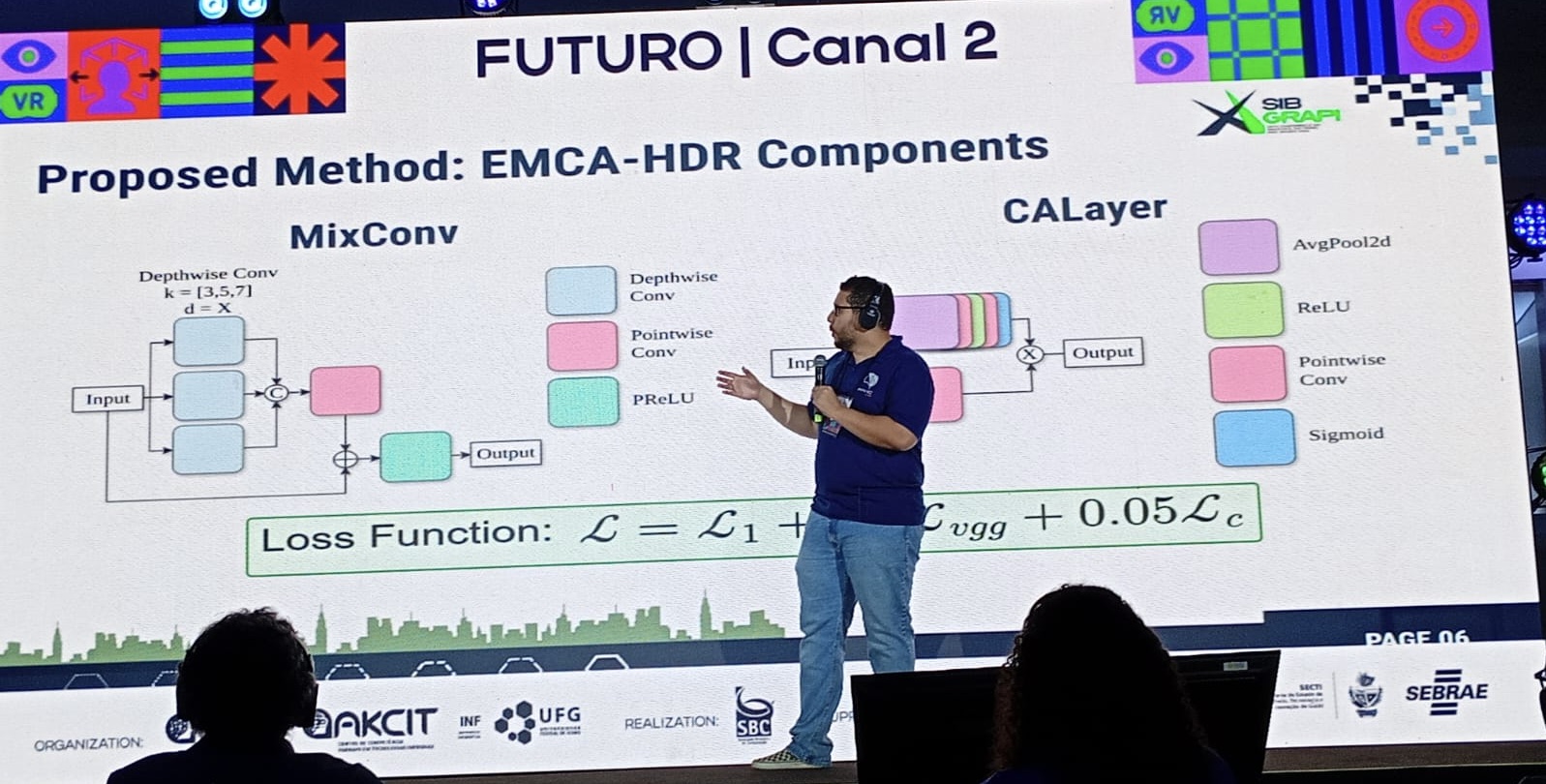
O Pavic-Lab desenvolve atividades de pesquisa voltadas ao processamento de imagens, ao aprimoramento da qualidade visual e à reconstrução tridimensional de ambientes e objetos. Após a participação no congresso, a equipe dará continuidade às pesquisas científicas, com novos experimentos e avaliações para aperfeiçoar os métodos, reduzir custos computacionais e ampliar as possibilidades de aplicação prática dos resultados.
Warning: Undefined array key 0 in /home/u824415267/domains/acre.com.br/public_html/wp-content/themes/zox-news/single.php on line 591
Warning: Attempt to read property "cat_name" on null in /home/u824415267/domains/acre.com.br/public_html/wp-content/themes/zox-news/single.php on line 591
6 dias agoEstudantes de Jornalismo da Ufac ensinam audiovisual a moradores da Reserva Cazumbá-Iracema — Universidade Federal do Acre


 ACRE6 dias ago
Ufac promove ação de prevenção à saúde da mulher durante o Outubro Rosa — Universidade Federal do Acre
 ACRE4 dias ago
Ufac abre 1ª Conferência Internacional Amazônia Nexus — Universidade Federal do Acre
 ACRE3 dias ago
Pavic-Lab da Ufac apresenta seis trabalhos em congresso internacional de computação — Universidade Federal do Acre


Warning: Undefined variable $user_ID in /home/u824415267/domains/acre.com.br/public_html/wp-content/themes/zox-news/comments.php on line 48
You must be logged in to post a comment Login