
ACRE
Why Do We Need Mining Law Reform? Just Look to Grand Canyon’s Pinyon Plain Mine. · National Parks Conservation Association

The 1872 Mining Law – yes, that’s when it was written! – is out of date. NPCA is among the groups advocating for mining law reform to better protect national parks and public health.
The interconnected canyons, watersheds, wildlife habitat and cultural resources that make up the Grand Canyon don’t stop at the borders of iconic Grand Canyon National Park, which millions of people from around the world visit every year. The park offers protection within its boundaries, yet much more is needed to ensure the long-term health of the landscape and the Indigenous communities that have deep connections to it.
For years, uranium mining threatened the region’s health and safety. Then, in August 2023, decades of relentless advocacy led by the Grand Canyon Tribal Coalition (see sidebar) resulted in the designation of Baaj Nwaavjo I’tah Kukveni – Ancestral Footprints of the Grand Canyon National Monument.
Many Tribal Nations and conservationists cheered. But a 150-year-old law — created when people in power didn’t consider the rights and sovereignty of Tribal Nations and viewed public lands primarily as resources to be exploited — allowed the Pinyon Plain Uranium Mine to begin extracting uranium in January 2024 within the boundaries of the newly designated national monument.
How could this happen on lands that were supposed to be protected from such threats?
While public support for preserving landscapes such as the Grand Canyon has grown since the 19th century, the 1872 Mining Law hasn’t kept up with the times. That is why many groups, including the National Parks Conservation Association, are advocating for mining law reform to better protect all national parks and public health.
What is Baaj Nwaavjo I’tah Kukveni – Ancestral Footprints of the Grand Canyon National Monument?
Baaj Nwaavjo means “where Tribes roam” in Havasupai, and I’tah Kukveni means “our footprints” in Hopi. This national monument in Arizona was designated by the Biden administration in 2023 to conserve nearly 1 million acres of the greater Grand Canyon landscape sacred to many Indigenous peoples. It consists of three distinct areas bordering Grand Canyon National Park, two located north of the Grand Canyon near Grand Staircase, Vermilion Cliffs and Pipe Spring national monuments and one area to the south. It extends protection of the Grand Canyon watershed beyond the national park’s boundaries. Rugged and largely undeveloped, the monument offers 360-degree views of some of the West’s most remote and secluded landscapes.
The monument is home to endangered species, such as the California condor, and endemic wildlife, including the Kaibab monkey grasshopper, and it protects vital water sources that feed the Grand Canyon’s rivers and creeks. Places of deep cultural significance are found throughout the area, representing thousands of years of history and traditions.
Where is uranium being mined within the national monument?
Energy Fuels began extracting uranium this year from the Pinyon Plain Mine (formerly known as the Canyon Mine), though the mine operators received permitting from the U.S. Forest Service in the 1980s. The mine is located less than 10 miles from Grand Canyon National Park and near Red Butte or “Wii’i Gdwiisa,” a traditional cultural property that is sacred to the Havasupai Tribe. The uranium from this type of mine is typically processed for use in nuclear energy production.
What are the risks associated with the Pinyon Plain Uranium Mine?
A toxic legacy of uranium mining in the Southwest, particularly on Tribal lands, has left a dangerous history of environmental contamination and health risks through radiation exposure that have affected generations of people with disproportionate rates of cancer across communities.
Kaibab squirrel
The Kaibab squirrel is found only on the Kaibab Plateau in Northern Arizona, including the North Rim of Grand Canyon National Park.
NPS/Allyson Mathis
One of the primary issues is water contamination, with growing concerns over impacts to below-ground aquifers that feed the Grand Canyon’s springs. The mine sits above two aquifers: the Coconino aquifer, located just 941 feet below the surface, and the Redwall-Muav aquifer. Its proximity to Grand Canyon National Park threatens the park’s springs and creeks that are crucial water sources for area residents and visitors, as well as flora and fauna. The mine poses a particular threat to sensitive and endangered species, such as the California condor, Mexican spotted owl and Kaibab monkey grasshopper.
These environmental risks and their impact on Tribal communities have fueled decades-long opposition by the Havasupai Tribe and other Tribal Nations. Local communities have expressed strong opposition, too, with city and county officials echoing Tribal concerns, residents protesting along the uranium transport route, and the Navajo Nation opposing the transport of uranium across its lands.
What is the history of uranium mining in the Grand Canyon region?
Uranium mining in the Grand Canyon region dates back to the 1950s. One of the most infamous examples is the abandoned Orphan Mine, which operated through the 1960s at the South Rim of the Grand Canyon near the national park’s headquarters. Its uranium contaminated nearby water sources, including Horn Creek and Salt Creek, which are now undrinkable along a significant stretch of the historic Tonto Trail. This site remains a stark reminder of the long-term environmental damage that uranium mining can cause.
The broader impacts of uranium mining throughout the Southwest have disproportionately affected Tribal Nations, whose communities are near mining operations, transportation routes and processing facilities. Toxic waste left behind at abandoned mines has led to high rates of cancer and related illnesses, which have affected communities for generations.
In 2012, NPCA played a key role in securing a 20-year moratorium on new uranium mining claims near the Grand Canyon, which was an important step in protecting the surrounding landscape. The new national monument was intended to build on that moratorium by permanently protecting the Grand Canyon’s rivers, springs, waterfalls and creeks from future uranium mining pollution, while preserving cultural and archaeological areas.
But the Pinyon Plain Mine continues to operate, prompting widespread calls for its closure and highlighting the urgent need for mining law reform to better protect national parks and monuments.
Doesn’t a national monument protect an area from mining?
Many people advocated for the creation of the national monument to prevent uranium mining in the region — and the designation stopped hundreds of mine claims from moving forward. Yet the Pinyon Plain Mine was allowed to continue operations due to a legal exemption.
Most mine claims on public lands are governed under the 1872 Mining Law, passed over 150 years ago. The law allows mining operations to continue for existing mining claims with “valid existing rights.” These are treated as private property rights under 1872 the Mining Law, meaning certain mine claims are excluded from new regulations, even on national park land. The Pinyon Plain Mine fits that definition.
Do these ‘exclusions’ apply to all national parks and monuments?
It depends. A new monument designation often includes a mineral withdrawal, a formal process that “withdraws” the land from being governed by the 1872 Mining Law and bans any new mining claims, including unvalidated claims. However, the mine claims at Pinyon Plain had what are known as “valid existing rights.”
A “valid existing right” refers to a mine that has gone through a process to prove there is a mineral deposit present and that it is economically viable to extract. Once a mine claim is “validated,” it resembles private property, meaning the right to mine cannot be revoked even if that land is given new protections.
Can a mine be stopped?
There are a few narrow pathways to stop mining operations for claims with valid existing rights. One approach is to purchase the mine claim and compensate the claim holder for the value of the mineral deposit.
Tonto Trail – Grand Canyon National Park
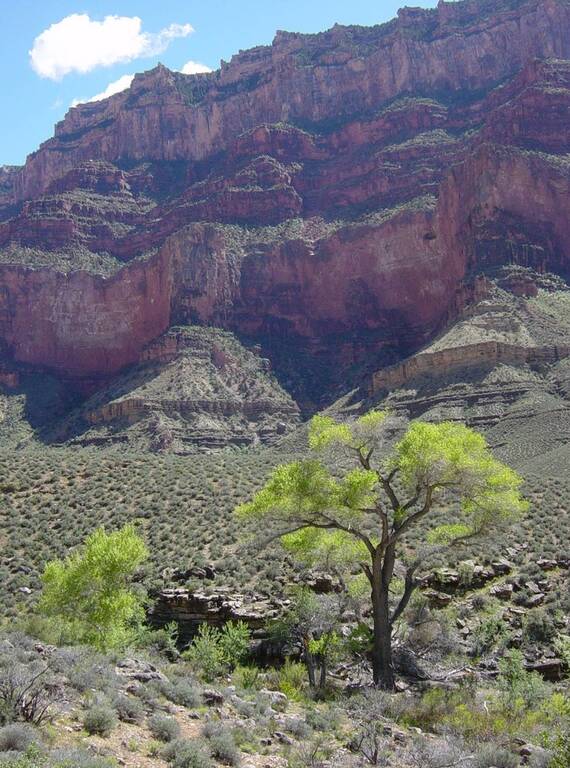
Cottonwood trees grow at a spring along the Tonto Trail in Grand Canyon National Park. Water along a significant stretch of the trail is undrinkable because of uranium contamination.
NPS/Michael Quinn
This happened at Grand Staircase-Escalante National Monument, when the Clinton administration purchased mining claims before the monument’s designation. However, this can be a costly and complicated process and is not that common. As a result, thousands of mine claims currently exist within the boundaries of national parks and monuments, highlighting the need for updates to the 1872 Mining Law.
While mining reform is essential for long-term protection of all national parks and monuments, immediate action is needed. In late September, Arizona Gov. Katie Hobbs asked the U.S. Forest Service for an updated environmental review of the Pinyon Plain Mine. NPCA is calling on the Biden administration and Arizona’s Gov. Katie Hobbs to close the Pinyon Plain Uranium Mine.
How would closing the mine benefit the monument and nearby communities?
Closing the Pinyon Plain Mine will protect the Grand Canyon’s water from uranium contamination, which is particularly important for the Havasupai Tribe’s Village of Supai. Closing the mine will also benefit neighboring communities, including the Navajo Nation and the White Mesa Ute Community of the Ute Mountain Ute Tribe, by preventing the transportation and processing of uranium.
What other mines within national parks or monuments are a concern?
The Pinyon Plain Mine is the most urgent threat within the National Park System, but several other parks and protected areas face similar threats from mining operations and exploration.
Mining companies are currently exploring or developing operations within or near Ash Meadows National Wildlife Refuge, Mojave National Preserve and Canyonlands National Park, including areas with delicate ecosystems, water sources and cultural sites.
Updating the 1872 Mining Law could prevent future mining conflicts with national parks and ensure that mines like Pinyon Plain are subject to modern regulations, including paying royalties, higher claim fees and eventual cleanup costs.
In strong support of our Tribal partners
NPCA stands in strong support of our Tribal partners, who have been vocal advocates for the closure of the Pinyon Plain Mine. It is also important to ensure that Baaj Nwaavjo I’tah Kukveni – Ancestral Footprints of the Grand Canyon National Monument is managed with Tribal co-stewardship, a key inclusion in its 2023 proclamation as well as respect for cultural values and sites. It is and always has been a key part of the long-term vision for the monument.


Warning: Undefined variable $user_ID in /home/u824415267/domains/acre.com.br/public_html/wp-content/themes/zox-news/comments.php on line 48
You must be logged in to post a comment Login