ACRE
Rumble in the Jungle 50 years on: how Ali danced rings around apartheid | Muhammad Ali
PUBLICADO
2 anos atrásem
Fifty years ago, in a corner of white South Africa, Muhammad Ali already seemed a miracle-maker. Deep in our strictly regimented and divided country, Ali danced rings around apartheid. I had first heard about the inspirational boxer from a black man, Cassius, who sold bottles of beer from the illegal shebeen he and his friends ran across the road from our house.
Cassius and his crew kept their illicit stash hidden in the drains outside the corner shop owned by an irritable Greek man. Whenever my football was booted over the garden wall, Cassius chased after it. After a dazzling display of slightly drunken footwork he would return the ball with a cackle. One day, while showcasing his trickery, he sang a strange song: “Ali, Ali, float like a butterfly, sting like a bee, Ali, Ali, Muhammad Ali.”
Cassius flicked rangy left jabs into the winter sunshine as his huge feet danced. He wore a pair of battered brown sandals that had split at the seams. They fluttered over the tar while the soles flapped in a jitterbug of their own. He pretended to be outraged when I asked who he was singing about: “You mean the baasie [Afrikaans for little boss] don’t know?” When I shook my head he became serious: “Ali is the heavyweight champion of the world.”
A thrill surged through me. Cassius told me how he was nicknamed after Ali – who had been born as Cassius Clay. I struggled to understand how one man could have two names. Cassius explained that the master boxer was a black American who dreamed up those happy bee and butterfly lines.
Years later, in 1974, when I had just turned 13, I learned that Ali had been stripped of his world title in 1967 when he refused to fight in the Vietnam war. But he had become even more of a mythical figure to me because Ali entranced our frightening Afrikaans teacher with the same spell he cast over Cassius.
When we summoned the courage to ask him why he liked Ali so much, while suspecting he was a staunch racist, the teacher softened. He spoke of the beauty and brilliance of Ali in the ring. Rather than being “one of our blacks”, Ali resembled the king of the world.
On 30 October 1974, Ali finally had a chance to regain the title when he faced George Foreman. We were agog that the fight would take place not too far from us, in Zaire [now the Democratic Republic of Congo].
The Rumble in the Jungle was promoted by Don King who underlined his ingenuity by taking the bout “back to Africa”. Zaire’s dictatorial President, Mobutu Sese Seko, agreed to pay the boxers an unprecedented $10m each.
Although the rest of Africa felt as far removed from our privileged suburb near Johannesburg as it did in Hertfordshire or New Hampshire, King brought the continent into our classrooms. Other kinder teachers confessed their fondness for Ali and favoured him over Foreman. Ali was also hailed by the black cleaners and gardeners who serviced the school and our homes. And the shebeen corner – from the Greek shop owner to the biggest drinkers – still belonged to him. Only Ali could forge such an alliance.
after newsletter promotion
No heavyweight was bigger or more threatening than Foreman, who had become world champion when demolishing Joe Frazier in two rounds. Frazier was so good he had beaten Ali in the Fight of the Century in 1971 – but he was blown away by Foreman who had a 40-0 record with 38 stoppages. Big George rained down bludgeoning punches, bringing sorrow to every fighter he faced. Only the 32-year-old Ali remained.
“Foreman by knockout,” I predicted mournfully. Maybe I made that pessimistic forecast because I feared so much for Ali. A quick knockout would save him from permanent damage. But Bennie da Silva, my friend’s dad and the only real boxing expert we knew, backed Ali. He was a stocky Portuguese man who made us laugh while flooring us with his ring knowledge.
He promised that Ali would dance the night away until Foreman was so dizzy he wouldn’t know what hit him. Ali would rumba through the rumble and be crowned world champion again.
Television was still banned in South Africa as the government regarded it as a tool of communist propaganda. So we could not watch the fight in the early hours of a spring morning. But we listened to games of English football on the BBC World Service every Saturday afternoon that meant our schoolyard was packed with staunch followers of Arsenal and Liverpool, Leeds and Manchester United.
My dad helped me tune into the BBC radio broadcast and, in bed, I trembled as Ali went into battle with the ogre. But I was stunned as, in the crackle and hiss of the wireless, Ali did not do the rumba. He simply refused to dance.
He not only stood still but, in an act of supposed madness, leaned against the ropes and allowed Foreman to hit him. Ali took every ruinous blow and still he stood, waving his man in and doing the “rope-a-dope” trick we would try to copy at school.
Then, as if he was as exultant as Cassius on the corner or Mr da Silva boxing in the kitchen, Ali began to pick off Foreman. Through the static and electrifying commentary it sounded like Ali was weaving a new kind of black magic.
Abruptly, near the end of the eighth round, it was all over. A cry reverberated from the tiny speaker, as penetrating as any factory siren: “Foreman is down! Foreman is down!” I tumbled in disbelief, wondering if there could be as much bliss in the hearts of Cassius and the scary Afrikaans teacher, wherever they were that memorable daybreak.
Ali, truly, was the king of the world and we felt proud that his coronation happened in Africa – from where, at last, we knew we really belonged.
Relacionado
VOCÊ PODE GOSTAR
ACRE
PZ da Ufac promove curso sobre uso do tomógrafo em árvores — Universidade Federal do Acre
PUBLICADO
1 dia atrásem
6 de novembro de 2026O Parque Zoobotânico (PZ) da Ufac promoveu o curso Tomografia de Impulso Ultrassônico Aplicada ao Diagnóstico Não Destrutivo de Árvores, ministrado pelo professor Moisés Lobão. A ação ocorreu na quarta-feira, 4, na sala ambiente e floresta do PZ, reunindo 16 participantes: servidores do parque, estudantes do programa de pós-graduação em Ciência Florestal e técnicos da Secretaria Municipal de Meio Ambiente (Semeia) e do Instituto de Meio Ambiente do Acre (Imac).
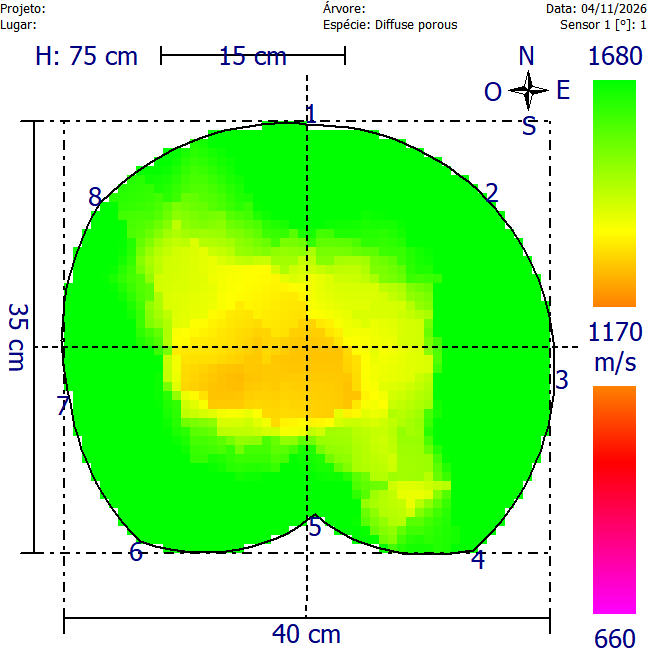
O curso teve como objetivo capacitar os participantes no uso do tomógrafo de impulso RINN-ABT06-P (sistema Arbotom). O equipamento avalia a saúde interna e a integridade do tronco e identifica apodrecimentos, ocos e outras anomalias sem cortar ou danificar a árvore.
A atividade consistiu em aula teórica e prática, com grupos que foram a campo para medir árvores do PZ, realizando inspeção visual, definição da altura de medição, instalação dos sensores, teste de sinal, coleta de dados, verificação da qualidade das medições e interpretação dos tomogramas para subsidiar laudos técnicos.
Os técnicos da Semeia e do Imac presentes na capacitação atuam no licenciamento e na fiscalização ambiental e analisam, entre outras demandas, pedidos de poda e supressão de árvores em vias, escolas e prédios públicos.
Funcionamento do tomógrafo
Sensores são fixados ao redor do tronco e, com um martelo de impacto, o operador bate em cada um deles. O aparelho registra o tempo que a onda leva para atravessar a madeira até os demais sensores. Em regiões comprometidas, a onda se propaga mais devagar. A partir desses dados, o software gera um tomograma, uma imagem colorida da seção transversal do tronco que mostra onde estão as áreas degradadas e qual é sua extensão.
Relacionado
Relacionado
ACRE
Ciências Contábeis debate auditoria e perícia em semana acadêmica — Universidade Federal do Acre
PUBLICADO
3 dias atrásem
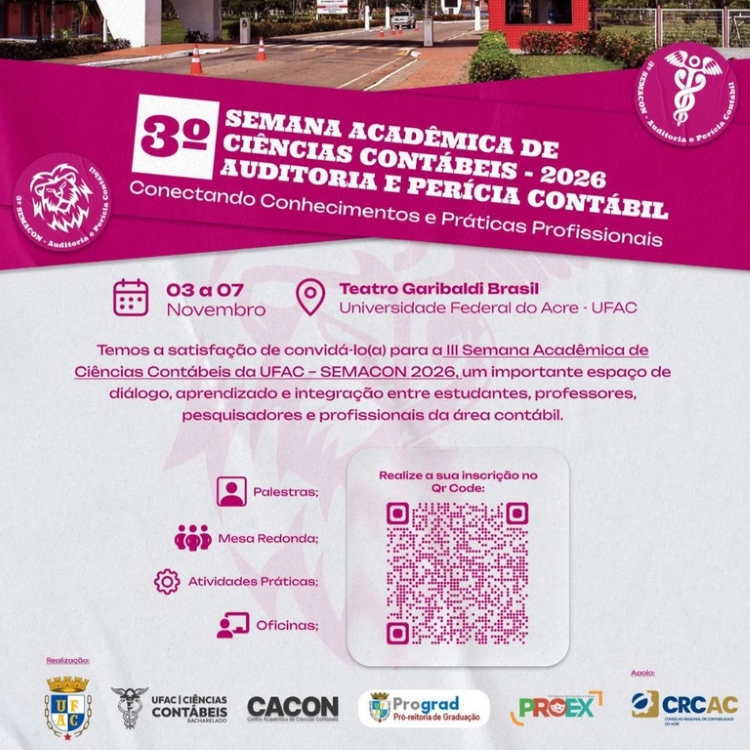
5 de novembro de 2026O curso de Ciências Contábeis da Ufac realizou, na terça-feira, 3, no anfiteatro Garibaldi Brasil, a abertura da sua 3ª Semana Acadêmica (Semacon), com o tema “Auditoria e Perícia Contábil: Conectando Conhecimentos e Práticas Profissionais”. O evento continua até sábado, 7, com palestras, mesa-redonda, atividades práticas e oficinas. A programação visa aproximar a teoria acadêmica das demandas reais do mercado.
“Preparamos uma programação diversificada para ampliar as perspectivas de nossos acadêmicos e reforçar o compromisso da universidade”, disse o coordenador do evento, Marconde Silva. “Queremos que essa semana seja um marco de valorização do curso e da profissão.”
Também compuseram o dispositivo de honra na abertura do evento o pró-reitor de Extensão e Cultura, Marco Amaro (representando o reitor Josimar Ferreira); a pró-reitora de Graduação, Danila Torres; o diretor do CCJSA, Francisco Raimundo Neto; a coordenadora do curso de Ciências Contábeis, Oleides de Oliveira; a presidente do CA de Ciências Contábeis, Hanara Ferreira; e o presidente do CRC-AC, Edberto Gomes.
(Camila Barbosa, estagiária Ascom/Ufac)
Relacionado
PESQUISE AQUI
MAIS LIDAS
ACRE5 dias agoAlunos do ensino médio visitam Laboratório de Sementes da Ufac — Universidade Federal do Acre
ACRE4 dias agoUfac realiza Jornada das Profissões para alunos do ensino médio — Universidade Federal do Acre
ACRE4 dias agoLetras/Inglês debate o local e o global em sua 8ª Semana Acadêmica — Universidade Federal do Acre
ACRE4 dias agoReitor da Ufac participa de encontro sobre censo da educação superior — Universidade Federal do Acre
Warning: Undefined variable $user_ID in /home/u824415267/domains/acre.com.br/public_html/wp-content/themes/zox-news/comments.php on line 48
You must be logged in to post a comment Login