
ACRE
The 2024 Elections: After record-breaking elections, the number of women in Congress is stagnating

While previous elections have seen significant increases in the number of women represented in the US House and Senate, Samantha Pettey predicts that the 2024 elections will see no additional women in the Senate, and potentially only a very small increase or even a decrease in the number of women in the House. One possible reason for this trend could be that women are running more strategically in races where they have a higher probability of success. Focusing on the only woman vs woman toss-up election this cycle, in Oregon’s 5th Congressional District, she writes that the candidates are largely appealing to the electoral middle and are stressing bipartisanship.
- This article is part of ‘The 2024 Elections’ series curated by Peter Finn (Kingston University). Ahead of the 2024 election, this series is exploring US elections at the state and national level. If you are interested in contributing to the series, contact Peter Finn (p.finn@kingston.ac.uk).
As we enter the final days of the campaign, attention at the top of the ticket for the 2024 presidential election is high – yet control of the 119th Congress is also at stake. Which party has control of Congress is just as important for governance and forecasts to control the House and Senate find that these elections are also extremely close. While previous elections have seen a growing number of women seated in Congress, what is the likelihood of this trend continuing into the 119th Congress? And what can a deep dive into the only woman versus woman toss-up race in the House tell us about how women get elected to Congress?
No additional women in the Senate in 2025
Currently, women make up 25 percent of seats in the Senate, but only 1/3 of seats in the chamber are up for grabs in any given election year, and therefore, 13 women Senators are not up for reelection. Further, an additional ten women are running in “likely” and “lean” states in which many incumbent and non-incumbent women are expected to win, bringing the overall number of women in the Senate very likely to be at least 23. As of October 22, the Cook Political Report has four Senate seats that are considered toss-ups: Michigan, Ohio, Pennsylvania, and Wisconsin.
In Wisconsin, Tammy Baldwin (D), the incumbent, is running for reelection against Eric Hovde. In Michigan, Elissa Slotkin (D) is running against Mike Rogers. The other toss-up states do not have women running on the major tickets. Using The Economist forecast, which considers polling, election fundamental data, and past electoral results, both Baldwin and Slotkin have a greater than 70 in 100 probability of winning the seat. Therefore, the number of women in the Senate will likely remain at 25 rather than increase.
Women may make small gains in the House
Moving to the House, where 126 women currently serve, making up 29 percent of the (435) total seats, the Center for American Women in Politics has reported fewer women ran in primaries in the 2024 election cycle. The number of women as primary candidates declined in both parties from a high of 583 (in 2020 and 2022) to 467 in 2024. Specifically, there were 301 Democratic candidates, a decrease of 6.5 percent from 2022, but only 166 Republican candidates, a decrease of 36.4 percent. Yet, the number of women nominees (those who won their primary) for the Democratic Party slightly increased from 178 to 191, while Republican nominees decreased from 82 to 67. But, while the number of candidates and nominees decreased, perhaps this means women are less likely to be running against incumbents and becoming more strategic in their decisions as to where and when to run.

“U.S. Capitol” (CC BY-NC-SA 2.0) by sniggie
To determine if this decrease in candidates will lead to a decrease in women in the 119th Congress, I looked at the general election. For the House forecast, I use FiveThirtyEight’s forecast to predict success and Cook Political Report’s Toss-up races to determine competitive races. Like in the Senate, many women are incumbents or highly favored to win since they are running in safe seats. Looking at these safe seats, I estimate there are about 118 races where women are expected to win as either incumbents or running in open seats that heavily favor their respective parties. Many of the women in the safe seats have at least a 90 in 100 probability of winning.
Using the forecast on October 22, if a female candidate had at least a 45 in 100 chance of winning their race, I coded them as a potential win for the expected number of women winning office in the 119th Congress. There are 15 toss-up races with at least one woman candidate running, and women are favored to win in 10 of the 15 toss-up races in which they appear. Given this estimate is based on whether the candidate has at least a 45 in 100 chance of winning in the FiveThirtyEight model, this brings the expected number of women in the House to 128, or 29.4 percent of seats, which would be a gain of two seats. In a stricter measure, which only includes women with an expected probability of more than 60 in 100, the number of women winning these toss-up seats would only be six, bringing the new estimate to 124 or 28.5 percent of seats. In this scenario, women’s numbers in Congress would slightly decrease in the 119th Congress.
In sum, women are continuing to make gains as candidates, albeit slow and glacial, as the literature expects. Women are likely to make up somewhere between 124 and 128 seats, given the latest forecast. Since the current number of women in the House is 126, we might see a slight gain or decrease— a better way to think about this is that women’s numbers in office have stagnated after a few record-breaking elections. While at first glance, this finding might be taken as a setback for gender parity, the forecasts imply that women are being more strategic when running for office— rather than running as a sacrificial candidate in a district they’re unlikely to win, women appear to be running more strategically in races where they have a higher probability of success. Women will enter office at a more glacial pace by waiting to challenge a vulnerable incumbent or waiting for an open seat. Of note, there is still a large difference between the parties, and Democrats continue to have more women in office, both overall and as a total percentage of each party. For gender parity to occur in Congress, Republicans need to nominate and elect more women to office.
A closer look Oregon-05: The only woman versus woman toss-up race
The Cook Political Report lists 27 toss-up races in the House, and women are running in just over half of them, with a total of 16 candidates. Only three of the 27 toss-up races are open seats, and only one woman candidate is running in a toss-up/open-seat race: Kristen Rivet in Michigan’s 8th Congressional District, who is slightly favored in the FiveThirtyEight forecast with a 56 in 100 probability of success. There is only one toss-up race with a woman versus woman race— Oregon’s 5th District. Janelle Bynum, a Democrat currently serving as a state representative, is running against the incumbent, Lori Chavez-DeRemer, a Republican. Currently, Bynum is favored to win in the FiveThirtyEight forecast with a 60 in 100 probability, but this race is also a prime example of how control of the House comes down to a small handful of seats. Both women are candidates of color, ensuring that regardless of who wins, there will be additional diversity in the House.
Open Secrets reports both candidates are neck and neck in terms of fundraising, with Bynum (D) slightly ahead. About 24 percent of Bynum’s fundraising comes from small individual donations versus about 11 percent for Chavez-DeRemer. Generally, when candidates can raise more in small individual donations (less than $200), this suggests candidates have more voter support.
Bynum (D) and Chavez-DeRemer (R) appear to be trying to capture the electoral middle ground. On her campaign website, Chavez-DeRemer, the incumbent, is promoting her work on bipartisan measures and committees in the House. Her website is fairly neutral, with no tab to read further on issues. Bynum, on the other hand, does promote a website with a tab featuring a variety of issues ranging from the economy to homelessness. Yet, conspicuously missing from both candidates’ websites are stances on abortion and immigration— both of which are top issues, among a handful of others, that voters say are important to them this election cycle.
Yet, these policies are not missing from the many campaign ads coming out in this race. The race has become heated these last few weeks, with many attacks coming from both sides. An ad by the Bynum campaign attacks Chavez-DeRemer’s endorsement of Trump and ‘MAGA’ extremists. The ad features a Republican voter saying she is not voting with her party in the election to protect democracy. Meanwhile, attack ads against Bynum from the Chavez-DeRemer campaign say Bynum wants to defund the police and are also honing in on Bynum’s support for legislation that decriminalized fentanyl, which has led to increased overdoses in the state.
Bipartisanship and competing for the electoral middle ground
There is a lot of back and forth in the campaign for Oregon’s 5th District, and the candidate’s advertisements seem to respond directly to their opponents’ attack ads while also trying to make a pitch for the electoral middle ground by stressing bipartisanship. In this ad, Bynum discusses how she works across the aisle as a politician and specifically worked to recriminalize fentanyl. In another pitch to the middle, and pushback against an attack, in an ad Bynum does not say she will defund the police but emphasizes working with police to protect communities. Here, in this promotion or positive ad, Chavez-DeRemer also brings up the same bipartisan messages that appear on her website.
This close race, despite being the only woman versus woman toss-up in this election cycle, seems to be following the strategy of many other toss-up campaigns: appeal to the middle while stressing bipartisanship, spending money on advertisements to reach voters, pulling in lots of money, especially from the parties, as both parties seek control of the House. While the outcome of this race will not change the gender makeup of Congress, it has the potential to decrease the number of women Republicans in the House to an even smaller number and is important for determining which party will control the House in 2025.


ACRE
Ufac retoma Semana Acadêmica de Física após 6 anos, com planetário — Universidade Federal do Acre

A Universidade Federal do Acre (Ufac) realiza até esta sexta-feira, 23, a 3ª Semana Acadêmica de Física, no prédio do curso, no campus-sede, em Rio Branco. Iniciado nessa segunda-feira, 19, o evento retoma as atividades presenciais da semana acadêmica após seis anos de interrupção, causada pela pandemia de covid-19 e pela reorganização do calendário universitário.
A programação tem atrações abertas ao público, como oficinas de astronomia, observação do Sol com telescópio e um planetário móvel, instalado no segundo andar do prédio de Física. Há ainda palestras, apresentações de pesquisas de estudantes e minicursos práticos de elaboração de material didático, física experimental, criação de mapas, processamento de dados e sismologia.
Organizada em três eixos temáticos, a semana é voltada aos estudantes da licenciatura e do bacharelado em Física e do curso de Física Aplicada às Ciências da Terra. Os primeiros dias tiveram debates e palestras sobre o ensino de física e a formação docente. Em seguida, a programação trata de física pura, como mecânica quântica, relatividade e física de partículas, e termina com geofísica, astronomia e fenômenos naturais.
Segundo o coordenador do evento e professor do curso de Física, Victor Carreira, a retomada presencial reaproxima o curso da comunidade externa e das escolas de educação básica. Turmas do Instituto Federal do Acre visitaram a semana, e escolas da rede pública foram convidadas.
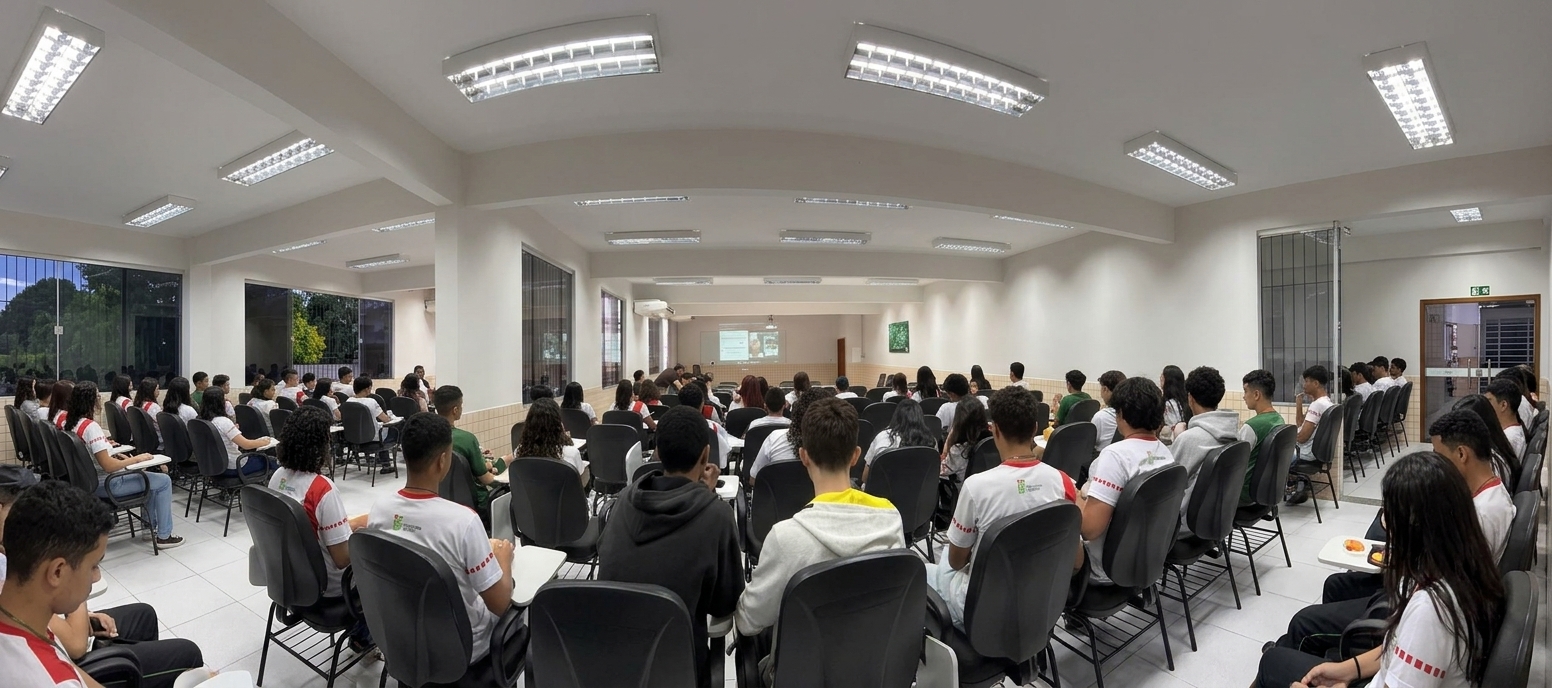
“A semana acadêmica é muito importante tanto para os nossos alunos quanto para a comunidade em geral de Rio Branco”, disse Carreira. “É uma oportunidade para jovens do ensino médio conhecerem a universidade e vivenciarem a ciência na prática.”
A cerimônia de encerramento ocorre nesta sexta-feira, 23, à tarde.
(Fhagner Soares, estagiário Ascom/Ufac)
ACRE
Pavic-Lab da Ufac apresenta seis trabalhos em congresso internacional de computação — Universidade Federal do Acre

Pesquisadores do projeto Pavic-Lab, da Universidade Federal do Acre (Ufac), apresentaram seis trabalhos científicos durante a Conference on Graphics, Patterns and Images (SIBGRAPI 2026), congresso internacional de referência nas áreas de computação gráfica, processamento de imagens e visão computacional, realizado de 29 de setembro a 2 de outubro, em Goiânia (GO). As pesquisas foram desenvolvidas no projeto de pesquisa e desenvolvimento (P&D) Pesquisas Aplicadas em Visão e Inteligência Computacional (Pavic-Lab), uma iniciativa de cooperação técnico-científica entre a Ufac, Motorola, Flextronics e Fundação de Apoio e Desenvolvimento ao Ensino, Pesquisa e Extensão Universitária no Acre (Fundape).
Segundo a professora do Centro de Ciências Exatas e Tecnológicas (CCET), Ana Beatriz Alvarez Mamani, a participação no congresso contribui para divulgar a produção científica desenvolvida no Acre e ampliar o intercâmbio com outras instituições. Ela destacou que a presença da Ufac em eventos científicos também ajuda a reduzir as desigualdades regionais na ciência brasileira, além de possibilitar novas parcerias e o aperfeiçoamento das pesquisas.
A equipe foi composta pela professora Ana Beatriz Alvarez Mamani, pelo pesquisador Quefren Leher, pelos mestrandos do Programa de Pós-Graduação em Ciência da Computação (PPGCC) Clécio Silva, Lucas Carvalho, Gustavo Ferreti, Julio Martins e Ian Teixeira, além do graduando em Sistemas de Informação Kauã Galvão de Macedo.
Dos seis trabalhos apresentados, um integrou uma sessão especial do congresso e já foi publicado na revista científica Computers & Graphics. Outros três foram apresentados na programação principal, com previsão de publicação nos anais do Instituto de Engenheiros Eletricistas e Eletrônicos (IEEE) e na biblioteca digital da Sociedade Brasileira de Computação (SBC). Os dois trabalhos restantes foram apresentados em workshops, também com previsão de publicação na biblioteca digital da SBC.
As pesquisas estão divididas em duas áreas principais: reconstrução tridimensional e processamento de imagens. Na primeira, Clécio Silva apresentou um método computacional para criar representações digitais mais detalhadas de ambientes internos a partir de imagens. A tecnologia pode ser aplicada em jogos, realidade virtual e aumentada, simulações e projetos da construção civil.
Na área de processamento de imagens, Lucas Carvalho apresentou uma pesquisa para reconstruir imagens de alta faixa dinâmica (HDR) a partir de uma única imagem convencional, buscando recuperar detalhes em regiões claras e escuras. Gustavo Ferreti desenvolveu uma rede neural para combinar imagens com diferentes níveis de exposição e melhorar a qualidade visual dos resultados.
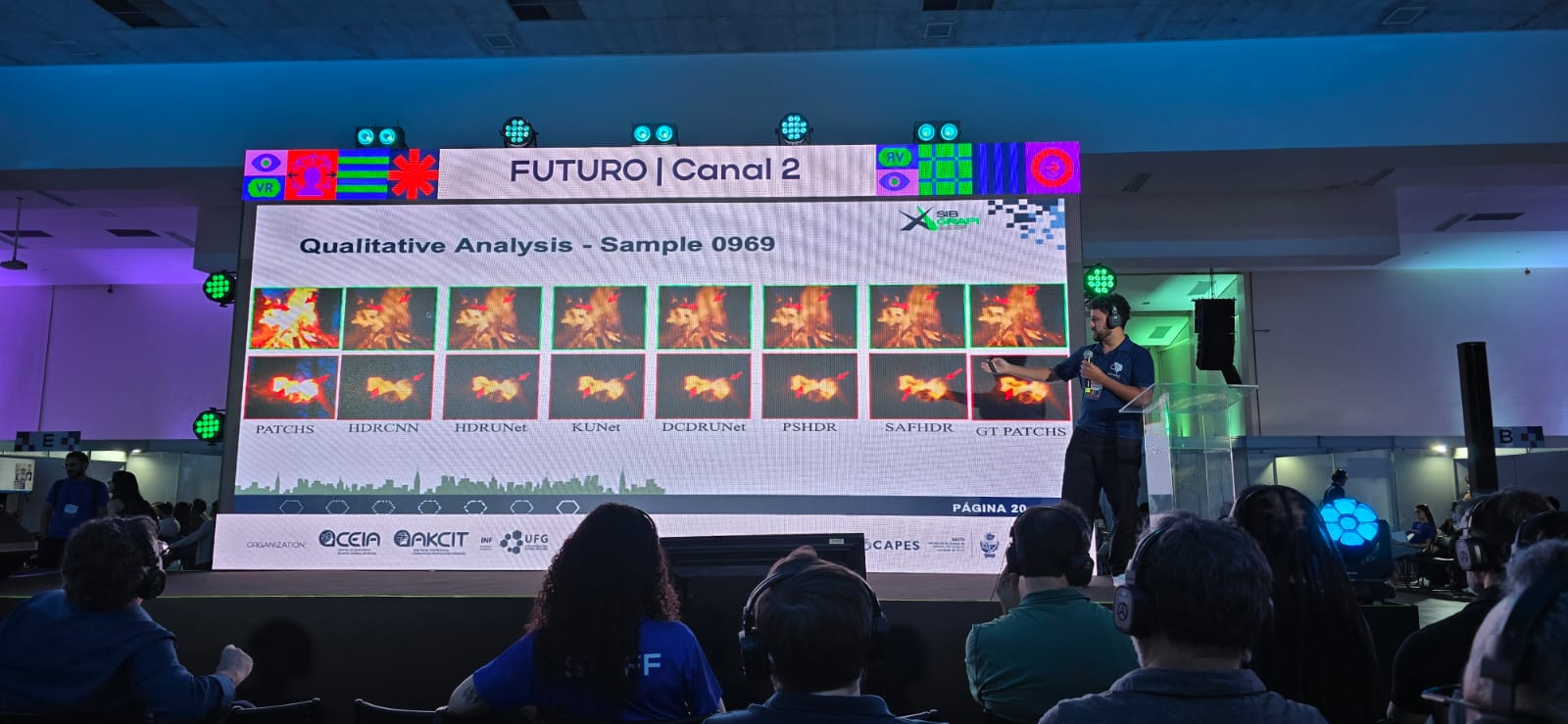
Julio Martins apresentou uma metodologia para reduzir o custo computacional da reconstrução de imagens HDR, preservando a qualidade das imagens produzidas. Ian Teixeira investigou o uso de mecanismos de atenção em modelos de inteligência artificial para recuperar informações em imagens de baixa qualidade. Já Kauã Galvão de Macedo apresentou uma abordagem que combina redes neurais e técnicas de processamento de sinais para melhorar imagens capturadas em ambientes com pouca iluminação.
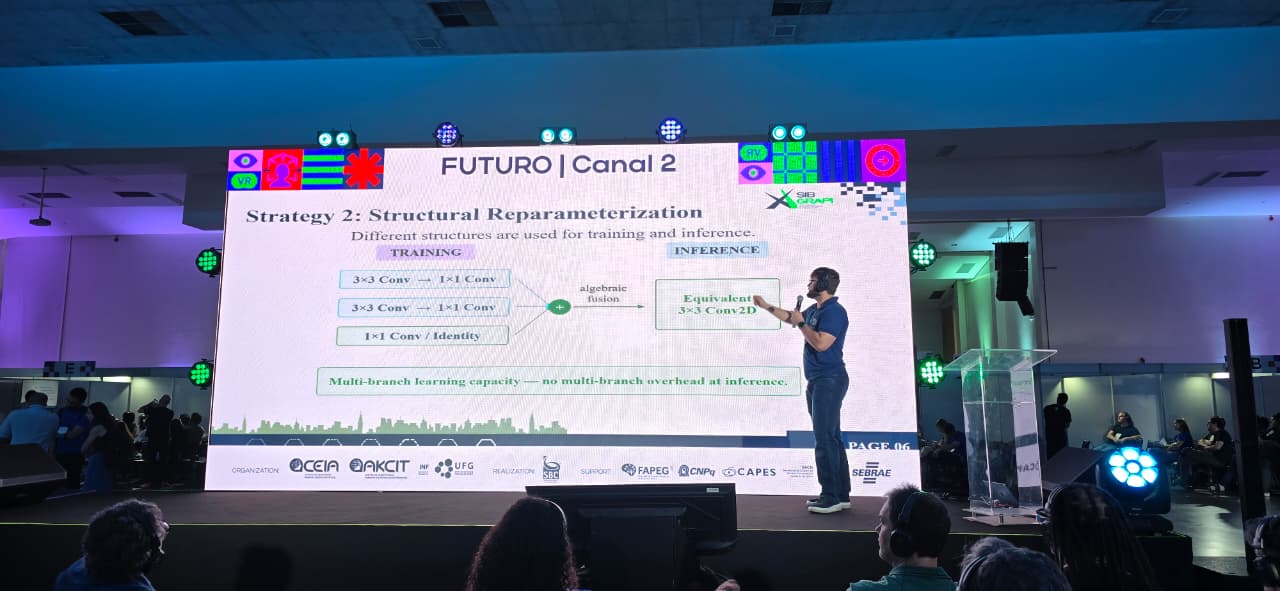
Os métodos desenvolvidos apresentam potencial de aplicação em sistemas embarcados com recursos computacionais limitados, como dispositivos eletrônicos que integram processamento de imagens, permitindo aprimorar a qualidade visual com menor demanda de processamento.
Para o graduando Kauã Galvão de Macedo, a participação no congresso proporcionou a oportunidade de apresentar os resultados de sua pesquisa e conhecer novas abordagens científicas. “Foi uma ótima experiência, tanto pela oportunidade de apresentar minhas pesquisas desenvolvidas na Ufac quanto pela troca de conhecimentos com pesquisadores de outras instituições”, afirmou.
Segundo Kauã, as discussões realizadas durante o evento possibilitaram o contato com técnicas que poderão contribuir para suas pesquisas e para os projetos desenvolvidos pelo Pavic-Lab, além de abrir oportunidades de colaboração científica.
O mestrando em Ciência da Computação Gustavo de Souza Ferreti também destacou a importância da experiência para sua formação acadêmica. “Tive a oportunidade gratificante de conhecer professores e pesquisadores com ampla trajetória no nosso campo, além de ouvir sobre suas vivências e receber orientações valiosas para aprimorar meu trabalho”, disse.

O Pavic-Lab desenvolve atividades de pesquisa voltadas ao processamento de imagens, ao aprimoramento da qualidade visual e à reconstrução tridimensional de ambientes e objetos. Após a participação no congresso, a equipe dará continuidade às pesquisas científicas, com novos experimentos e avaliações para aperfeiçoar os métodos, reduzir custos computacionais e ampliar as possibilidades de aplicação prática dos resultados.
Warning: Undefined array key 0 in /home/u824415267/domains/acre.com.br/public_html/wp-content/themes/zox-news/single.php on line 591
Warning: Attempt to read property "cat_name" on null in /home/u824415267/domains/acre.com.br/public_html/wp-content/themes/zox-news/single.php on line 591
6 dias agoEstudantes de Jornalismo da Ufac ensinam audiovisual a moradores da Reserva Cazumbá-Iracema — Universidade Federal do Acre


 ACRE6 dias ago
Ufac promove ação de prevenção à saúde da mulher durante o Outubro Rosa — Universidade Federal do Acre
 ACRE4 dias ago
Ufac abre 1ª Conferência Internacional Amazônia Nexus — Universidade Federal do Acre
 ACRE3 dias ago
Pavic-Lab da Ufac apresenta seis trabalhos em congresso internacional de computação — Universidade Federal do Acre


Warning: Undefined variable $user_ID in /home/u824415267/domains/acre.com.br/public_html/wp-content/themes/zox-news/comments.php on line 48
You must be logged in to post a comment Login