ACRE
J.K. Dobbins’ late touchdown propels Chargers past Bengals on ‘Sunday Night Football:’ Key takeaways
PUBLICADO
2 anos atrásem
By Daniel Popper, Paul Dehner Jr. and Zach Powell
Courtesy of a late touchdown by J.K. Dobbins, the Los Angeles Chargers survived a second-half comeback attempt by the Cincinnati Bengals to pick up a 34-27 win at SoFi Stadium on “Sunday Night Football.”
Inside the final minute of regulation, quarterback Justin Herbert commanded Los Angeles down the field 54 yards, which led to Dobbins’ rush into the end zone from 29 yards out.
J.K. DOBBINS HOUSE CALL!
via @NFL pic.twitter.com/1LhyHO0x5g
— NFL on Prime Video (@NFLonPrime) November 18, 2024
The Bengals (4-7), who struggled mightily in the first half and went without a touchdown, turned their efforts around in the second half, scoring 21 consecutive points to tie the game. Cincinnati had two chances to grab the lead but kicker Evan McPherson missed two fourth-quarter field goal attempts, one from 48 yards and the other from 51 yards.
Chargers narrowly escape Bengals
The Chargers somehow escaped. After a dominant first half, they completely unraveled in the second half. The offense could not move the ball. The defense, battling injuries in the secondary, let Joe Burrow, Ja’Marr Chase and Tee Higgins take over the game. The pass rush wilted. It felt like so many Chargers games of the past. Until it wasn’t.
And maybe this is a sign of the shift under coach Jim Harbaugh. The Chargers surely needed some luck, including the Bengals’ two missed field goals in the fourth quarter. Burrow also missed an open Chase on a deep ball down the right sideline that could have been a go-ahead touchdown. But the Chargers did not let this game become a full-on collapse. That means something for this organization. — Daniel Popper, Chargers beat writer
Sunday’s win shows Chargers’ improvements
There will be plenty to clean up moving forward. For one, a defense that had not given up more than 20 points in a game looked far more mediocre against a more professional offense. The Chargers built a lead and then could not protect it by running the ball down the stretch. They were anemic in that phase until Dobbins scored the winner.
Herbert was missing open receivers until he snapped back into form for the winning drive. Some issues persist. But the Chargers are 7-3. They might not be contenders. At the same time, they are an improved team. They are a different team. They are a resilient team. And when the game was slipping away, they found enough winning plays. — Popper
Has Cincy lost trust in Evan McPherson?
How many brutal, heartbreaking ways can one team lose games in a single season? The Bengals are 1-6 in one-score games. From fourth-and-16 in Kansas City, a dropped hold on a game-winning field goal attempt at home against Baltimore, the Terry McLaurin deep ball versus Washington, the 35-34 loss in Baltimore and now this. The whisper of the McPherson concerns became primal screams as he missed two go-ahead boots in the fourth quarter.
The Bengals extended McPherson, who earned the name Money Mac, before the season but he has been leaky this year. He’s now missed a PAT, two field goals inside 50 and gone 3 of 7 from 50-plus. Taylor didn’t put him on the field in two spots last week in Baltimore but claimed trust still existed. You have to believe that is severed now. — Paul Dehner, Bengals beat writer
Bengals nearly found a way
With the season hanging in the balance, the Bengals’ defense put together an effort so embarrassing in the first half that it was fair to wonder if everyone would still have their jobs by the time the team landed in Cincinnati. They benched starting cornerback Cam Taylor-Britt, blew assignments, missed tackles and allowed 8.8 yards per play, 17 first downs and 272 yards.
Those were among the worst marks since coach Zac Taylor and defensive coordinator Lou Anarumo took the job in Cincinnati in 2019.
Yet, they were able to find enough resiliency to flip the script after the break. The Bengals only allowed three points and forced a turnover to let Burrow bring the team nearly all the way back. As much as the group deserves all the heat imaginable for the lack of effort and execution in the first half, that’s an impressive turn of attitude to recalibrate and come up with some big stops. — Dehner
Never count Joe Burrow out
You can never count Burrow out. He looked demoralized and beaten down during the first half sitting on the sideline and taking long, slow walks off the field after failed possessions. Yet, an increased aggression (two fourth-down touchdown passes) and a willingness to hold the ball to find chunk plays set off the Bengals’ wild comeback attempt.
Burrow used every trick in his bag from magical pocket escapes for conversions, gutsy fourth-quarter deep balls for a score, precision timing and eventually putting two go-ahead field goals into position in the final minutes. He was hard on himself for missed passes late, but he’s been playing at an MVP level statistically all season. The inexplicable way the Bengals have been losing is wearing on him but it’s hardly his fault. — Dehner
Required reading
(Photo: Ronald Martinez / Getty Images)
Relacionado
ACRE
Projeto realiza maratona de programação para escolas — Universidade Federal do Acre
PUBLICADO
12 horas atrásem
25 de novembro de 2026O projeto “O Futuro da Programação: O Desenvolvimento de Soluções Digitais na Educação Básica na Amazônia”, coordenado pela professora da Ufac, Catarina de Souza Costa, no âmbito do Programa Mais Ciência na Escola, do governo federal, realiza a Maratona de Programação Python: Ensino Fundamental. O evento ocorre na segunda-feira, 30, a partir das 14h, no Núcleo Avançado de Empreendedorismo e Tecnologia do Acre (NaveTech), no andar superior da Biblioteca Central, campus-sede da Ufac.
A competição envolve estudantes das escolas Lourival Sombra, Serafim Salgado e do Colégio de Aplicação da Ufac. A premiação está prevista para ocorrer entre 15h50 e 16h10.
Relacionado
ACRE
Pesquisadores descobrem novos roedores que viveram no Mioceno — Universidade Federal do Acre
PUBLICADO
1 dia atrásem
24 de novembro de 2026O professor Ricardo Negri, do campus Floresta e do Laboratório de Paleontologia, da Ufac, participa de artigo publicado, em inglês, na revista “Acta Palaeontologica Polonica”, sobre a biodiversidade amazônica no Mioceno, por meio da descoberta de pequenos roedores que habitaram a Amazônia aproximadamente 9 milhões de anos atrás. A pesquisa foi liderada por Emmanuelle Fontoura, do Museu de Ciências Naturais (MCN), da Secretaria do Meio Ambiente e Infraestrutura do Rio Grande do Sul.
Negri e a pesquisadora do MCN, Ana Maria Ribeiro, que também assina o artigo, lideraram expedições nos anos de 2010, 2019, 2022 e 2024, no rio Envira, Estado do Acre, onde encontraram pequenos dentes isolados, de cerca de um milímetro, pela técnica de peneiramento de sedimento em água corrente.
“Visto que os roedores possuem morfologias dentárias únicas e alguns possuem dentes com crescimento contínuo, a morfologia varia ao longo da vida do indivíduo. Portanto, os pesquisadores fizeram tomografia computadorizada (micro-TC) de alguns dentes para avaliar os padrões de desgaste dentário e visualizar características morfológicas, permitindo comparações entre diferentes estágios de desgaste”, disse Emmanuelle Fontoura.
Ela informou que as novas espécies da família ‘Erethizontoidea’ (grupo de roedores nativos das Américas, popularmente conhecidos como porcos-espinho) receberam seus nomes em homenagem às pesquisadoras doutoras Adriana Candela, Norma Nasif e Guiomar Vucetich, reconhecidas pelas suas contribuições à Paleontologia, especialmente sobre roedores na Argentina.
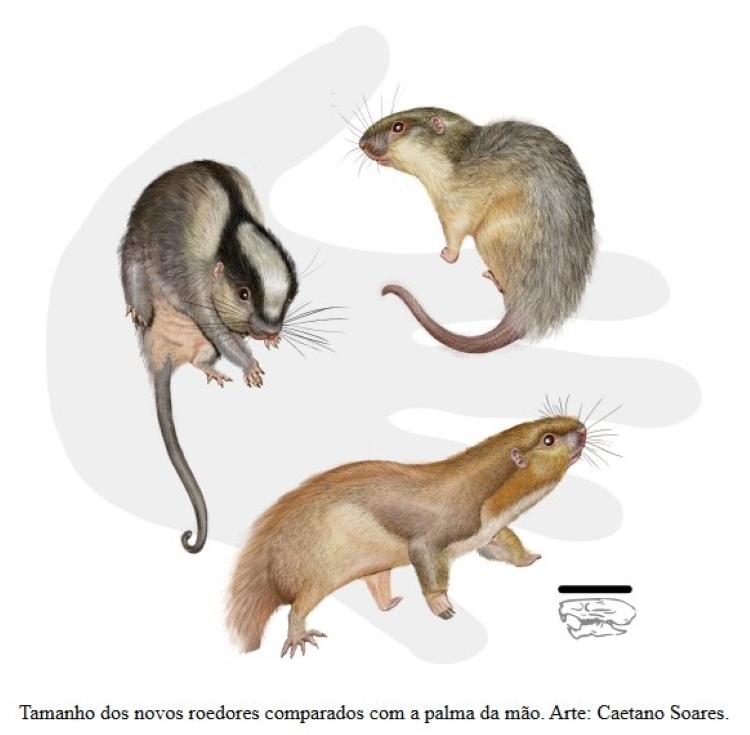
“A presença de eretizontoideos, presumivelmente arborícolas, sugere a existência de habitats florestais na Amazônia Ocidental”, complementou. “A descoberta desses roedores de pequeno porte contribui para o aprimoramento do nosso conhecimento sobre a evolução e a biogeografia dos mamíferos na região amazônica.”
Também compõem a equipe de pesquisadores que publicaram o artigo Leonardo Kerber (da Universidade Federal de Santa Maria), Laurent Marivaux, Pierre-Olivier Antoine e Narla S. Stutz (da Universidade de Montpellier, França) e Myriam Boivin (da Universidade Nacional de Jujuy, Argentina).
O trabalho foi financiado pelo Conselho Nacional de Desenvolvimento Científico e Tecnológico e pela Fundação de Amparo à Pesquisa do Estado do Rio Grande do Sul.
Relacionado
ACRE
Ufac cria Observatório de Mídia e Gênero na Amazônia Acreana — Universidade Federal do Acre
PUBLICADO
2 dias atrásem
24 de novembro de 2026A Ufac passa a contar com o Observatório de Mídia e Gênero na Amazônia Acreana (OMeGA), iniciativa vinculada ao curso de Jornalismo que tem como objetivo promover a produção e a circulação do conhecimento científico sobre as relações entre comunicação, mídia, gênero e sexualidade, considerando as particularidades sociais e culturais da região amazônica.
O OMeGA é coordenado pela professora de Jornalismo, Francielle Modesto. Segundo ela, a produção de conhecimento sobre a Amazônia é marcada por olhares externos, que frequentemente construíram representações estereotipadas sobre seus territórios e suas populações.
“Isso também se reflete na maneira como a região aparece na mídia: muitas vezes associada à floresta, à natureza, aos conflitos ambientais ou às situações de violência, enquanto outras dimensões da vida social, especialmente as experiências de mulheres e de pessoas LGBTQIA+, permanecem pouco visibilizadas”, disse.
Entre as atividades previstas estão a realização de encontros de leitura e discussão de textos acadêmicos, o desenvolvimento de pesquisas, a promoção de debates e a organização de ações de extensão que aproximem a universidade da comunidade. A proposta também busca incentivar a participação de estudantes na produção científica e ampliar o diálogo entre diferentes áreas do conhecimento.
Inscrições abertas
O OMeGA está com inscrições abertas até 30 de novembro para interessados em participar de suas atividades. A iniciativa é voltada a estudantes de graduação, pós-graduação, professores e pesquisadores que tenham interesse nas temáticas abordadas pelo observatório.
Para mais informações, os interessados podem entrar em contato pelo e-mail omega.ufac@gmail.com ou pelo perfil do observatório no Instagram.
(Fhagner Soares, estagiário Ascom/Ufac)
Relacionado
PESQUISE AQUI
MAIS LIDAS
ACRE3 dias agoEstudo revela origem de complexo de ilhas na costa amazônica — Universidade Federal do Acre
ACRE3 dias agoUfac promove ação de segurança hídrica na Resex Chico Mendes — Universidade Federal do Acre
ACRE3 dias agoSistemas de Informação da Ufac inicia sua 3ª Semana Acadêmica — Universidade Federal do Acre
ACRE2 dias agoMedicina da Ufac realiza abertura de sua 1ª Semana Acadêmica — Universidade Federal do Acre
Warning: Undefined variable $user_ID in /home/u824415267/domains/acre.com.br/public_html/wp-content/themes/zox-news/comments.php on line 48
You must be logged in to post a comment Login