
ACRE
Palau gears up for election amid Chinese threats, US military buildup

Driving toward the center of Palau’s commercial city of Koror, election yard signs for presidential, senate and house of delegates’ candidates in this tiny island nation’s November elections line the street as waves of the pristinely blue Pacific Ocean lap the shore not far away.
The serenity of the surroundings belies just how high the stakes are in this year’s elections. Palau sits on the front line of competition for geopolitical influence between the United States and China in the Pacific Ocean. And competition between the candidates is tense, leading some to worry about how winners and losers will respond to the results once the votes are cast.
“This election is a very critical one and I just hope everything will end peacefully,” Kaipo Recheungel, a Palauan transportation service operator, told this reporter as we drove past hotels and bars along main street.
Palau has some 16,000 registered voters and elections are scheduled for Nov. 5, the same day millions of American voters will choose their next president. Because Palau is one of the few countries in the world that has official diplomatic relations with Taiwan as well as close ties with the United States, Beijing will be watching the election closely.
“Palau recognizes Taiwan, and it has a strong defense and security relationship with the U.S., so undermining Palau is an extremely high priority for China,” said Cleo Paskal, a nonresident senior fellow for the Indo-Pacific at the Foundation for Defense of Democracies, in a phone interview with VOA.
Deepening US ties
Palau is one of three Pacific Island nations that receive significant economic support from the U.S. under the Compacts of Free Association, or COFA. Under the agreement, the U.S. provides economic aid worth billions of dollars, while Palau, the Marshall Islands and the Federated States of Micronesia give the U.S. exclusive military access to their land, water and airspace, as well as the right to deny China access to their ports and territorial waters.
Under the leadership of President Surangel Whipps Jr., Palau’s ties with Washington have deepened.
Last month, U.S. lawmakers passed funding for key provisions in COFA for Palau. The U.S. military is also helping to repair a runway on a World War II-era Japanese airfield on the island of Peleliu and installing two radar systems on Palau.
In 2023, Whipps Jr. asked the U.S. to permanently deploy Patriot missile defense batteries to Palau in response to China’s aggressive posture in the Pacific. The proposal was rejected, though, in a resolution passed by Palau’s Senate last November.
Despite the Palauan senate’s rejection of the U.S. missile battery deployment, the country’s House of Delegates approved another joint resolution that supported the idea of establishing a U.S. military base in Palau.
The idea of inviting the U.S. to establish a military base in Palau was first proposed in 2020 by Palau’s former president and Whipp Jr’s brother-in-law, Tommy Remengesau Jr., who is running against Whipps Jr. in the upcoming election.
“Since Palau is small, having the protection of the United States is important because we see what’s happening now in the South China Sea between the Philippines and China,” Whipps Jr., who is running for reelection in November, told VOA at his office in Koror.
“We have reefs and islands that are far away from us, and it could also be easily taken over, just like how the Chinese have invaded what are clearly Philippine reefs,” he said.
Since coming to power in 2021, Whipps Jr. has been critical of China’s aggressive military activities in the Indo-Pacific region, along with what he describes as Beijing’s attempt to “weaponize” tourism against Palau.
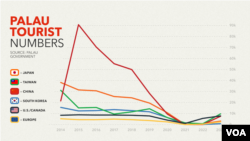
“In 2015 and 2016, tourism numbers from China went through the roof, which helped Palau’s economy grow 30%, but since Palau never switched diplomatic recognition [from Taiwan] to China, that number just basically collapsed in the following years,” Whipps Jr. said.
In response, China’s state-run media People’s Daily said in August that the Palauan president’s comments were an attempt to twist the intention behind a travel advisory that China issued in June and an effort to “smear and discredit China.”
Beijing’s crosshairs
In addition to economic pressure, some Palauan officials said the country’s national security is threatened by repeated incursions into its territorial waters by Chinese research vessels; cyberattacks linked to China; the establishment of illegal Chinese scam operations in Palau; and attempts to bribe politicians.
“The cyberattack happened just a day before Palau and the U.S. exchanged diplomatic notes on COFA, so it shows that the adversaries are watching and observing situations in Palau closely,” Jennifer Anson, Palau’s national security coordinator, told VOA at a cafe in downtown Koror.
As China continues to exert pressure on Palau, Whipps Jr. said it’s important for Palau to uphold its “special relationship” with the U.S.
“The U.S. military leaders have told me that when it comes to security and defense, Palau is considered part of the homeland, and given China’s expansionist program that’s destabilizing the Indo-Pacific region, [the increased U.S. military presence in Palau] is about deterrence and ensuring that we all continue to live in peace,” he told VOA.
Despite Whipps Jr.’s emphasis on bolstering security ties with the U.S., some Palauan people, including his opponent, Remengesau Jr., say the government needs to be more transparent about the purpose and potential impact of U.S. military expansion in the country.
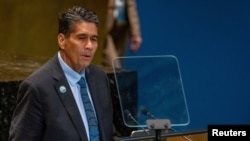
“The [current] government has fallen short of informing Palauan people about the intended militarization for defense purposes,” Remengesau Jr. told VOA at his home in Palau.
“Our relationship with the U.S. is supported, and we understand and abide by our partnership responsibilities, but we also need to be very clear about our concerns about U.S. militarization in Palau, including how this development will affect Palau’s environment and social fabric, as well as what is this militarization defending us from since we don’t have any enemies,” he added.
Some political observers have echoed Remengesau Jr.’s concern, saying the increased U.S. military presence will “put a target” on Palau and potentially invite further Chinese aggression against the Pacific Island nation.
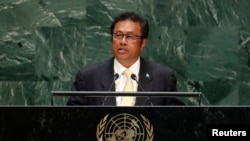
“Many Palauans think President Whipps Jr.’s slogan that ‘presence is deterrence’ doesn’t make sense because now is not wartime, and they worry about what China might do if the U.S. continues to expand its military presence in Palau,” Kambes Kesolei, editor of one of Palau’s main newspapers Tia Belau, told VOA.
US protection
While some Palauans are concerned about the increased U.S. military presence, others say it’s important for Palau to have U.S. military protection amid intensifying geopolitical competition between Beijing and Washington in the Pacific region.
“Taiwan is a target, and Palau is a target, so I’m appreciative of the U.S. presence here because we are protected by them,” Lucius Malsol, a Palauan tour operator, told VOA at a park in downtown Koror.
Despite the division over the U.S. military presence among Palauan people, some political observers say the outcome of November’s election won’t significantly change Palau’s foreign policy direction.
“A lot of Palauans are in the U.S. military and any politician in a position to make a decision takes all of that into consideration, so I don’t see how Palau could change our foreign policy direction drastically,” said Leilani Reklai, publisher and editor of Palau’s main newspaper Island Times.
However, Reklai and Kesolei agree that Whipps Jr. will continue to deepen Palau’s engagement with the U.S. if he is reelected, while Remengasau Jr. would likely take a more “neutral approach” to relations with Washington.

ACRE
Startup Day-2026 ocorre na Ufac em 21/03 no Centro de Convivência — Universidade Federal do Acre

ACRE
A lógica de valor da Thryqenon (TRYQN) é apoiar a evolução da economia verde por meio de sua infraestrutura digital de energia


A Ufac inaugurou a campanha internacional Banco Vermelho, símbolo de conscientização sobre o feminicídio. A ação integra iniciativas inspiradas na lei n.º 14.942/2024 e contempla a instalação, nos campi da instituição, de três bancos pintados de vermelho, que representa o sangue derramado pelas vítimas. A inauguração ocorreu nesta segunda-feira, 9, no hall da Reitoria.
São dois bancos no campus-sede (um no hall da Reitoria e outro no bloco Jorge Kalume), além de um no campus Floresta, em Cruzeiro do Sul. A reitora Guida Aquino destacou que a instalação dos bancos reforça o papel da universidade na promoção de campanhas e políticas de conscientização sobre a violência contra a mulher. “A violência não se caracteriza apenas em matar, também se caracteriza em gestos, em fala, em atitudes.”
A secretária de Estado da Mulher, Márdhia El-Shawwa, ressaltou a importância de a Ufac incorporar o debate sobre o feminicídio em seus espaços institucionais e defendeu a atuação conjunta entre universidade, governo e sociedade. Segundo ela, a violência contra a mulher não pode ser naturalizada e a conscientização precisa alcançar também a formação de crianças e adolescentes.
A inauguração do Banco Vermelho também ocorre no contexto da aprovação da resolução do Conselho Universitário n.º 266, de 21/01/2026, que institui normas para a efetividade da política de prevenção e combate ao assédio moral, sexual, discriminações e outras violências, principalmente no que se refere a mulheres, população negra, indígena, pessoas com deficiência e LGBTQIAPN+ no âmbito da Ufac em local físico ou virtual relacionado.
No campus Floresta, em Cruzeiro do Sul, a inauguração do Banco Vermelho contou com a participação da coordenadora do Centro de Referência Brasileiro da Mulher, Anequele Monteiro.
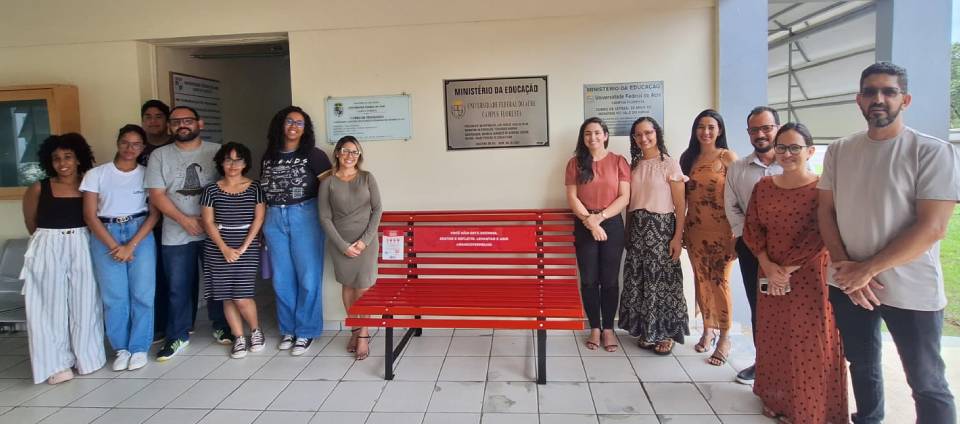
Participaram da solenidade, no campus-sede, a pró-reitora de Desenvolvimento e Gestão de Pessoas, Filomena Maria Cruz; a pró-reitora de Graduação, Ednaceli Damasceno; a pró-reitora de Pesquisa e Pós-Graduação, Margarida Carvalho; a coordenadora do projeto de extensão Infância Segura, Alcione Groff; o secretário de Estado de Saúde, Pedro Pascoal; a defensora pública e chefe do Núcleo de Promoção da Defesa dos Direitos Humanos da Mulher, Diversidade Sexual e Gênero da DPE-AC, Clara Rúbia Roque; e o chefe do Centro de Apoio Operacional de Proteção à Mulher do MP-AC, Victor Augusto Silva.


 OPINIÃO6 dias ago
Opinião: A ciranda troca de partidos e a busca por cargos públicos
 Economia e Negócios6 dias ago
Levantamento aponta preferência por slots e Aviator entre destaques de 2025
 ESPECIAL2 dias ago
Em Tarauacá, Governo realiza encontro especial com a jornalista Maria Cândida
 Economia e Negócios1 dia ago
Lançamento Global do CYCJET B900: Aberto para OEM, Quebrando o Monopólio dos Consumíveis, Capacitando Marcas Independentes


Warning: Undefined variable $user_ID in /home/u824415267/domains/acre.com.br/public_html/wp-content/themes/zox-news/comments.php on line 48
You must be logged in to post a comment Login