NOSSAS REDES

ACRE

Quincy Jones, musical titan and entertainment icon, dead at 91

PUBLICADO

em


CNN
 — 

Musical titan Quincy Jones, the composer and producer who added his tasteful polish to recordings by everyone from Ray Charles to Frank Sinatra to Michael Jackson, has died, according to his representatives. He was 91.

Jones died Sunday night at his home in Bel Air, California, surrounded by his children, siblings and other family members, his publicist told CNN in a statement.

“Tonight, with full but broken hearts, we must share the news of our father and brother Quincy Jones’ passing,” the Jones family said in the statement. “And although this is an incredible loss for our family, we celebrate the great life that he lived and know there will never be another like him. He is truly one of a kind and we will miss him dearly; we take comfort and immense pride in knowing that the love and joy, that were the essence of his being, was shared with the world through all that he created. Through his music and his boundless love, Quincy Jones’ heart will beat for eternity.”

A renowned jazz and pop musician, Jones was also a prolific cross-genre arranger, conductor, record label executive and civil rights advocate. His talent and drive led to an almost unparalleled career in entertainment.

His long and varied list of credits include composing the score for the Oscar-winning film, “In the Heat of the Night,” producing Michael Jackson’s blockbuster “Thriller” album and gathering dozens of pop and rock stars to record the 1985 charity single “We Are the World.”

Born in Chicago to a carpenter father and a mother who suffered from mental illness, Jones developed a love of music early on and took up the piano.

His family eventually moved to Seattle, Washington, and Jones began taking lessons from famed horn player Clark Terry.

He also met and became close friends with a then-unknown pianist named Ray Charles. The pair would enjoy a lifelong friendship.

A teenaged Jones began performing with jazz bands, and his talent at composing and arranging music drew the attention of bandleader Lionel Hampton.

Jones was only 15 when Hampton invited him to tour with the group, something Hampton’s wife, Gladys, put a stop to right away.

“I got on the band bus right away, and Gladys got on and said, “Hamp, what’s that child doing on the bus?” Jones recalled in an interview with the National Endowment for the Arts. “And I was so upset. And she said, ‘Get him off here. Make him go back to school. We’ll call him later when he gets his schooling.’”

Jones heeded her advice, finished school and earned a scholarship to Schillinger House (now known as Berklee College of Music) in Boston, from which he graduated in 1951.

After graduation he headed out on tour with Hampton and his band.

Thus began a storied a career which found Jones soon arranging and recording for such legends as Count Basie, Duke Ellington, Sarah Vaughan and his friend Ray Charles. Bandleader Lionel Hampton, trumpeter Dizzy Gillespie and other giants also tapped the young Jones for their European tours.
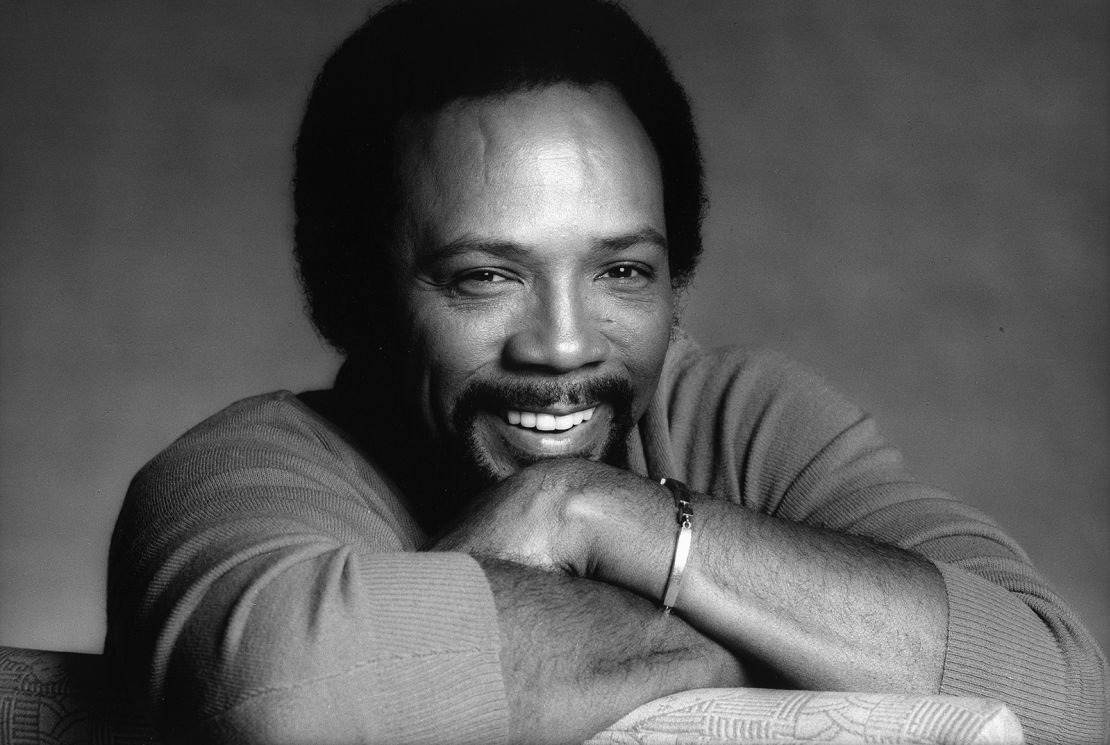
Musician, composer and producer Quincy Jones poses for a portrait in 1981 in Los Angeles.

In 1961 Jones was hired by Mercury Records as their artists-and-repertoire director. He made history three years later when he was promoted to vice president, making him the first African-American man to hold such a position within a white owned record label.

He had his first pop hit with Leslie Gore’s 1963 single “It’s My Party,” which shot to No. 1. Jones also worked with the likes of Frank Sinatra and Peggy Lee during his time with the label.

That same year found him scoring what would be the first of many Grammys, with the initial one being for the arrangement the Count Basie Band song “I Can’t Stop Loving You.”

The 1960s also began Jones composing music soundtracks including “In The Heat of the Night” and “In Cold Blood.”

He worked with A & M Records from 1969 to 1981 and formed his own label his own record label, Qwest.

In 1982 Jones had one of his most famous collaboration when he produced Michael Jackson’s best-selling album “Thriller.”

Three years later he called on Jackson and a host of other stars for the charity single “We Are the World.” That same year he found success on the big screen with producing the Steven Spielberg-directed film “The Color Purple.”

Singers and producers of

Jones also had a hit on the small screen with and the television series “The Fresh Prince of Bel-Air,” which starred his mentee Will Smith.

Jones delved into the world of publication in 1993 when he founded the music/cultural magazine Vibe, which he sold in 2006.

A brain aneurysm in 1974 caused Jones to temporarily lighten his workload and focus on spending time with his family.

Over the years he had three marriages and seven children with five different women.

Jones was married to his high school sweetheart Jeri Caldwell from 1957 to 1966, and the couple had had one daughter, Jolie.

In 1967 he married Swedish model Ulla Andersson, and they had two children, Martina and Quincy Jones III, before divorcing in 1974.

That same year Jones married actress Peggy Lipton, a union which lasted until 1990, and produced two daughters, actresses Rashida Jones and Kidada Jones.

He also had a daughter, Rachel, with dancer Carol Reynolds, and a daughter – fashion model Kenya Kinski-Jones – with actress Nastassja Kinski.

Jones didn’t slow down personally or professionally in his later years. In 2014 he produced the documentary “Keep on Keepin’ On” about his mentor, jazz trumpeter Clark Terry.

Reflecting on his own career that year, Jones told Rolling Stone, “I never thought about it until I hit 80, but I have been blessed to work with every major music star in the history of America — including Louie Armstrong.”

“You can’t plan that,” Jones said. “You can’t say, ‘Mr. Sinatra, I want to work with you.’ No. You have to wait until he calls you.”

This is a developing story and will be updated.

Leia Mais

Advertisement
Comentários

Warning: Undefined variable $user_ID in /home/u824415267/domains/acre.com.br/public_html/wp-content/themes/zox-news/comments.php on line 48

You must be logged in to post a comment Login

Comente aqui

ACRE

Ufac recebe visita da RFB para apresentação do projeto NAF — Universidade Federal do Acre

PUBLICADO

em

Ufac recebe visita da RFB para apresentação do projeto NAF — Universidade Federal do Acre

A Ufac recebeu, nesta quarta-feira, 25, no gabinete da Reitoria, representantes da Receita Federal do Brasil (RFB) para a apresentação do projeto Núcleo de Apoio Contábil e Fiscal (NAF). A reunião contou com a participação da Coordenação do curso de Ciências Contábeis e teve como foco a proposta de implantação do núcleo na universidade.
O reitor em exercício e pró-reitor de Planejamento, Alexandre Hid, destacou a importância da iniciativa para os estudantes e sua relação com a curricularização da extensão. Segundo ele, a proposta representa uma oportunidade para os alunos e pode fortalecer ações extensionistas da universidade.

A analista tributária da RFB e representante de Cidadania Fiscal, Marta Furtado, explicou que o NAF é um projeto nacional voltado à qualificação de acadêmicos do curso de Ciências Contábeis, com foco em normas tributárias, legislação e obrigações acessórias. Segundo ela, o núcleo é direcionado ao atendimento de contribuintes de baixa renda e microempreendedores, além de aproximar os estudantes da prática profissional.

Durante a reunião, foi informada a futura assinatura de acordo de cooperação técnica entre a universidade e a RFB. Pelo modelo apresentado, a Ufac disponibilizará espaço para funcionamento do núcleo, enquanto a receita oferecerá plataforma de treinamento, cursos de capacitação e apoio permanente às atividades desenvolvidas.

Como encaminhamento, a RFB entregou o documento referencial do NAF, com orientações para montagem do espaço e definição dos equipamentos necessários. O processo será enviado para a Assessoria de Cooperação Institucional da Ufac. A expectativa apresentada na reunião é de que o núcleo seja integrado às ações de extensão universitária.

Também participaram da reunião o professor de Ciências Contábeis e vice-coordenador do curso, Cícero Guerra; e o auditor fiscal e delegado da RFB em Rio Branco, Claudenir Franklin da Silveira.


Leia Mais: UFAC

Continue lendo

ACRE

Startup Day-2026 ocorre na Ufac em 21/03 no Centro de Convivência — Universidade Federal do Acre

PUBLICADO

em

Startup Day-2026 ocorre na Ufac em 21/03 no Centro de Convivência — Universidade Federal do Acre

A Pró-Reitoria de Inovação e Tecnologia (Proint) da Ufac e o Serviço Brasileiro de Apoio às Micro e Pequenas Empresas do Acre (Sebrae-AC) realizam o Startup Day-2026, em 21 de março, das 8h às 12h, no espaço Sebrae-Lab, Centro de Convivência do campus-sede. O evento é dedicado à inovação e ao empreendedorismo, oferecendo oportunidades para transformar projetos em negócios de impacto real. As inscrições são gratuitas e estão abertas por meio online.

O Startup Day-2026 visa fortalecer o ecossistema, promover a troca de experiências, produzir e compartilhar conhecimento, gerar inovação e fomentar novos negócios. A programação conta com show de acolhimento e encerramento, apresentações, painel e palestra, além de atividades paralelas: carreta game do Hospital de Amor de Rio Branco, participação de startups de game em tempo real, oficina para crianças, exposição de grafiteiros e de projetos de pesquisadores da Ufac.


Leia Mais: UFAC

Continue lendo

ACRE

A lógica de valor da Thryqenon (TRYQN) é apoiar a evolução da economia verde por meio de sua infraestrutura digital de energia

PUBLICADO

em

Foto de capa [internet]

Com a aceleração da transição para uma economia de baixo carbono e a reestruturação do setor elétrico em diversos países, cresce a discussão sobre como a infraestrutura digital pode sustentar, no longo prazo, a evolução da economia verde. Nesse contexto, a plataforma de energia baseada em blockchain Thryqenon (TRYQN) vem ganhando atenção por propor uma estrutura integrada que combina negociação de energia, gestão de carbono e confiabilidade de dados.

A proposta da Thryqenon vai além da simples comercialização de energia renovável. Seu objetivo é construir uma base digital para geração distribuída, redução de emissões e uso colaborativo de energia. À medida que metas de neutralidade de carbono se tornam compromissos regulatórios, critérios como origem comprovada da energia, transparência nos registros e liquidação segura das transações deixam de ser diferenciais e passam a ser requisitos obrigatórios. A plataforma utiliza registro descentralizado em blockchain, correspondência horária de energia limpa e contratos inteligentes para viabilizar uma infraestrutura verificável e auditável.

A economia verde ainda enfrenta obstáculos importantes. Existe descompasso entre o local e o momento de geração da energia renovável e seu consumo final. A apuração de emissões costuma ocorrer de forma anual, dificultando monitoramento em tempo real. Além disso, a baixa rastreabilidade de dados limita a criação de incentivos eficientes no mercado. A Thryqenon busca enfrentar essas lacunas por meio de uma estrutura digital que integra coleta, validação e liquidação de informações energéticas.

Na arquitetura da plataforma, há conexão direta com medidores inteligentes, inversores solares e dispositivos de monitoramento, permitindo registro detalhado da geração e do consumo. Na camada de transações, o sistema possibilita verificação automatizada e liquidação hora a hora de energia e créditos de carbono, garantindo rastreabilidade. Já na integração do ecossistema, empresas, distribuidoras, comercializadoras e consumidores podem interagir por meio de interfaces abertas, promovendo coordenação entre diferentes agentes do setor elétrico.

O potencial de longo prazo da Thryqenon não está apenas no crescimento de usuários ou no volume de negociações, mas em sua capacidade de se posicionar como infraestrutura de suporte à governança energética e ao mercado de carbono. Com o avanço de normas baseadas em dados e reconhecimento internacional de créditos ambientais, plataformas transparentes e auditáveis tendem a ter papel relevante na transição energética e no financiamento sustentável.

Continue lendo

MAIS LIDAS