
ACRE
The disappearing island nation recreating itself in the metaverse

 Getty Images
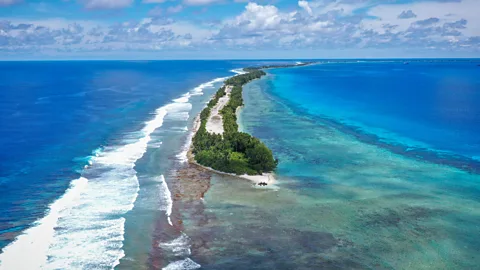
Facing erasure due to climate change, the Pacific Island nation of Tuvalu is digitally backing up everything from its houses to its trees as it endeavors to save whatever it can.
Faced with such an existential threat, what do you do? Build sea walls? Try to reclaim some land from the sea? Move away altogether? These are all solutions that have been attempted by other small island nations facing similar problems, and indeed by the Tuvaluans themselves.
But Tuvalu is going one step further in its attempt to preserve its land and statehood. As the physical reality of the nation slips beneath the ocean, the government is building a digital copy of the country, backing up everything from its houses to its beaches to its trees. It hopes this virtual replica will preserve the nation’s beauty and culture – as well as the legal rights of its 11,000 citizens – for generations to come.
The initiative was first announced in 2022 by Tuvalu’s minister for foreign affairs, Simon Kofe, via a video speech played at COP27 in Sharm El-Sheikh, Egypt, as part of the government’s wider Future Now (or Te Ataeao Nei in Tuvaluan) project, which is focusing on both international diplomacy and pragmatic adaptation to climate change.
In the clip, which looks more like a sequel to The Matrix than an official government speech, Kofe at first appears to stand on a beach, complete with white sand and rustling palms. But as the camera zooms out, revealing more of the scenery, the image starts to glitch. Rocks and sand shift unnaturally, and a seabird flies across the black abyss of the background.
“Our land, our ocean, our culture are the most precious assets of our people – and to keep them safe from harm, no matter what happens in the physical world, we’ll move them to the cloud,” says Kofe in the video.

 Alamy
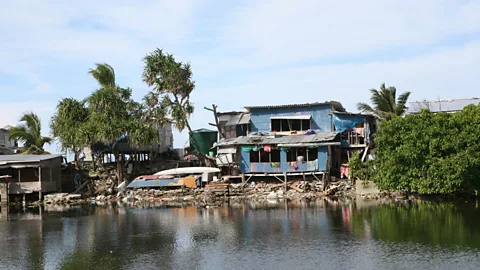
AlamyAs well as creating a virtual copy of the islands, the Digital Nation project will seek to back up the nation’s cultural heritage. Citizens have been invited to submit their most valued possessions and memories – sentimental items, grandfathers’ stories, and festival dances, for instance – for digitisation, creating an archive “designed to carry the very soul of Tuvalu”, according to an update from Kofe in 2023.
But Kofe has also made it clear there is a strongly practical element to the project. Small island states, faced with the loss of their physical landmass, are grappling in a very real way with the question of how to preserve their sovereignty.
Current international law is ill-suited to countries facing loss of territory or habitability due to climate change: it requires that a sovereign nation-state must have both a clearly defined territory and a permanent population – two characteristics that are no longer a guaranteed feature of Tuvalu’s future.
So as well as securing the nation’s boundaries within the metaverse, the Tuvalu government is seeking to create digital passports, stored on the blockchain, to allow the government to continue to function. These passports include everything from holding elections and referendums, to registering births, deaths and marriages.
Ultimately, Tuvalu hopes that the project could provide a new model of statehood, better adapted to the needs and capacities of a modern, warming and increasingly online world.
Already, Tuvalu has enshrined a new definition of statehood in its own constitution, which is being increasingly recognised by other countries – largely those who are in a similar predicament. Whether many of the countries facing less existential threats will prove similarly sympathetic remains to be seen.
Not everyone is convinced by the proposal, however, with some arguing that it represents the same kind of resource-intensive approach that is causing climate change in the first place. Even within the Tuvaluan government, there has been some scepticism about the Digital Nation project.
At its heart, though, the proposal acknowledges that change is coming to the islands, and that many will inevitably leave as life becomes harder and opportunities fewer.
According to a recent assessment by scientists at Nasa, much of Tuvalu’s land, including its critical infrastructure, will sit below the level of the current high tide by 2050. Across all climate scenarios, the country will experience more than 100 days of flooding each year by the end of this century. Then there are the other impacts to reckon with, including saltwater intrusion, heatwaves and intensified cyclones.
 Alamy
AlamyThis arguably represents a shift from the “we are not drowning, we are fighting” mantra that has shaped the rhetoric of Pacific Island nations to date.
Already, the prospect of mass relocation from Tuvalu to Australia (some 5,000km/3,000 miles away) has recently become a reality, following a 2023 treaty between the two nations allowing for the migration of 280 Tuvaluans each year. They will be given new visas which allow them to live, work and study in Australia – with paths to citizenship available.
But not everyone agrees that it is time to give up on the islands.
“The concept for the creation of a digital nation of Tuvalu in the metaverse implies that Tuvalu will disappear because of sea level rise and that we should make a digital copy of it,” said former prime minister Enele Sopoaga, now the leader of the opposition, in a 2023 media statement responding to the proposals. “There is no basis of such proposition in international law, and there is absolutely no reason to believe that Tuvalu will disappear even with sea level rise.”
Speaking in September at a UN General Assembly plenary about the existential threats from sea-level rise, Tuvaluan climate activist Grace Malie told delegates that Tuvalu and other ocean states will “not go quietly into the rising sea” but will “continue the fight” for their land, culture and future.
“It’s more than just our homes at stake,” she said of Tuvaluans. “It’s our dignity, our culture, our heritage. It is not something we can pack into suitcases and take with us. We have done the least to cause the crisis, but we are paying the highest price.”
Others, however, point out that the construction of a digital twin for Tuvalu does not mean giving up on efforts to save its islands themselves. They argue that efforts to physically protect the islands can sit alongside those to preserve its memory within the metaverse.
“The Digital Nation programme does not represent an acceptance of the loss of the nation as a physical entity,” says Taukiei Kitara, a Tuvaluan research fellow at Griffith University in Australia and co-author of a recent paper about the Digital Nation initiative. He points out that the project is just one of many in Tuvalu’s fight against climate change and has the advantage of being driven by Tuvaluans themselves.
For instance, the government is also spending millions of dollars on land reclamation through a coastal adaptation project. Over the last two years, strips of flood-free land have been added to the islands of Funafuti and Fogafale, providing space for housing, infrastructure and other essential services. On the outer islands of Nanumaga and Nanumea, new protective barriers are holding back the tides from reaching homes, schools, hospitals, farmland and other cultural assets.
“Planning for multiple scenarios – both best-case and worst-case and in between – is sensible when it comes to risk management, and this is the approach of Tuvalu’s current government, and indeed successive previous Tuvalu governments,” adds Kitara.
 Alamy
AlamyLeaving aside the question of whether or not the government should prepare for a future beyond the islands, some have suggested that the Digital Nation plan is simply impractical in a nation that remains comparatively disconnected from the digital world. They argue that it is little more than a PR exercise, designed to grab international attention and persuade richer nations to reduce their emissions – something which is key to the survival of the physical islands themselves.
But the effort that the Tuvaluan government is putting into mapping its islands and boosting connectivity suggests that this project is more than just a means of applying diplomatic pressure.
In the first year after the COP27 announcement, Tuvalu completed a 3D scan of all its 124 islands and islets using light detection and ranging (Lidar) technology, an airborne laser scanning technique. It is now improving its digital connectivity with the construction of an undersea telecommunications cable, which will help provide the bandwidth required to put the plan into action.
In March and April 2024, Place, a global non-profit organisation which supports open access mapping and other geographical data, began mapping the physical features of Funafuti, Tuvalu’s capital, using drones and 360-degree cameras to record both aerial and street-level imagery.
This raw data can be used to create a Google Earth or Street View-style image, but with the super high resolution required for capturing the details of the narrow islands, which are just tens of metres wide in places. When it comes to their finer details, the accuracy of satellite imagery is not fine enough to cut it.
“We drove all of the island, then we switched to mopeds for the bike baths, and then we switched to tiny GoPros for all of the walking paths,” says Frank Pichel, who oversees field operations at Place. “I think we have covered about 80 or 90km (50 or 56 miles), and really covered as much as we could.”
Far from being a PR exercise, he points out that creating a “digital twin” in this way has various real-world applications, including helping the nation adapt to and mitigate climate change in practical ways. By recording the size and angle of rooftops, for instance, it can model the capacity for solar panels in the future. Scans of water storage tanks, meanwhile, can help estimate the availability of drinking water on the island.
It is an approach that is not unique to places like Tuvalu, even if the cultural dimension and the urgency of climate change add an extra dimension to the task, says Pichel.
“If you look at advanced economies, they are looking to go this way, even if they’re not calling it a digital twin. London wants a ‘digital twin’ of subterranean cabling to make sure they’re not hitting wires or old sewer lines. So it is something that has existed in spatial data management for a long time and is perhaps growing a bit under a new label.”
The next step for Tuvalu would be to map the remainder of the islands, then work on filling any remaining gaps, says Pichel.
Due to the remoteness of the islands, which lie in a chain covering some 420 miles (676km), this in itself will be a difficult and time-consuming endeavour. Nonetheless, the Place team hopes to return and capture more data every two years, reflecting the fact that the islands themselves are in constant flux due to the impacts of climate change.
As the seas rise, building a digital replica may help Tuvalu save more than it otherwise would. The islands’ physical future may be uncertain, but its digital journey has only just begun.
For more science, technology, environment and health stories from the BBC, follow us on Facebook, X and Instagram.


O reitor da Ufac, Josimar Ferreira, entregou a bandeira institucional aos atletas que participarão dos Jogos Universitários Brasileiros (Jubs), que ocorrem de domingo, 23, a 5 de setembro, em Goiânia e Trindade (GO), com organização da Confederação Brasileira do Desporto Universitário. A entrega ocorreu nessa quinta-feira, 20, no hall da Reitoria, campus-sede.
“As oportunidades nascem a partir do momento em que dialogamos e temos compromisso. Quero transmitir a toda a equipe o nosso empenho de trabalhar o fortalecimento do esporte”, disse Josimar. “Eu estou neste momento como reitor por vocês, estudantes, e é com vocês que eu quero honrar esse compromisso todos os dias da minha vida, com o sentimento de união e diálogo.”
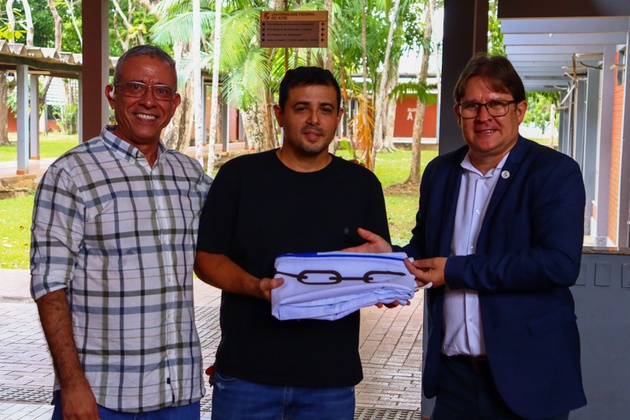
Também participaram do ato o pró-reitor de Extensão e Cultura, Marco Amaro; e o diretor de Arte, Cultura e Integração Comunitária, Givanildo Pereira Ortega.
(Fhagner Soares, estagiário Ascom/Ufac)

ACRE
Ufac retoma reuniões presenciais dos conselhos superiores após 6 anos — Universidade Federal do Acre


 ACRE7 dias ago
Podcast da Ufac entrevista novo reitor Josimar Ferreira — Universidade Federal do Acre
 ACRE5 dias ago
Ufac retoma reuniões presenciais dos conselhos superiores após 6 anos — Universidade Federal do Acre
 Economia e Negócios4 dias ago
Estatística aplicada ao esporte: o que os números realmente medem

 ACRE4 dias ago
Participe da Autoavaliação do Curso de ciências contábeis — Universidade Federal do Acre


Warning: Undefined variable $user_ID in /home/u824415267/domains/acre.com.br/public_html/wp-content/themes/zox-news/comments.php on line 48
You must be logged in to post a comment Login