
ACRE
Christopher Reeve’s Children Carry on His Legacy

After nearly a decade of flying past skyscrapers and supervillains onscreen, Superman actor Christopher Reeve found himself suddenly grounded. A horseback-riding accident in 1995 left him paralyzed from the waist down and unable to breathe without a ventilator. But to the world—and especially to his family—Reeve’s heroism didn’t end there. In the final years of his life, he came to this realization: “A hero is an ordinary individual who finds the strength to persevere and endure in spite of overwhelming obstacles.”
We hear Reeve speak those words in a new documentary about his life titled Super/Man: The Christopher Reeve Story, in select theaters this Friday, October 11. The film explores everything from the actor’s iconic performance as Superman to his accident, his reinvention, and the legacy that lives on in his children, Matthew, Alexandra, and Will. For as much as Reeve’s story is his own, it’s just as much a part of the lives left to tell it.
“We were conscious about making sure we told that story, but I was surprised at how much of the focus was on the universal elements of being a family,” Alexandra tells Esquire. “We went in thinking that we were telling the linear story of our dad’s life, but to have the directors do the thoughtful work of really pulling out these themes and turning us into characters made the film a lot more powerful.”
All three of Reeve’s children continue to serve on the board of directors for the Reeve Foundation, which fights to support spinal-cord-injury research and improve the quality of life for individuals who suffer from paralysis and their families. Outside of their work with the foundation, Matthew, forty-four, is a film producer who lives in Stockholm; Alexandra, forty, is the president and CEO of the Center for Democracy and Technology nonprofit in Washington, D.C.; and Will, thirty-two, serves as an on-air correspondent for ABC News.
Thankfully, the trio took some time out of their busy schedules to visit Esquire’s offices and share the “emotional gamut,” as they call it, of seeing their family story finally told onscreen.
ESQUIRE: I was in tears watching this movie—I can’t imagine what it feels like for you.
MATTHEW: Even after having seen it a couple of times now, it still hits hard. The most emotional moments are when [my siblings] are talking about their experiences and sharing the perspectives of what we went through together. We’re all extremely thrilled with how it turned out. And we got to spend a lot more time together—which has been a fantastic side effect.
Did any unexpected emotions come up as you watched the film?
ALEXANDRA: It was really fun watching those early Superman years, thinking what it was like to be in your mid-twenties and suddenly have your career take off like a rocket ship. There’s amazing footage from that time—the audition reels for Superman, early acting-class footage, and watching Jeff Daniels explain what it was like to go from off-Broadway obscurity and suddenly have one of your friends make it over the course of a weekend. Just seeing how well they tell that story, how fun it is to look back on that time period and think what that must’ve been like for him.
I imagine—maybe a bit more for you, Will, since you’re the youngest—that this might’ve been the first time that you’ve seen home movies from when Matthew and Alexandra were very young.
WILL: It was a blessing that someone always had a camera out. My mom loved breaking out the camcorder. Our dad did the same….To see so many of the stories that I knew come to life on the screen from the time before I was born—the peak of the Superman years, my parents’ courtship, my dad’s childhood and younger years—was a gift.
Even for someone like me—who was born just a few months before your father’s accident—he is still the image of Superman in my mind. And I’m sure it’s the same for many others. What was it like growing up around that kind of fandom for someone who, to you, was also your father?
MATTHEW: I was of the age where it was peak Superman popularity. We would be at the playground and other kids would swarm him. I remember one time we took the Staten Island Ferry to see the Statue of Liberty, and it coincided with two school outings.
ALEXANDRA: He thought he was still a normal guy.
MATTHEW: He thought he could get away with it. It was just a little naive. I also remember conversations like “It’s just a movie. Dad’s not getting hurt.” And I remember his other films that we weren’t allowed to watch. He did some movies that were certainly rated R. Death Trap. For a lot of those, still, there’s this barrier like Am I allowed to watch that? But primarily he was just Dad. It was actually far cooler to me that he would fly us around in an airplane and we’d sit up there in the copilot seat, or go sailing. He used to drive us around in little sports cars. Things like that mattered more to me.
ALEXANDRA: We didn’t grow up in Hollywood, and that was for a reason. Dad felt connected to New York. If anything, it was the theater scene and being part of the cultural vibe of New York that was important to him. But he didn’t want us in some bubble. He wanted us out in the real world having a normal childhood.
What did you make of how the film handled the more objective aspects of your father’s life, like when he wasn’t at home as much at the height of his celebrity, or the controversy surrounding his 2000 Super Bowl commercial?
ALEXANDRA: We thought it was important to let them tell the full story; his legacy has that much more meaning because he wasn’t perfect. It’s not some starry-eyed depiction but instead shows that he was a real person with human flaws. And Dad was quite a self-reflective person, too. He was quite open about challenges that he’d had, and about the shame of repeating some of the patterns of his father and learning from that. So we thought it actually did him justice to let it be an honest and objective story. Ultimately, that’s what was going to make this a truly meaningful piece.
WILL: I’ve always said that I am proud of every single element of our family story. I’m so proud to be part of this family and to be my father’s son. To anyone who says, “Go digging,” I say, “You won’t find skeletons. You’ll find a human story.”
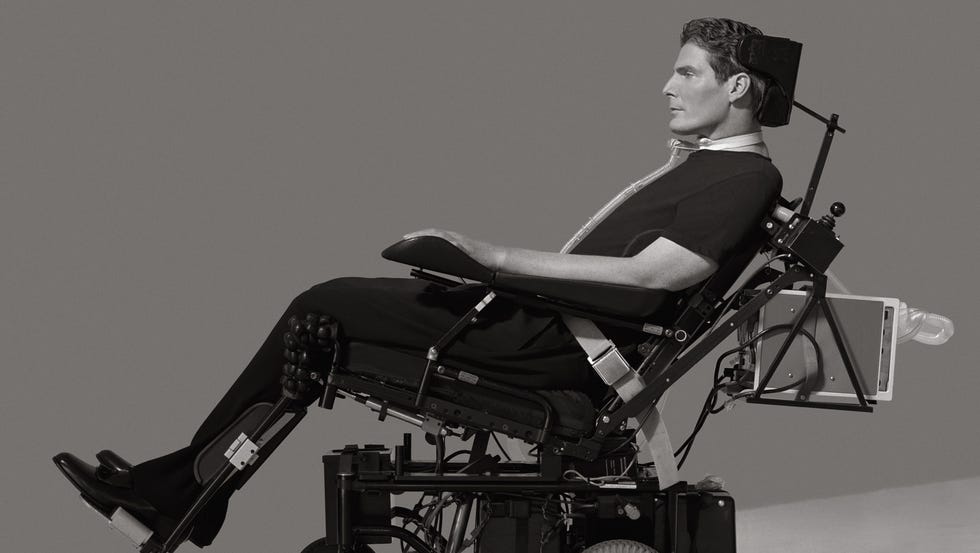
After the accident, Christopher Reeve was paralyzed from the waist down.
Did it surprise you how much of the film focused on Dana Reeve’s story?
ALEXANDRA: That was a surprise. We hoped that they would tell Dana’s story. She’s so central to our dad’s life and really was the bedrock of our whole family. And that comes through in the film. So that mattered to us in our interviews. That it was a story about how relationships can change over time and how you rebuild and create a fresh love.
WILL: Having my mom’s story told was essential to me. My mom was my hero, my best friend, and my inspiration. Everything that a son could hope for in a mother I had tenfold in my mom—and she had this singular blend of grace, compassion, perseverance, courage, grit, and good humor. Seeing that portrayed onscreen…that in itself is a gift to the world.
ALEXANDRA: It’s also been amazing how much people relate to hearing that part of the story. A lot of caretakers, like Dana, do not get enough attention in this world. To have a love story depicted with the beautiful, tender moments you see between them? It is really special seeing people react to that and find so much to connect with.
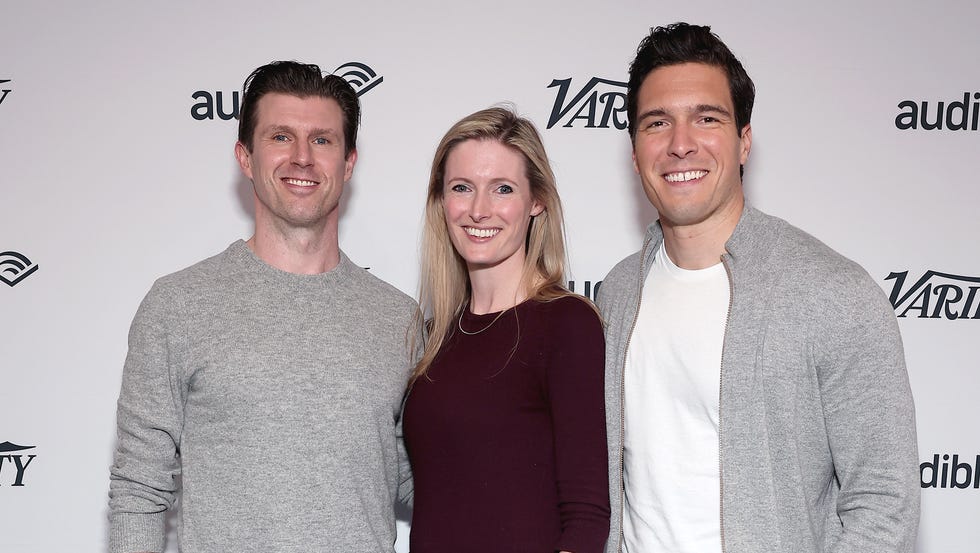
“We’ve gotten to spend a lot more time together, which has been a fantastic side effect,” Matthew Reeve tells Esquire about promoting the film.
Will, I just saw your story on Good Morning America, where you met a paralyzed man in Switzerland who is learning to walk again with the help of a surgically implanted AI chip in his brain. Did it feel like kismet that you worked on that story?
WILL: Having this legacy—being the son of Christopher and Dana Reeve and sitting on the board of the Reeve Foundation—general awareness about paralysis is a central part of my life. To have that then cross over into my day job, it’s an honor and it’s something I take incredibly seriously—especially in stories that I know I’m uniquely positioned to tell because of my life experience. I think those stories resonate most with viewers. And they’re stories that reaffirm my love for what I do.
I also must mention, Will—even though I feel the red dot on my forehead—that I saw you’re going to cameo in the next Superman movie.
WILL: It was an honor to be asked. It’s a nice full-circle moment. For as long as I can remember, people have reached out to me in person and online about how much they loved my dad’s Superman, and how much they just loved my dad. But when the news came out, it was a reminder that this means a lot to a lot of people.
It’s not a blink-and-you’ll-miss-it moment, but it’s one that will be a treat for fans—and was a treat for me because it was a fun thing to do. They sent me one page of the script, and everything except for the couple words I had to say was redacted. So I have no idea what scene I’m in. I know that I’m not Superman. I can share that with the world. But it was an enjoyable experience.
Is there anything—now that you’re all older and have some kids of your own—that you’ve taken from your parents and passed down to the next generation?
MATTHEW: There’s so much. Everything from the lessons we learned from the actual accident happening, to the fragility of life and having gratitude for the present moment, to understanding that things can change in an instant. Also, how Dana didn’t falter for a second as those marriage vows were pushed to the extreme, and how Dad adapted to his circumstances to continue to parent but also to work and become an advocate. You have all these incredible benchmarks that you can really only aspire to.
WILL: I’m definitely the cool uncle. But a foundational pillar for our family is you show up for the people you love. Regardless of whatever the family tree looked like, we had our parents and our loved ones there for us. They were present, they showed up, they cared, they made us feel safe and supported. And that matters more to us than anything.
ALEXANDRA: Dana just had this unbelievable power to make magic anywhere she was. And you see a little bit of this in the film where we’re all there in the intensive care unit on Will’s birthday. She’s throwing a birthday party in the middle of this unbelievable crisis. Just making memories—creating those moments of joy, of spending time together—is so precious and so special.


 ACRE5 dias ago
Curso de Música divulga chamada para Jornada Acadêmica — Universidade Federal do Acre


 ACRE4 dias ago
NAI da Ufac realiza evento cultural sobre arte, corpo e inclusão — Universidade Federal do Acre
 ACRE4 dias ago
Membros da Academia Acreana de Letras visitam a Ufac — Universidade Federal do Acre
 ACRE4 dias ago
Gestão da Ufac realiza visita ao laboratório Charles Mérieux — Universidade Federal do Acre


Warning: Undefined variable $user_ID in /home/u824415267/domains/acre.com.br/public_html/wp-content/themes/zox-news/comments.php on line 48
You must be logged in to post a comment Login