
ACRE
Pacific’s sinking island nation Tuvalu recreating itself on the metaverse – Firstpost

PUBLICADO
1 ano atrásem
Tuvalu, a small country in the Pacific Ocean made up of nine coral islands, is facing erasure from climate change.
According to a BBC report, as sea level rise is eating away at its shores, the government is taking drastic measures to preserve its land and culture — by creating a digital backup of everything from its houses to its trees as it endeavors to save whatever it can.
With the physical land sinking beneath the waves, Tuvalu is building a virtual replica, aiming to preserve not just the nation’s beauty, but also the legal rights of its 11,000 citizens for future generations.
Announced in 2022 by Foreign Minister Simon Kofe at COP27, the initiative is part of Tuvalu’s “Future Now” project, which blends diplomacy and climate adaptation. Kofe introduced the virtual replica in a striking video where a beach scene slowly glitches into a digital version of Te Afualiku, a small island expected to be the first to vanish due to rising seas, added the report.
In the clip, which looks more like a sequel to The Matrix than an official government speech, Kofe at first appears to stand on a beach, complete with white sand and rustling palms. But as the camera zooms out, revealing more of the scenery, the image starts to glitch. Rocks and sand shift unnaturally, and a seabird flies across the black abyss of the background.
This is not the real Tuvalu but the beginning of its digital twin: a virtual reconstruction of Te Afualiku, a low-lying islet that is expected to be Tuvalu’s first casualty of climate change.
“Our land, our ocean, our culture are the most precious assets of our people – and to keep them safe from harm, no matter what happens in the physical world, we’ll move them to the cloud,” the BBC quoted Kofe as saying in the video.
Apart from creating Tuvalu virtual landscape, the ‘Digital Nation’ project also aims to preserve the island nation’s cultural heritage.
According to the BBC report, citizens have been invited to submit personal memories, stories, and traditions for digitisation, creating an archive to carry the nation’s “soul,” as described by Foreign Minister Simon Kofe in 2023.
The project also addresses a practical need: preserving sovereignty as rising sea levels threaten Tuvalu’s physical territory. Current international law requires a defined landmass and permanent population for statehood, but Tuvalu’s future is uncertain.
To adapt, the government is creating digital passports on the blockchain, enabling functions like elections and civil registrations. Tuvalu hopes this digital model will redefine statehood for a warming, online world, added the report.
The initiative has garnered support from countries in similar predicaments but faces skepticism, including within Tuvalu’s own government.
Critics argue it mirrors the resource-intensive systems driving climate change, while others acknowledge that the project reflects the inevitable reality of displacement as life on the islands becomes increasingly untenable, added the report.
According to the BBC, citing a recent assessment by scientists at Nasa, much of Tuvalu’s land, including its critical infrastructure, will sit below the level of the current high tide by 2050.
Across all climate scenarios, the country will experience more than 100 days of flooding each year by the end of this century. Then there are the other impacts to reckon with, including saltwater intrusion, heatwaves and intensified cyclones, added the report.
Scientists have warned that exceeding a 1.5°C global temperature rise poses a severe threat to small island nations. For the first time, global temperatures surpassed this threshold over an entire year, from February 2023 to January 2024.
As developed nations struggle to reduce emissions quickly enough, Tuvalu’s digital twin offers a way for its diaspora to stay connected to their heritage and homeland, even as they lose both. This shift marks a move away from the Pacific Islands’ “we are not drowning, we are fighting” rhetoric.
Reality of relocation
In response to climate change, Tuvaluans are already facing the reality of relocation, with a 2023 treaty between Tuvalu and Australia allowing for the annual migration of 280 Tuvaluans. The agreement provides new visas for work, study, and eventual citizenship.
However, not everyone believes it’s time to abandon the islands just yet.
“The concept for the creation of a digital nation of Tuvalu in the metaverse implies that Tuvalu will disappear because of sea level rise and that we should make a digital copy of it,” BBC quoted former prime minister Enele Sopoaga, now the leader of the opposition, as saying in a 2023 media statement responding to the proposals.
“There is no basis of such proposition in international law, and there is absolutely no reason to believe that Tuvalu will disappear even with sea level rise,” Sopoaga added.
Speaking in September at a UN General Assembly plenary about the existential threats from sea-level rise, Tuvaluan climate activist Grace Malie told delegates that Tuvalu and other ocean states will “not go quietly into the rising sea” but will “continue the fight” for their land, culture and future.
“It’s more than just our homes at stake,” she was quoted as saying. “It’s our dignity, our culture, our heritage. It is not something we can pack into suitcases and take with us. We have done the least to cause the crisis, but we are paying the highest price,” she added.
While some Tuvaluans consider migrating to Australia, Tuvalu has intensified its efforts to push Australia to reduce fossil fuel extraction and exports.
At the same time, some argue that creating a digital twin of Tuvalu doesn’t signal abandonment of the islands. They believe efforts to physically protect the islands can go hand in hand with preserving its legacy in the metaverse.
“The Digital Nation programme does not represent an acceptance of the loss of the nation as a physical entity,” BBC quoted Taukiei Kitara, a Tuvaluan research fellow at Griffith University in Australia and co-author of a recent paper about the Digital Nation initiative, as saying.
He points out that the project is just one of many in Tuvalu’s fight against climate change and has the advantage of being driven by Tuvaluans themselves.
The government is investing millions in land reclamation through a coastal adaptation project. In the past two years, flood-free land has been added to Funafuti and Fogafale, creating space for housing, infrastructure, and essential services. On the outer islands of Nanumaga and Nanumea, new protective barriers are preventing tides from reaching homes, schools, hospitals, farmland, and other cultural sites.
“Planning for multiple scenarios – both best-case and worst-case and in between – is sensible when it comes to risk management, and this is the approach of Tuvalu’s current government, and indeed successive previous Tuvalu governments,” Kitara added.
‘Digital Nation plan impractical’
Some critics argue that the ‘Digital Nation’ plan is impractical for a country still relatively disconnected from the digital world, suggesting it’s more of a PR move aimed at attracting international attention and pressuring wealthier nations to cut emissions — critical for the survival of Tuvalu’s physical islands.
However, the effort the Tuvaluan government is putting into mapping its islands and improving connectivity suggests that this initiative is more than just a diplomatic tactic.
In the year following the COP27 announcement, Tuvalu completed a 3D scan of all its 124 islands and islets using Lidar (light detection and ranging) technology, an airborne laser scanning technique. The government is now building an undersea telecommunications cable to improve digital connectivity and support the plan.
In March and April 2024, the global non-profit Place began mapping Funafuti, Tuvalu’s capital, using drones and 360-degree cameras to capture both aerial and street-level imagery. This high-resolution data will create a detailed digital representation of the islands, where satellite imagery alone lacks the accuracy needed for finer details.
“We drove all of the island, then we switched to mopeds for the bike paths, and then we switched to tiny GoPros for all of the walking paths,” BBC quoted Frank Pichel, field operations lead at Place, as saying. “I think we have covered about 80 or 90 km (50 or 56 miles), and really covered as much as we could.”
With inputs from agencies
Relacionado

VOCÊ PODE GOSTAR


Ufac entrega equipamentos a programas de pós-graduação com recursos da Capes — Universidade Federal do Acre


Doutorandos da Ufac elaboram plano de prevenção a incêndios no PZ — Universidade Federal do Acre

Lady Gaga faz show histórico no Rio para 2,1 milhões de fãs e deixa recado sobre depressão e LGBT+, vídeo


ACRE
Ufac realiza formatura de alunos do CAp pela 1ª vez no campus-sede — Universidade Federal do Acre
PUBLICADO
7 dias atrásem
30 de janeiro de 2026
A Ufac realizou a cerimônia de certificação dos estudantes concluintes do ensino médio do Colégio de Aplicação (CAp), referente ao ano letivo de 2025. Pela primeira vez, a solenidade ocorreu no campus-sede, na noite dessa quinta-feira, 29, no Teatro Universitário, e marcou o encerramento de uma etapa da formação educacional de jovens que agora seguem rumo a novos desafios acadêmicos e profissionais.
A entrada da turma Nexus, formada pelos concluintes do 3º ano, foi acompanhada pela reitora Guida Aquino; pelo diretor do CAp, Cleilton França dos Santos; pela vice-diretora e patronesse da turma, Alessandra Lima Peres de Oliveira; pelo paraninfo, Gilberto Francisco Alves de Melo; pelos homenageados: professores Floripes Silva Rebouças e Dionatas Ulises de Oliveira Meneguetti; além da inspetora homenageada Suzana dos Santos Cabral.
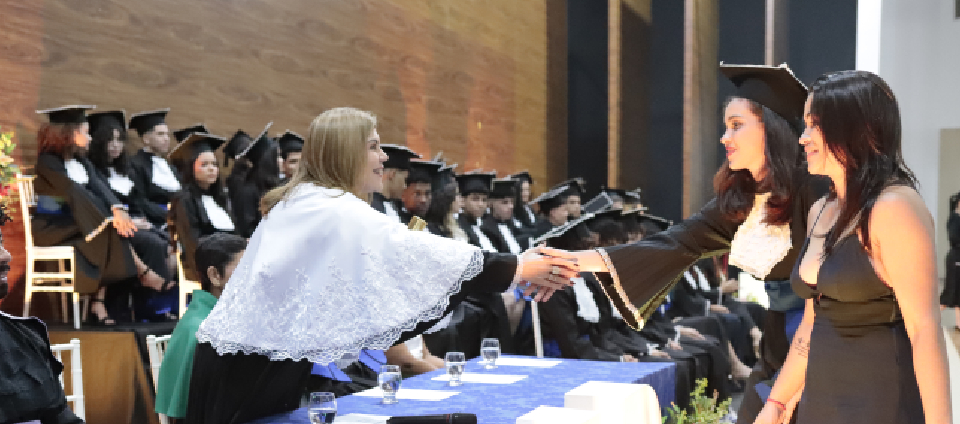
Guida destacou a importância do momento para os estudantes, suas famílias e toda a comunidade escolar. Ela parabenizou os formandos pela conquista e reconheceu o papel essencial dos professores, da equipe pedagógica e dos familiares ao longo da caminhada. “Tenho certeza de que esses jovens seguem preparados para os próximos desafios, levando consigo os valores da educação pública, do conhecimento e da cidadania. Que este seja apenas o início de uma trajetória repleta de conquistas. A Ufac continua de portas abertas e aguarda vocês.”
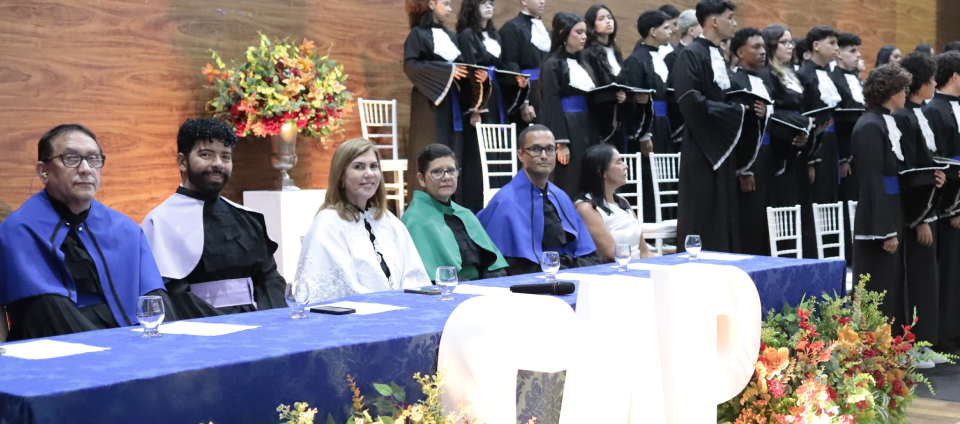
Durante o ato simbólico da colocação do capelo, os concluintes reafirmaram os valores que orientaram sua trajetória escolar. Em nome da turma, a estudante Isabelly Bevilaqua Rodrigues fez o discurso de oradora.
A cerimônia seguiu com a entrega dos diplomas e as homenagens aos professores e profissionais da escola indicados pelos concluintes, encerrando a noite com o registro da foto oficial da turma.
Relacionado
ACRE
Especialização em Enfermagem Obstétrica tem aula inaugural — Universidade Federal do Acre
PUBLICADO
1 semana atrásem
27 de janeiro de 2026
O curso de especialização em Enfermagem Obstétrica teve sua aula inaugural nesta terça-feira, 27, na sala Pedro Martinello do Centro de Convenções, campus-sede da Ufac. O curso é promovido pela Universidade Federal de Minas Gerais, com financiamento do Ministério da Saúde, no âmbito da Rede Alyne; a Ufac é um dos 39 polos que sedia essa formação em nível nacional.
A especialização é presencial, com duração de 16 meses e carga horária de 720 horas; tem como objetivo a formação e qualificação de 21 enfermeiros que já atuam no cuidado à saúde da mulher, preparando-os para a atuação como enfermeiros obstetras. A maior parte dos profissionais participantes é oriunda do interior do Estado do Acre, com predominância da regional do Juruá.
“Isso representa um avanço estratégico para o fortalecimento da atenção obstétrica qualificada nas regiões mais afastadas da capital”, disse a coordenadora local do curso, professora Sheley Lima, que também ressaltou a relevância institucional e social da ação, que está alinhada às políticas nacionais de fortalecimento da atenção à saúde da mulher e de redução da morbimortalidade materna.
A aula inaugural foi ministrada pela professora Ruth Silva Lima da Costa, com o tema “Gravidez na Adolescência e Near Miss Neonatal na Região Norte: Dados da Pesquisa Nascer no Brasil 2”. Ela é doutora em Ciências da Saúde pela Fiocruz, enfermeira da Ufac e docente da Uninorte.
Relacionado
ACRE
Calendário 2026 do Acre: Veja o calendário do Governo e Judiciário que vai ditar o ritmo do ano

PUBLICADO
2 semanas atrásem
20 de janeiro de 2026
Clique aqui para baixar o calendário estadual completo: Decreto 11.809, Calendário 2026 Acre, ed. 14.173-B, de 22.12.2025
Há quem organize a vida por metas, há quem organize por boletos… e existe um grupo que planeja o ano inteiro por uma régua silenciosa, porém poderosa: o calendário oficial. Desde início de janeiro, essa régua ganhou forma no Acre com dois instrumentos que, na prática, definem como o Estado vai pulsar em 2026 — entre atendimentos, plantões, prazos, audiências e aquele respiro estratégico entre uma data e outra.
De um lado, o Governo do Estado publicou o Decreto nº 11.809, de 22 de dezembro de 2025, fixando feriados e pontos facultativos de 2026 para os órgãos do Poder Executivo, do dia 1º de janeiro ao último dia do ano, com a ressalva de que serviços essenciais não podem parar.
Do outro, o Tribunal de Justiça do Acre respondeu com a sua própria cartografia do tempo: a Portaria nº 6569/2025, que institui o calendário do Poder Judiciário acreano para 2026, preservando o funcionamento em regime de plantão sempre que não houver expediente. O texto aparece no DJe (edição nº 7.925) e também em versão integral, como documento administrativo autônomo.
Clique aqui para baixar o calendário forense completo: DJE – Portaria 6.5692025, edição 7.925, 22.12.2025
O “mapa do descanso” tem regras — e tem exceções
No calendário do Executivo, as datas nacionais aparecem como pilares já conhecidos (como Confraternização Universal, Tiradentes, Dia do Trabalho, Independência, Natal), mas o decreto também reforça a identidade local com feriados estaduais e pontos facultativos típicos do Acre.
Chamam atenção duas engrenagens que costumam passar despercebidas fora da rotina pública:
- ponto facultativo não é sinônimo de folga garantida — a chefia pode convocar para expediente normal por necessidade do serviço;
- quando o servidor é convocado nesses dias, o decreto prevê dispensa de compensação para quem cumprir horário no ponto facultativo.
No Judiciário, a lógica é parecida no objetivo (manter o Estado funcionando), mas diferente na mecânica. A Portaria do TJAC prevê expressamente que, havendo necessidade, pode haver convocação em regime de plantão, respeitando-se o direito à compensação de horas, conforme regramento administrativo interno.
Quando o município faz aniversário, a Justiça muda o passo
O “calendário do fórum” também conversa com o mapa das cidades. A Portaria prevê que, em feriado municipal por aniversário do município, não haverá expediente normal nas comarcas correspondentes — apenas plantão. E, quando o município declara ponto facultativo local, a regra traz até prazo de comunicação no interior: pelo menos 72 horas de antecedência para informar se haverá adesão.
É o tipo de detalhe que não vira manchete — mas vira realidade para quem depende de balcão, distribuição, atendimento e rotina de cartório.
Um ano que já começa “com cara de planejamento”
Logo na largada, o Executivo lista 1º de janeiro como feriado nacional e já prevê, para 2 de janeiro, ponto facultativo (por decreto específico citado no anexo). Também aparecem o Carnaval e a Quarta-feira de Cinzas como pontos facultativos, desenhando, desde cedo, o recorte de semanas que tendem a ser mais curtas e mais estratégicas.
No Judiciário, a Portaria organiza o mesmo período com olhar forense — e, além de datas comuns ao calendário civil, agrega as rotinas próprias do Poder Judiciário, preservando a prestação jurisdicional via plantões e regras de compensação.
Rio Branco também entra no compasso de 2026
Para além do calendário estadual e do Judiciário, a capital também oficializou seu próprio “mapa do tempo”: o Prefeito de Rio Branco editou o Decreto Municipal nº 3.452, de 30/12/2025, estabelecendo os feriados e pontos facultativos de 2026 para os órgãos e entidades do Poder Executivo Municipal, com referência expressa ao calendário do Estado.
Na prática, a cidade reforça o mesmo recado institucional: serviços essenciais não param, funcionando por escala ou plantão, e os gestores ficam autorizados a convocar servidores em dias de ponto facultativo, sem exigência de compensação para quem cumprir expediente. No anexo, aparecem datas que impactam diretamente a rotina da população, como o Carnaval (16 a 18/02, ponto facultativo), o Dia do Servidor Público (28/10, ponto facultativo) e o Aniversário de Rio Branco (28/12, feriado municipal) — fechando o ano com a véspera de Ano Novo (31/12, ponto facultativo).
Clique aqui para baixar o calendário municipal completo: DOE, edição 3.452, de 30.12.2025 – Calendário Prefeitura de Rio Branco-AC
Por que isso importa
O calendário oficial é mais do que uma lista de “dias marcados”: ele é o roteiro do funcionamento do Estado. Para o cidadão, significa previsibilidade; para advogados e jurisdicionados, significa atenção ao modo como cada órgão funcionará em datas críticas; para gestores, significa logística e escala; e para o próprio Acre, significa um desenho institucional que equilibra tradição, trabalho e continuidade.
Skip to PDF content


Warning: Undefined variable $user_ID in /home/u824415267/domains/acre.com.br/public_html/wp-content/themes/zox-news/comments.php on line 48
You must be logged in to post a comment Login